
Close Menu
    Facebook X (Twitter) Instagram
    SciTechDaily
    • Biology
    • Chemistry
    • Earth
    • Health
    • Physics
    • Science
    • Space
    • Technology
    Facebook X (Twitter) Pinterest YouTube RSS
    SciTechDaily
    Home»Physics»The Physics Behind the Bubble Cascade That Forms in a Glass of Guinness Beer
    Physics

    The Physics Behind the Bubble Cascade That Forms in a Glass of Guinness Beer

    By Osaka UniversityJuly 7, 20211 Comment4 Mins Read
    Facebook Twitter Pinterest Telegram LinkedIn WhatsApp Email Reddit
    Share
    Facebook Twitter LinkedIn Pinterest Telegram Email Reddit
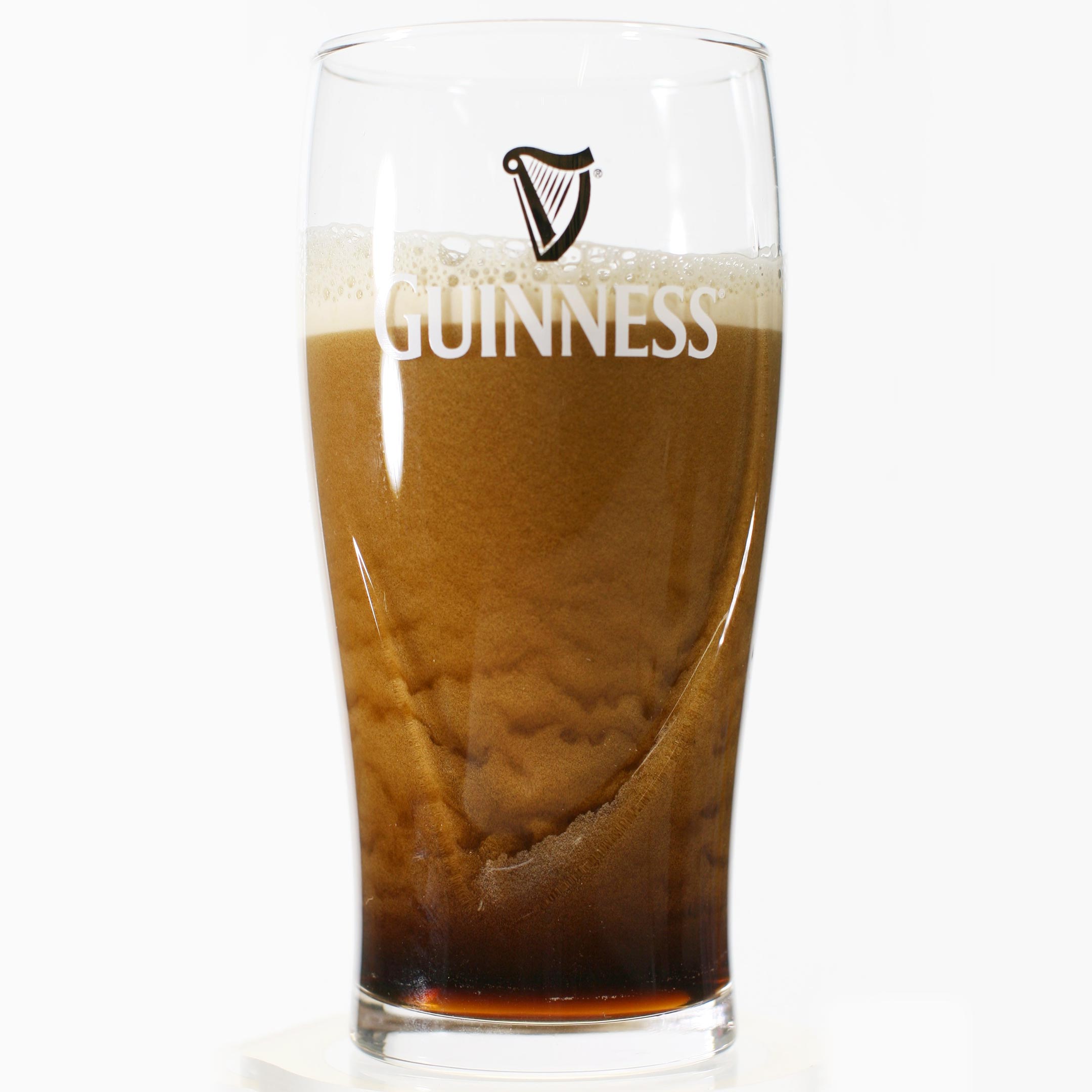
    Bubble Texture of Guinness Beer in Pint Glass
    Bubble texture of Guinness beer in a pint glass, featuring the creamy taste of tiny bubbles and fascinating texture motion. Credit: Osaka University

    Does Bubble Cascade Form Only in a Glass of Guinness Beer?

    Researchers from Osaka University and Kirin HD explain the physics that underpins the cascading flow of nitrogenated stout beer, with applications to water purification and pharmaceutical production.

    As far back as 1959, brewers at Guinness developed a system that fundamentally altered the texture of their draught beer. Now, researchers from Japan have solved the physics of Guinness’ cascading flow, which will have widespread applications to technology in life and environmental sciences.

    In a study recently published in Physical Review E, researchers from Osaka University have revealed why the nitrogen bubbles of Guinness draught beer flow similarly to a fluid.

    Why Guinness Bubbles Go Down, Not Up

    The bubbles of many just-opened carbonated beverages simply move upwards, following Archimedes’ principle. Much of the appeal of the draught from Guinness beer is that the bubbles sink and flow collectively, known as “bubble cascade.” Brewers and researchers believe this collective flow behavior must have something to do with how draught Guinness beer is dispensed. At present, the physics of the collective flow remains unresolved, something the researchers at Osaka University aimed to address.
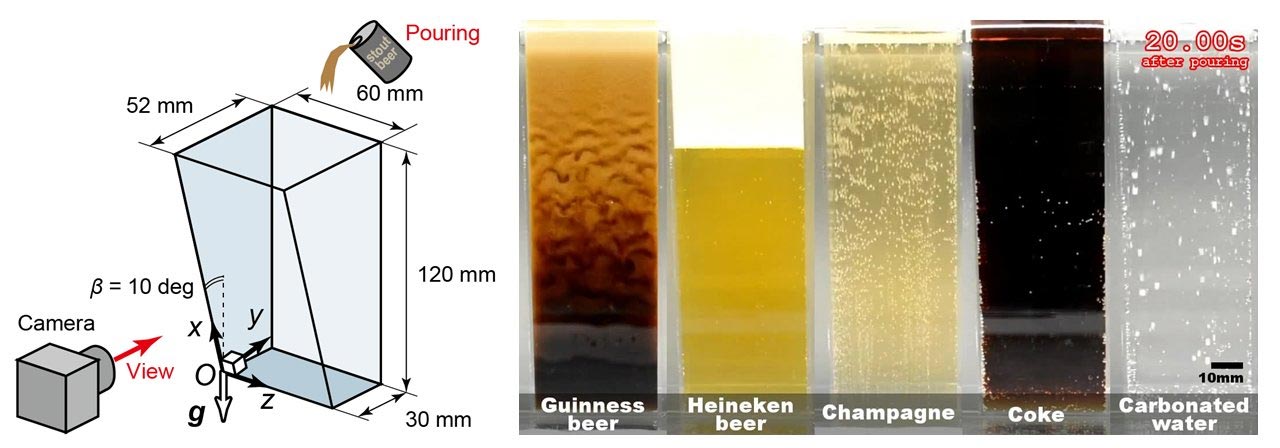
    Bubble Motion Trapezium Glass
    Bubble motion in a trapezium glass: Each drink (from left to right in each panel, Guinness beer; Heineken beer; Champagne; Coke; Carbonated water) was poured into a trapezium glass. Credit: Osaka University

    “A wide range of lab work and computational simulations has been useful for estimating individual and collective bubble motion, but only after the flow has occurred,” says lead and senior author of the study Tomoaki Watamura, Osaka University. “We’re interested in predicting cascading flow via mathematical modeling, rather than results from experiments or simulations after the fact.”

    To do this, the researchers used numerical simulations to approximate the fluid and bubble particles of cascading draught beer. Bench work experiments consisted of testing a transparent “pseudo-Guinness fluid,” which is a mixture of ultra-small hollow particles in tap water, and actual Guinness beer.
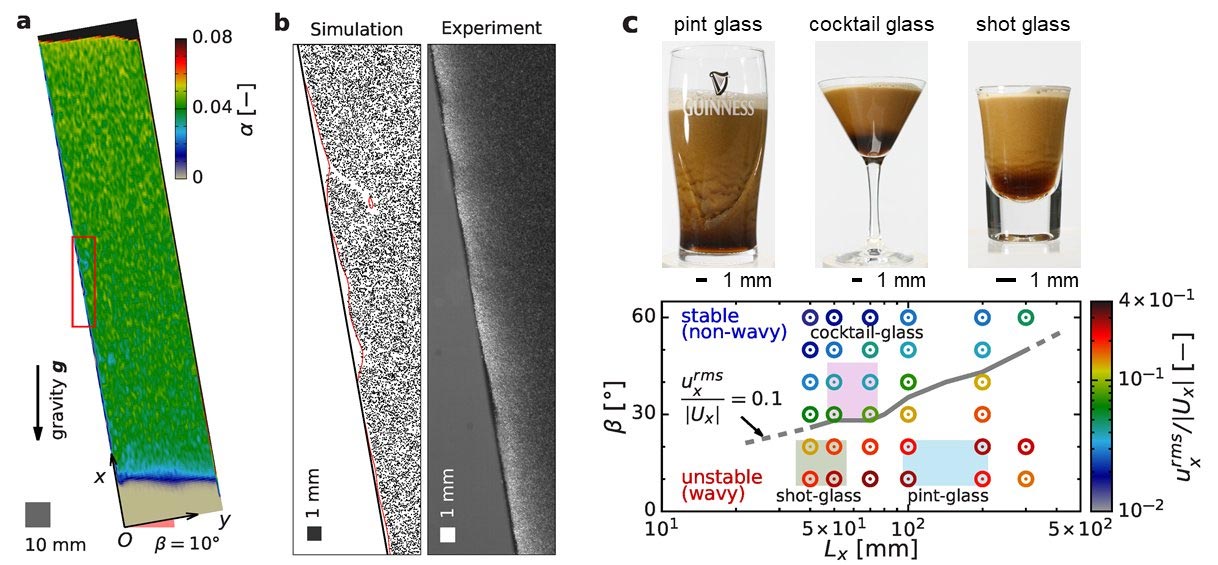
    Particle Concentration Distribution
    (a) Configuration and snapshot of particle concentration distribution. (b) Comparison of the distribution of simulated particles (left) and Guinness beer bubbles (right) at the midpoint. (c) Snapshots of a bubble-concentration wave forming in: a pint glass (top left), a cocktail glass (top center), and a 1-oz (30-ml) shot glass (top right). Phase diagrams of scaled velocity fluctuation (bottom). The shaded areas correspond to the typical dimensions of the glasses. Credit: Osaka University

    “The simulation results matched experimental data, over a wide range of glass sizes and other conditions,” explains Watamura. “We have developed the most successful simulation of cascading flow in Guinness beer to date.”

    Bubble Cascades Without Guinness?

    Intriguingly, cascading bubbles may not require a nitrogenated stout beer after all.

    “The bubble diameter and bubble volume fraction in carbonated water, poured into the approximate dimensions of a common 200-liter drum with inclination angle, facilitate cascading bubbles,” says Hideyuki Wakabayashi, Kirin HD. “Furthermore, the associated fluid motion near an inclined container wall pertains to maintenance of product quality during brewing, suggesting an immediate application of our findings.”

    In addition to providing insight into optimizing brewing conditions, this research has clear applications to any work that involves fermenters or cell incubation. As such, the Osaka University and Kirin HD researchers’ findings may be used to meet diverse needs, such as pharmaceutical production from industrial-scale cell cultures, and city water purification.

    Reference: “Bubble cascade may form not only in stout beers” by Tomoaki Watamura, Kazuyasu Sugiyama, Yuko Yotsumoto, Mihoko Suzuki and Hideyuki Wakabayashi, 7 June 2021, Physical Review E.
    DOI: 10.1103/PhysRevE.103.063103

    Funding: Japan Society for the Promotion of Science

    Never miss a breakthrough: Join the SciTechDaily newsletter.
    Follow us on Google and Google News.

    Beer Pharmaceuticals Popular University of Osaka Water
    Share. Facebook Twitter Pinterest LinkedIn Email Reddit

    Related Articles

    “Quantum Friction” Explains Fluid Dynamics Mystery That Has Baffled Scientists for 15 Years

    Using Ice To Boil Water: Heat Transfer Discovery Expands on 18th Century Physics Principle

    Hot “Black Ice” – Come On In, the Water Is Superionic

    Origin of Water’s Strange Properties: Scientists Capture a “Quantum Tug” Between Neighboring Water Molecules

    Two Distinct Different Liquid States of Water Exist, Both Made of H2O Molecules

    Generating Megatesla Magnetic Fields on Earth Using Intense-Laser-Driven Microtube Implosions

    Black Hole Plasma Conditions Created on Earth – Laser Briefly Uses 1,000 Times the Electric Consumption of the Entire Globe

    Laser Doppler Velocimetry Delivers New Insights Into Mysterious Fluid Motions

    Quantum Destabilization of a Water Sandwich – Laws of Classical Physics Break Down

    1 Comment

    1. xABBAAA on July 17, 2021 8:56 am

      … like the Bubble show, or dark synergy, bubbling, bubbling, bubbling on…

      Reply
    Leave A Reply Cancel Reply

    • Facebook
    • Twitter
    • Pinterest
    • YouTube

    Don't Miss a Discovery

    Subscribe for the Latest in Science & Tech!

    Trending News

    Researchers Have Found a Dietary Compound That Increases Longevity

    Scientists Baffled by Bizarre “Living Fossil” From 275 Million Years Ago

    Your IQ at 23 Could Predict Your Wealth at 27, Study Finds

    320 Light-Years Away, a Planet Confirms a Fundamental Cosmic Assumption

    The Crown Jewel of Dentistry? Breakthrough Tech Could Transform Tooth Repair

    Python Blood Could Hold the Secret to Weight Loss Without Side Effects

    Naturally Occurring Bacteria Completely Eradicate Tumors in Mice With a Single Dose

    New “Nanozyme Hypothesis” Could Rewrite the Story of Life’s Origins

    Follow SciTechDaily
    • Facebook
    • Twitter
    • YouTube
    • Pinterest
    • Newsletter
    • RSS
    SciTech News
    • Biology News
    • Chemistry News
    • Earth News
    • Health News
    • Physics News
    • Science News
    • Space News
    • Technology News
    Recent Posts
    • A New Chapter in Chemistry? Scientists Uncover New Way Metals Bind Oxygen
    • New Study Reveals Earth Is Getting Brighter at Night – About 2% Each Year
    • Accidental Deep Ocean Discovery Reveals Hidden Carbon Sink
    • Cooling the Planet Could Come at a Devastating Cost
    • These New Molecules Could Change How We Treat Lupus and Arthritis
    Copyright © 1998 - 2026 SciTechDaily. All Rights Reserved.
    • Science News
    • About
    • Contact
    • Editorial Board
    • Privacy Policy
    • Terms of Use

    Type above and press Enter to search. Press Esc to cancel.