
Close Menu
    Facebook X (Twitter) Instagram
    SciTechDaily
    • Biology
    • Chemistry
    • Earth
    • Health
    • Physics
    • Science
    • Space
    • Technology
    Facebook X (Twitter) Pinterest YouTube RSS
    SciTechDaily
    Home»Space»Discovery of a Dying Supermassive Black Hole by Accident – Via a 3,000-Year-Long Light Echo
    Space

    Discovery of a Dying Supermassive Black Hole by Accident – Via a 3,000-Year-Long Light Echo

    By Tohoku UniversityJune 10, 20218 Comments3 Mins Read
    Facebook Twitter Pinterest Telegram LinkedIn WhatsApp Email Reddit
    Share
    Facebook Twitter LinkedIn Pinterest Telegram Email Reddit
    Supermassive Black Hole Research
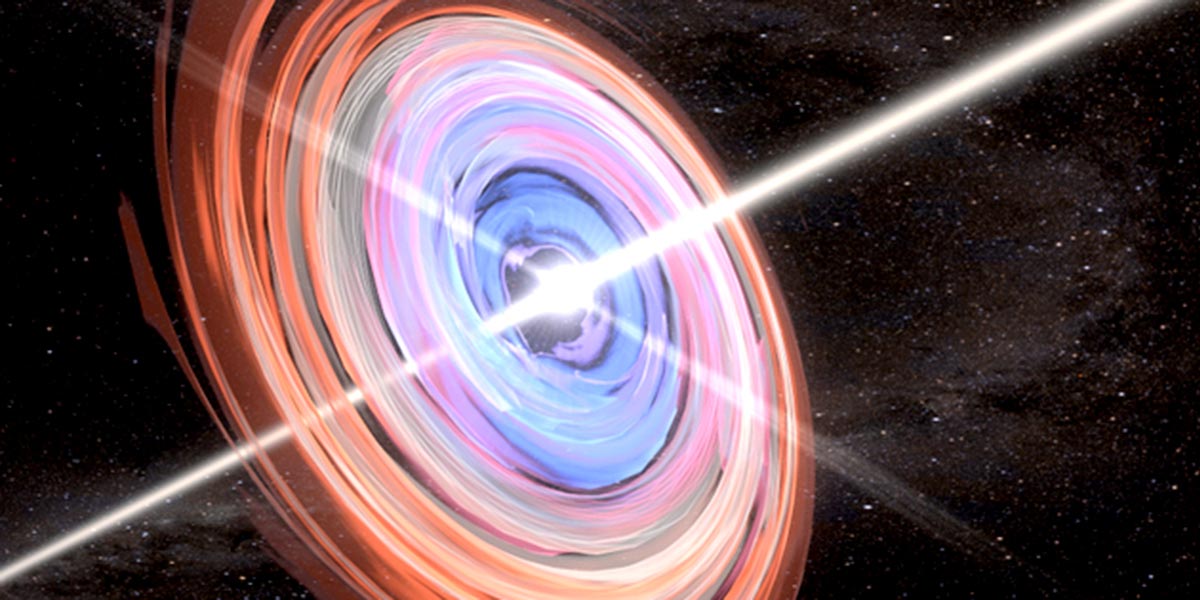
    Scientists accidentally found an aging Active Galactic Nucleus (AGN) in the Arp 187 galaxy.

    A research team in Japan discovered signs that the AGN in galaxy Arp 187 has shut down within the last 3,000 years. This rare finding offers insight into the timeline and mechanics of AGN death.

    Supermassive black holes (SMBH) occupy the center of galaxies, with masses ranging from one million to 10 billion solar masses. Some SMBHs are in a bright phase called active galactic nuclei (AGN).

    AGNs will eventually burn out since there is a maximum mass limit for SMBHs; scientists have long since pondered when that will be.

    Tohoku University’s Kohei Ichikawa and his research group may have discovered an AGN towards the end of its life span by accident after catching an AGN signal from the Arp 187 galaxy.
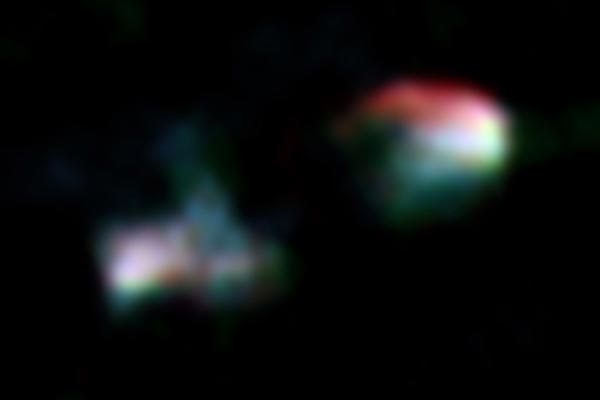
    Arp 187 VLA and ALMA
    The radio band composite image of Arp 187 obtained by VLA and ALMA telescopes (blue: VLA 4.86 GHz, green: VLA 8.44 GHz, red: ALMA 133 GHz). The image shows clear bimodal jet lobes, but the central nucleus (center of the image) is dark/non-detection. Credit: ALMA (ESO/NAOJ/NRAO), Ichikawa et al.

    Through observing the radio images in the galaxy using two astronomy observatories – the Atacama Large Millimeter/submillimeter Array (ALMA) and the Very Large Array (VLA) – they found a jet lobe, a hallmark sign of AGN.

    However, they noticed no signal from the nucleus, indicating the AGN activity might be silent already.

    Upon further analysis of the multi-wavelength data, they found all the small scale AGN indicators to be silent, while the large-scale ones were bright. This is because the AGN has recently been quenched within the last 3,000 years.
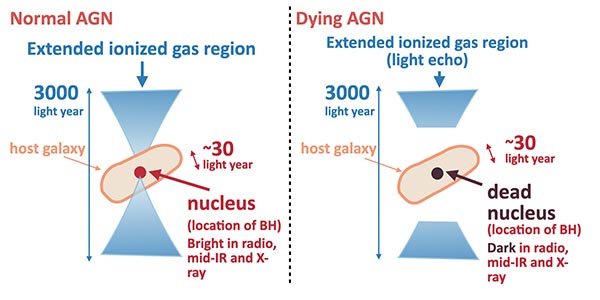
    Discovery of a Dying Supermassive Black Hole
    The observational difference between a standard AGN (left) and a dying AGN (right) discovered by this study. In the dying AGN, the nucleus is very faint in any wavelength bands because the AGN activity is already dead, while the extended ionized region is still visible for ~3,000 light years since it takes ~3,000 years for the light to cross the extended region. Credit: Ichikawa et al.

    Once an AGN dies off, smaller-scale AGN features become faint because further photon supplies also shut down. But the large scale ionized gas region is still visible since it takes about 3000 years for photons to arrive at the region’s edge. Observing past AGN activity is known as light echoing.

    “We used the NASA NuSTAR X-ray satellite, the best tool to observe current AGN activity,” said Ichikawa. “It enables non-detection, so we were able to discover that the nucleus is completely dead.”
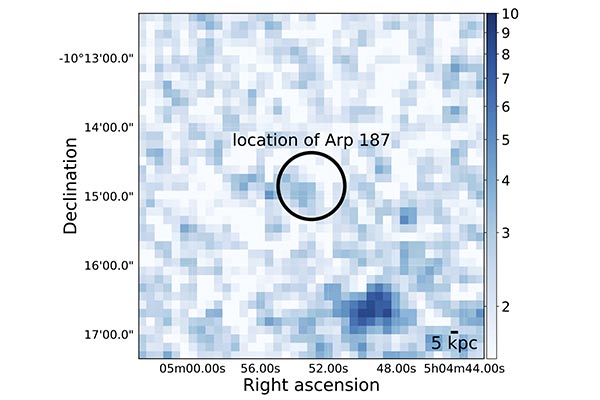
    Arp 187 NASA NuSTAR
    An X-ray (8-24 keV) image of Arp 187 obtained by NASA NuSTAR X-ray satellite. The black circle shows the location of Arp 187, showing a non-detection. Credit: Ichikawa et al.

    The findings indicate AGN turn-off occurs within a 3000-year time scale, and the nucleus becomes over 1000 times fainter during the last 3000 years.

    Ichikawa, who co-authored a paper for the 238 Meeting of the American Astronomical Society, says they will continue to investigate dying AGNs moving forward. “We will search for more dying AGN using a similar method as this study. We will also obtain the high spatial resolution follow-up observations to investigate the gas inflows and outflows, which might clarify how the shut down of AGN activity has occurred.

    Meeting: AAS 238

    Funding: Program for Establishing a Consortium for the Development of Human Resources in Science and Technology, JST, JSPS KAKENHI

    Never miss a breakthrough: Join the SciTechDaily newsletter.
    Follow us on Google and Google News.

    Astronomy Astrophysics Black Hole Popular Tohoku University
    Share. Facebook Twitter Pinterest LinkedIn Email Reddit

    Related Articles

    “Cannibal Stars” and Black Holes May Have Formed in the Universe’s First Second

    Black Hole Shadows Could Reveal the Limits of Einstein’s Theory of Relativity

    “Truly Extraordinary” – Supermassive Black Hole Found in the Last Place Scientists Expected

    Scientists Just Solved a Black Hole Mystery 100 Years in the Making

    Einstein Was Right Again: Ripples in Space-Time Confirm Century-Old Theory

    Mysterious “Universe Breaker” Red Dots Could Be Black Holes in Disguise

    90% Chance: Physicists Predict a Black Hole Could Explode This Decade

    Webb Telescope Spots Oldest Black Hole, Shattering Cosmic Records

    Astronomers Spot Possible Biggest Black Hole in the Universe

    8 Comments

    1. Aleksandr7364 on June 10, 2021 9:30 am

      A galaxy in which the nucleus has ceased to exist breaks out of its orbit around the Center of Our Universe and is bound to collide with a neighboring galaxy. Watch.
      https://www.youtube.com/watch?v=tFUM3vAlaGc

      Reply
    2. Frosted Flake on June 12, 2021 9:52 am

      There is probably a better word to use for this. A ‘dying supermassive black hole’ is about as far as you can take click-bait, at least in that general direction.

      Reply
    3. Waleed on June 13, 2021 1:52 am

      Nice post…I love deep space content
      Download Latest Mod Apk

      Reply
    4. Shane Van order on June 13, 2021 12:14 pm

      So what happens when a blackhole dies?

      Reply
    5. Science Lover on June 13, 2021 5:41 pm

      Hey Frosted Flake, if anything lives up to a click bait name, it’s deep space. Science always gives extreme and quirky names to extreme and quirky things. It’s actually good English. If anything deserves such a name, it would be a black hole the mass of more than a million suns. It’s hyperbole that even Shakespeare can’t match.

      Reply
    6. Cynthia Binder on June 14, 2021 8:06 am

      Big♻️♾♻️♾ bang 💣vacuum in 🗯💥🔥🗯💧💥believe 1 n 2 o1o1o1andso on vacuum out. Winds movement

      Reply
    7. Vizier on June 14, 2021 7:35 pm

      Hey Science Lover…
      The click-bait Frosty was referring to, i’m pretty sure, is the word ‘dying’ not smbh. Since black holes (real cf. theoretical Kugelblitz) can’t realistically die, or cease to exist (only merge).

      Reply
    8. Scott on June 17, 2021 8:54 am

      They only THINK they know’the reality of it is it’s all only theory’s’they said things before then years later tell you they was wrong an it’s something else that causes this or that to happen

      Reply
    Leave A Reply Cancel Reply

    • Facebook
    • Twitter
    • Pinterest
    • YouTube

    Don't Miss a Discovery

    Subscribe for the Latest in Science & Tech!

    Trending News

    Mezcal “Worm” in a Bottle Mystery: DNA Testing Reveals a Surprise

    New Research Reveals That Your Morning Coffee Activates an Ancient Longevity Switch

    This Is What Makes You Irresistible to Mosquitoes

    Shockingly Powerful Giant Octopuses Ruled the Seas 100 Million Years Ago

    Scientists Stunned by New Organic Molecules Found on Mars

    Rewriting Dinosaur Evolution: Scientists Unearth Remarkable 150-Million-Year-Old Stegosaur Skull

    Omega-3 Supplements Linked to Cognitive Decline in Surprising New Study

    First-of-Its-Kind Discovery: Homer’s Iliad Found Embedded in a 1,600-Year-Old Egyptian Mummy

    Follow SciTechDaily
    • Facebook
    • Twitter
    • YouTube
    • Pinterest
    • Newsletter
    • RSS
    SciTech News
    • Biology News
    • Chemistry News
    • Earth News
    • Health News
    • Physics News
    • Science News
    • Space News
    • Technology News
    Recent Posts
    • These Simple Daily Habits Can Quickly Improve Blood Pressure and Heart Risk Factors
    • A Common Nutrient May Play a Surprising Role in Anxiety
    • Doing This After 9 p.m. Could Double Your Risk of Gut Issues
    • New Research Challenges Long-Held Beliefs About How the Brain Makes Decisions
    • Breakthrough Technology Reveals New Treatment Targets for Cancer
    Copyright © 1998 - 2026 SciTechDaily. All Rights Reserved.
    • Science News
    • About
    • Contact
    • Editorial Board
    • Privacy Policy
    • Terms of Use

    Type above and press Enter to search. Press Esc to cancel.