
Close Menu
    Facebook X (Twitter) Instagram
    SciTechDaily
    • Biology
    • Chemistry
    • Earth
    • Health
    • Physics
    • Science
    • Space
    • Technology
    Facebook X (Twitter) Pinterest YouTube RSS
    SciTechDaily
    Home»Space»Stunning Celestial Fireworks Celebrate Birth of Colossal Star Cluster
    Space

    Stunning Celestial Fireworks Celebrate Birth of Colossal Star Cluster

    By National Radio Astronomy ObservatoryJuly 4, 2020No Comments4 Mins Read
    Facebook Twitter Pinterest Telegram LinkedIn WhatsApp Email Reddit
    Share
    Facebook Twitter LinkedIn Pinterest Telegram Email Reddit
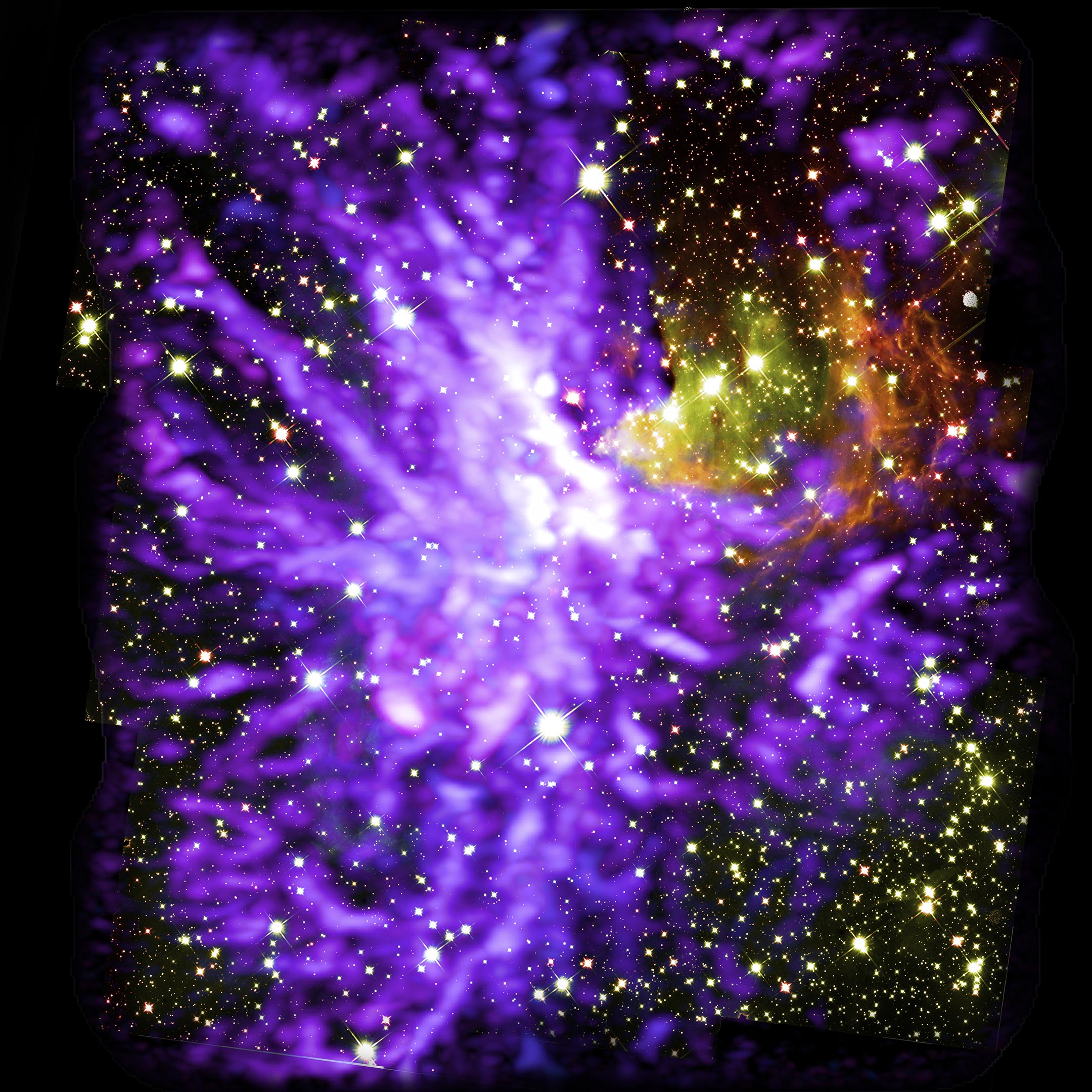
    star cluster G286.21+0.17
    Image of star cluster G286.21+0.17, caught in the act of formation. This is a multiwavelength mosaic of more than 750 ALMA radio images, and 9 Hubble infrared images. ALMA shows molecular clouds (purple) and Hubble shows stars and glowing dust (yellow and red). Credit: ALMA (ESO/NAOJ/NRAO), Y. Cheng et al.; NRAO/AUI/NSF, S. Dagnello; NASA/ESA Hubble.

    Astronomers created a stunning new image showing stellar fireworks in star cluster G286.21+0.17.

    Most stars in the universe, including our Sun, were born in massive star clusters. These clusters are the building blocks of galaxies, but their formation from dense molecular clouds is still largely a mystery.

    The image of cluster G286.21+0.17, caught in the act of formation, is a multi-wavelength mosaic made out of more than 750 individual radio observations with the Atacama Large Millimeter/submillimeter Array (ALMA) and 9 infrared images from the NASA/ESA Hubble Space Telescope. The cluster is located in the Carina region of our galaxy, about 8000 light-years away.

    Dense clouds made of molecular gas (purple ‘fireworks streamers’) are revealed by ALMA. The telescope observed the motions of turbulent gas falling into the cluster, forming dense cores that ultimately create individual stars.

    The stars in the image are revealed by their infrared light, as seen by Hubble, including a large group of stars bursting out from one side of the cloud. The powerful winds and radiation from the most massive of these stars are blasting away the molecular clouds, leaving faint wisps of glowing, hot dust (shown in yellow and red).
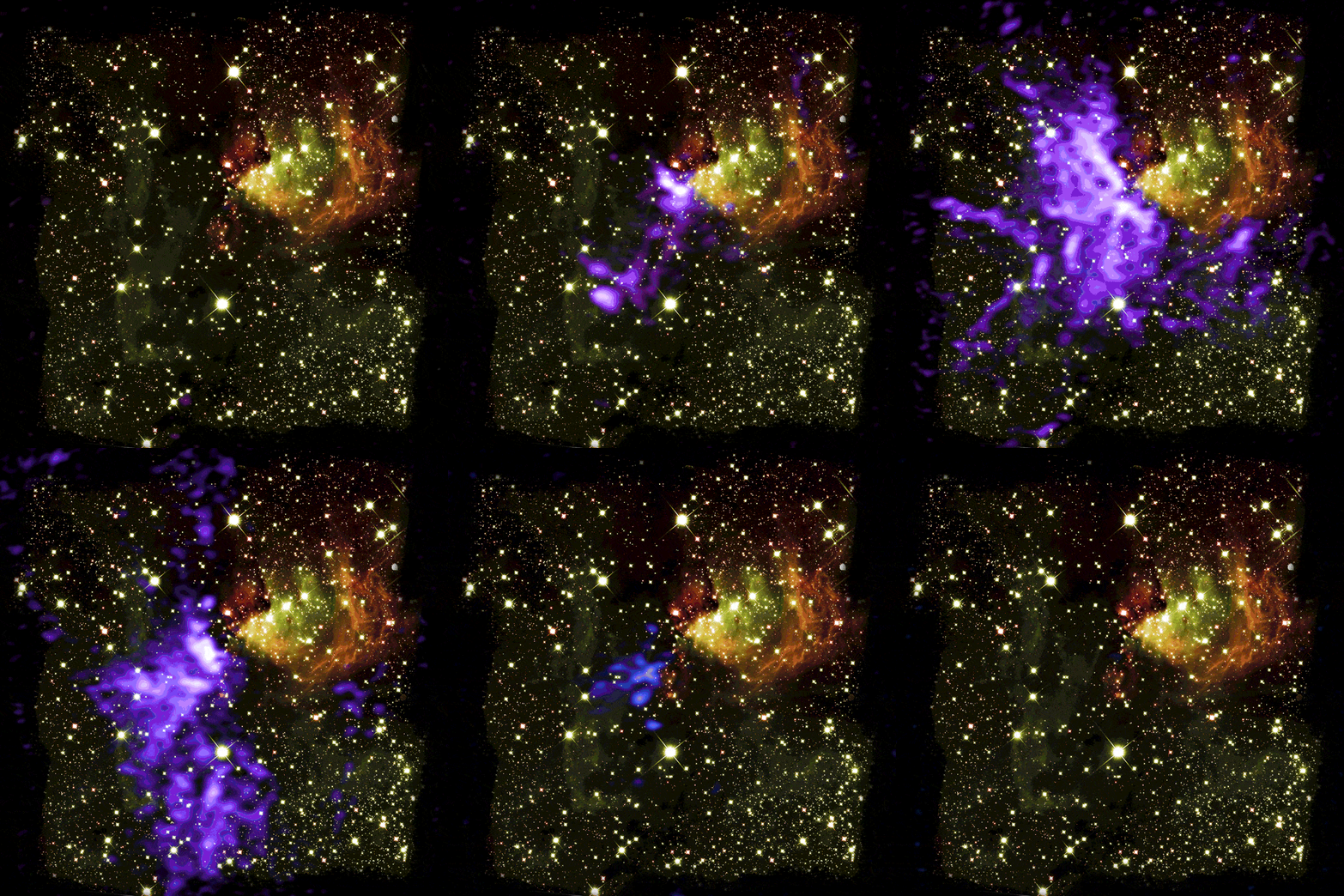
    Stellar Fireworks
    This animated gif shows the structure and motions (speed in direction towards the Sun) of gas in the forming cluster, as seen with ALMA (purple) on top of the infrared Hubble image. The color-scales from pink-purple to blue-purple represent the gas moving at different velocities, from 15km/s to 24 km/s. These motions are controlled by gravity, turbulence and wind, and radiation pressure “feedback” from the new-born stars. Credit: ALMA (ESO/NAOJ/NRAO), Y. Cheng et al.; NRAO/AUI/NSF, S. Dagnello; NASA/ESA Hubble.

    “This image shows stars in various stages of formation within this single cluster,” said Yu Cheng of the University of Virginia in Charlottesville, Virginia, and lead author of two papers published in The Astrophysical Journal.

    Hubble revealed about a thousand newly-formed stars with a wide range of masses. Additionally, ALMA showed that there is a lot more mass present in dense gas that still has to undergo collapse. “Overall the process may take at least a million years to complete,” Cheng added.

    “This illustrates how dynamic and chaotic the process of star birth is,” said co-author Jonathan Tan of Chalmers University in Sweden and the University of Virginia and principal investigator of the project. “We see competing forces in action: gravity and turbulence from the cloud on one side, and stellar winds and radiation pressure from the young stars on the other. This process sculpts the region. It is amazing to think that our own Sun and planets were once part of such a cosmic dance.”

    “The phenomenal resolution and sensitivity of ALMA are evident in this stunning image of star formation,” said Joe Pesce, NSF Program Officer for NRAO/ALMA. “Combined with the Hubble Space Telescope data we can clearly see the power of multiwavelength observations to help us understand these fundamental universal processes.”

    References:

    “Stellar Variability in a Forming Massive Star Cluster” by Yu Cheng, Morten Andersen and Jonathan Tan, 1 July 2020, The Astrophysical Journal.
    DOI: 10.3847/1538-4357/ab93bc

    “Gas Kinematics of the Massive Protocluster G286.21+0.17 Revealed by ALMA” by Yu Cheng, Jonathan C. Tan, Mengyao Liu, Wanggi Lim and Morten Andersen, 8 May 2020, The Astrophysical Journal.
    DOI: 10.3847/1538-4357/ab879f

    The National Radio Astronomy Observatory is a facility of the National Science Foundation, operated under cooperative agreement by Associated Universities, Inc.

    Never miss a breakthrough: Join the SciTechDaily newsletter.
    Follow us on Google and Google News.

    Astronomy Astrophysics National Radio Astronomy Observatory Stars
    Share. Facebook Twitter Pinterest LinkedIn Email Reddit

    Related Articles

    Astronomers Solve the 1936 Mystery of FU Orionis’ Dramatic Outburst

    Astronomers May Have Discovered the Youngest Planet Ever Detected in Our Galaxy

    Mysterious Death of Carbon-Rich Star Plays Out Like Six-Ring Circus

    Surprising Insights Into Star Formation From Unprecedented Survey of the “Nurseries” Where Stars Are Born

    Mind the Gap: Direct Link Uncovered Between Protoplanetary Disk Structures and Giant Exoplanets

    Young Chaotic Star System Reveals Secrets of Planet Formation

    Stirred-Up Planet Factory Captured by the Revolutionary ALMA Telescope

    Unprecedented Astronomy: Atmosphere of the Red Supergiant Star Antares Revealed by Radio Telescopes

    Hubble Observes Rare Blue Stars in Andromeda’s Core

    Leave A Reply Cancel Reply

    • Facebook
    • Twitter
    • Pinterest
    • YouTube

    Don't Miss a Discovery

    Subscribe for the Latest in Science & Tech!

    Trending News

    New Pill Lowers Stubborn Blood Pressure and Protects the Kidneys

    Humans May Have Hidden Regenerative Powers, New Study Suggests

    Scientists Just Solved the Mystery of Why Crabs Walk Sideways

    Doctors Are Surprised by What This Vaccine Is Doing to the Heart

    This Popular Supplement May Boost Your Brain, Not Just Your Muscles

    Scientists Say This Simple Supplement May Actually Reverse Heart Disease

    Warming Oceans Could Trigger a Dangerous Methane Surge

    This Simple Movement Could Be Secretly Cleaning Your Brain

    Follow SciTechDaily
    • Facebook
    • Twitter
    • YouTube
    • Pinterest
    • Newsletter
    • RSS
    SciTech News
    • Biology News
    • Chemistry News
    • Earth News
    • Health News
    • Physics News
    • Science News
    • Space News
    • Technology News
    Recent Posts
    • New MRI Breakthrough Captures Stunningly Clear Images of the Eye and Brain
    • Scientists Warn Sitting Too Much Can Harm Your Body in Surprising Ways
    • Your Blood Pressure Reading Could Be Wrong Because of One Simple Mistake
    • Scientists Discover Cheap Material That Kills Deadly Superbugs
    • This Magnetic Field Trick Creates Entirely New Forms of Matter
    Copyright © 1998 - 2026 SciTechDaily. All Rights Reserved.
    • Science News
    • About
    • Contact
    • Editorial Board
    • Privacy Policy
    • Terms of Use

    Type above and press Enter to search. Press Esc to cancel.