
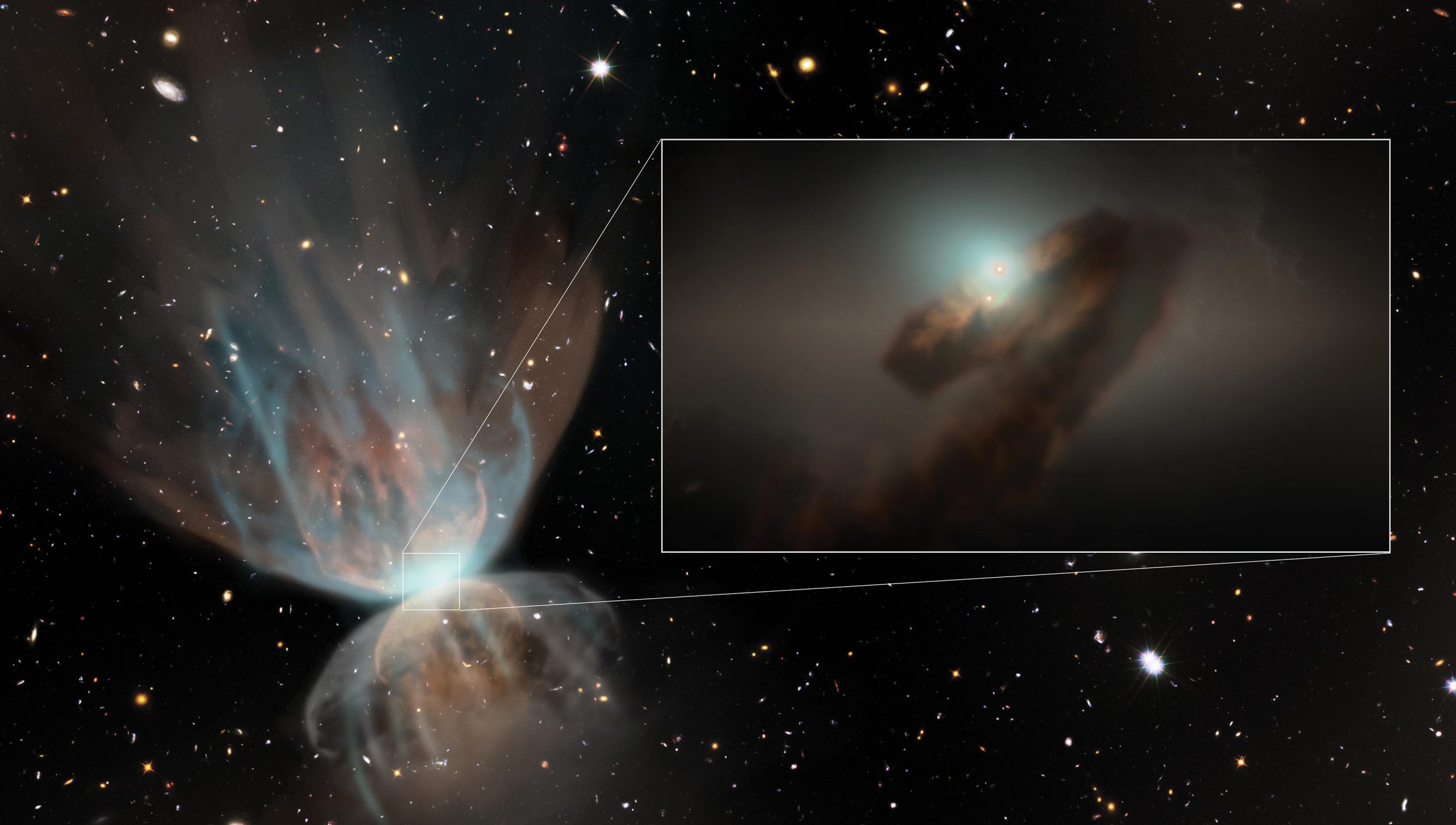
ALMA observations of FU Orionis reveal how gravitational accretion from a past gas stream causes sudden brightness in young stars, shedding light on star and planet formation processes.
An unusual group of stars in the Orion constellation have revealed their secrets. FU Orionis, a double star system, first caught astronomers’ attention in 1936 when the central star suddenly became 1,000 times brighter than usual. This behavior, expected from dying stars, had never been seen in a young star like FU Orionis.
The strange phenomenon inspired a new classification of stars sharing the same name (FUor stars). FUor stars flare suddenly, erupting in brightness, before dimming again many years later.
It is now understood that this brightening is due to the stars taking in energy from their surroundings via gravitational accretion, the main force that shapes stars and planets. However, how and why this happens remained a mystery—until now, thanks to astronomers using the Atacama Large Millimeter/submillimeter Array (ALMA).
Breakthrough Observations With ALMA
“FU Ori has been devouring material for almost 100 years to keep its eruption going. We have finally found an answer to how these young outbursting stars replenish their mass,” explains Antonio Hales, deputy manager of the North American ALMA Regional Center, scientist with the National Radio Astronomy Observatory, and lead author of this research, published on April 29 in the Astrophysical Journal. “For the first time, we have direct observational evidence of the material fueling the eruptions.”
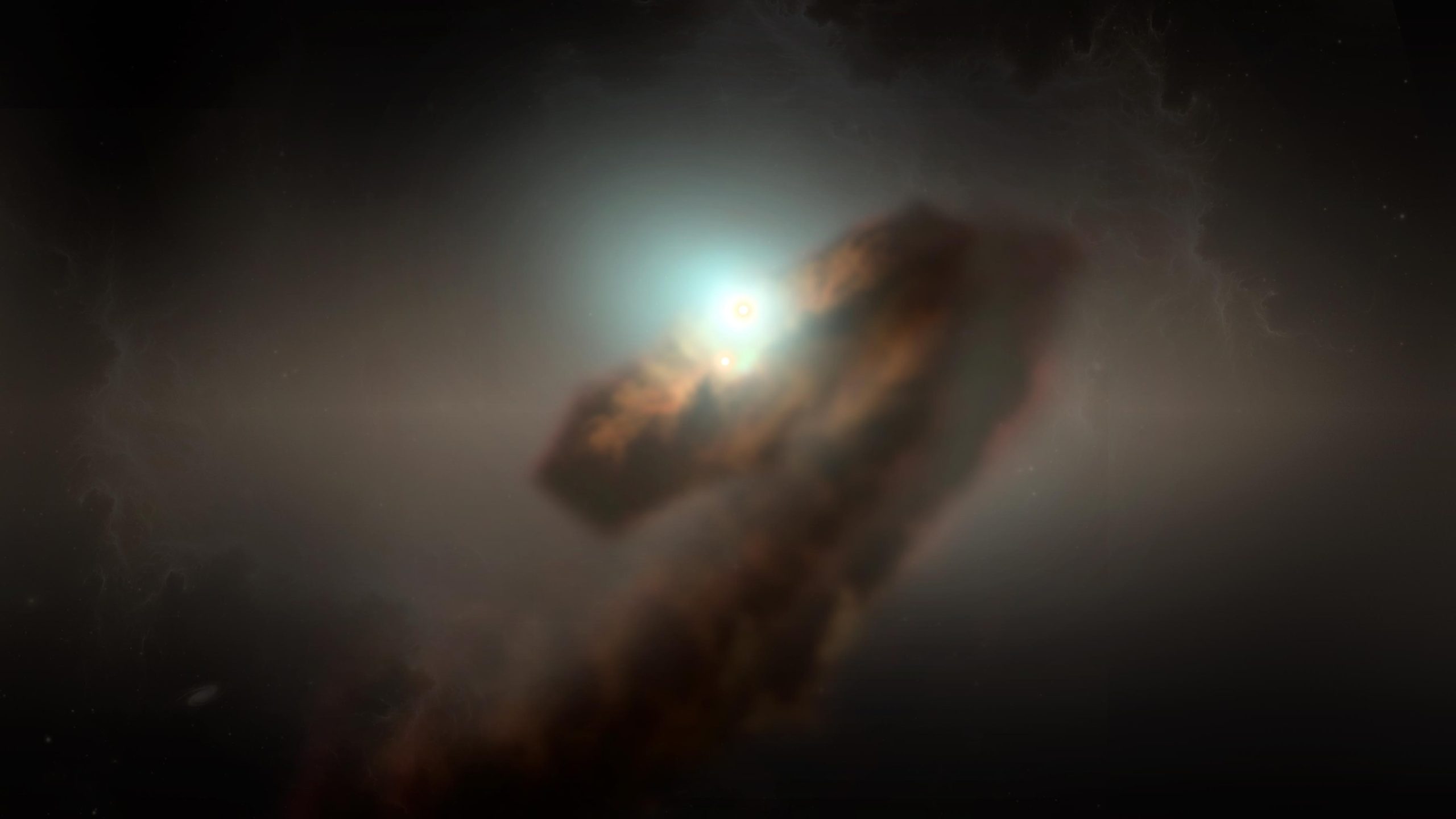
Zoom into the FU Ori binary system and the newly discovered accretion streamer. This artist’s impression shows the newly discovered streamer constantly feeding mass from the envelope into the binary system. Credit: NSF/NRAO/S. Dagnello
ALMA observations revealed a long, thin stream of carbon monoxide falling onto FU Orionis. This gas didn’t appear to have enough fuel to sustain the current outburst. Instead, this accretion streamer is believed to be a leftover from a previous, much larger feature that fell into this young stellar system.
“It is possible that the interaction with a bigger stream of gas in the past caused the system to become unstable and trigger the brightness increase,” explains Hales.
Advances in Stellar Formation Understanding
Astronomers used several configurations of ALMA antennas to capture the different types of emission coming from FU Orionis, and detect the flow of mass into the star system. They also combined novel numerical methods to model the mass flow as an accretion streamer and estimate its properties.
“We compared the shape and speed of the observed structure to that expected from a trail of infalling gas, and the numbers made sense,” says Aashish Gupta, a Ph.D. candidate at European Southern Observatory (ESO), and a co-author of this work, who developed the methods used to model the accretion streamer.
“The range of angular scales we are able to explore with a single instrument is truly remarkable. ALMA gives us a comprehensive view of the dynamics of star and planet formation, spanning from large molecular clouds in which hundreds of stars are born, down to the more familiar scales of solar systems,” adds Sebastián Pérez of Universidad de Santiago de Chile (USACH), director of the Millennium Nucleus on Young Exoplanets and their Moons (YEMS) in Chile, and co-author of this research.
These observations also revealed an outflow of slow-moving carbon monoxide from FU Orionis. This gas is not associated with the most recent outburst. Instead, it is similar to outflows observed around other protostellar objects.
Adds Hales, “By understanding how these peculiar FUor stars are made, we’re confirming what we know about how different stars and planets form. We believe that all stars undergo outburst events. These outbursts are important because they affect the chemical composition of the accretion discs around nascent stars and the planets they eventually form.”
“We have been studying FU Orionis since ALMA’s first observations in 2012,” adds Hales. It’s fascinating to finally have answers.”
Reference: “Discovery of an Accretion Streamer and a Slow Wide-angle Outflow around FU Orionis” by A. S. Hales, A. Gupta, D. Ruíz-Rodríguez, J. P. Williams, S. Pérez, L. Cieza, C. González-Ruilova, J. E. Pineda, A. Santamaría-Miranda, J. Tobin, P. Weber, Z. Zhu and A. Zurlo, 29 April 2024, The Astrophysical Journal.
DOI: 10.3847/1538-4357/ad31a1
Never miss a breakthrough: Join the SciTechDaily newsletter.
Follow us on Google and Google News.