
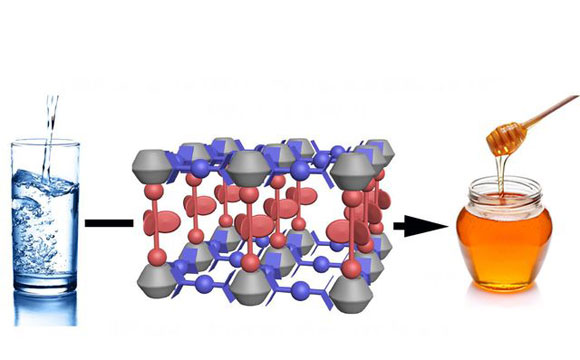
Scientists from UCLA reveal that a fluid that behaves similarly to water in our day-to-day lives becomes as heavy as honey when trapped in a nanocage of a porous solid, offering new insights into how matter behaves in the nanoscale world.
“We are learning more and more about the properties of matter at the nanoscale so that we can design machines with specific functions,” said senior author Miguel García-Garibay, dean of the UCLA Division of Physical Sciences and professor of chemistry and biochemistry.
The research is published in the journal ACS Central Science.
Just how small is the nanoscale? A nanometer is less than 1/1,000 the size of a red blood cell and about 1/20,000 the diameter of a human hair. Despite years of research by scientists around the world, the extraordinarily small size of matter at the nanoscale has made it challenging to learn how motion works at this scale.
“This exciting research, supported by the National Science Foundation, represents a seminal advance in the field of molecular machines,” said Eugene Zubarev, a program director at the NSF. “It will certainly stimulate further work, both in basic research and real-life applications of molecular electronics and miniaturized devices. Miguel Garcia-Garibay is among the pioneers of this field and has a very strong record of high-impact work and ground-breaking discoveries.”
Possible uses for complex nanomachines that could be much smaller than a cell include placing a pharmaceutical in a nanocage and releasing the cargo inside a cell, to kill a cancer cell, for example; transporting molecules for medical reasons; designing molecular computers that potentially could be placed inside your body to detect disease before you are aware of any symptoms; or perhaps even to design new forms of matter.
To gain this new understanding into the behavior of matter at the nanoscale, García-Garibay’s research group designed three rotating nanomaterials known as MOFs, or metal-organic frameworks, which they call UCLA-R1, UCLA-R2, and UCLA-R3 (the “r” stands for rotor). MOFs, sometimes described as crystal sponges, have pores — openings which can store gases, or in this case, liquid.
Studying the motion of the rotors allowed the researchers to isolate the role a fluid’s viscosity plays at the nanoscale. With UCLA-R1 and UCLA-R2 the molecular rotors occupy a very small space and hinder one another’s motion. But in the case of UCLA-R3, nothing slowed down the rotors inside the nanocage except molecules of liquid.
García-Garibay’s research group measured how fast molecules rotated in the crystals. Each crystal has quadrillions of molecules rotating inside a nanocage, and the chemists know the position of each molecule.
UCLA-R3 was built with large molecular rotors that move under the influence of the viscous forces exerted by 10 molecules of liquid trapped in their nanoscale surroundings.
“It is very common when you have a group of rotating molecules that the rotors are hindered by something within the structure with which they interact — but not in UCLA-R3,” said García-Garibay, a member of the California NanoSystems Institute at UCLA. “The design of UCLA-R3 was successful. We want to be able to control the viscosity to make the rotors interact with one another; we want to understand the viscosity and the thermal energy to design molecules that display particular actions. We want to control the interactions among molecules so they can interact with one another and with external electric fields.”
García-Garibay’s research team has been working for 10 years on motion in crystals and designing molecular motors in crystals. Why is this so important?
“I can get a precise picture of the molecules in the crystals, the precise arrangement of atoms, with no uncertainty,” García-Garibay said. “This provides a large level of control, which enables us to learn the different principles governing molecular functions at the nanoscale.”
García-Garibay hopes to design crystals that take advantage of the properties of light, and whose applications could include advances in communications technology, optical computing, sensing, and the field of photonics, which takes advantage of the properties of light; light can have enough energy to break and make bonds in molecules.
“If we are able to convert light, which is electromagnetic energy, into motion, or convert motion into electrical energy, then we have the potential to make molecular devices much smaller,” he said. “There will be many, many possibilities for what we can do with molecular machines. We don’t yet fully understand what the potential of molecular machinery is, but there are many applications that can be developed once we develop a deep understanding of how motion takes place in solids.”
Co-authors are lead author Xing Jiang, a UCLA graduate student in García-Garibay’s laboratory, who this year completed his Ph.D.; Hai-Bao Duan, a visiting scholar from China’s Nanjing Xiao Zhuang University who spent a year conducting research in García-Garibay’s laboratory; and Saeed Khan, a UCLA crystallographer in the Department of Chemistry and Biochemistry.
The research was funded by the National Science Foundation (grant DMR140268).
García-Garibay will continue his research on molecular motion in crystals and green chemistry during his tenure as dean.
Reference: “Diffusion-Controlled Rotation of Triptycene in a Metal–Organic Framework (MOF) Sheds Light on the Viscosity of MOF-Confined Solvent” by Xing Jiang, Hai-Bao Duan, Saeed I. Khan and Miguel A. Garcia-Garibay, 23 August 2016, ACS Central Science.
DOI: 10.1021/acscentsci.6b00168
Never miss a breakthrough: Join the SciTechDaily newsletter.
Follow us on Google and Google News.