
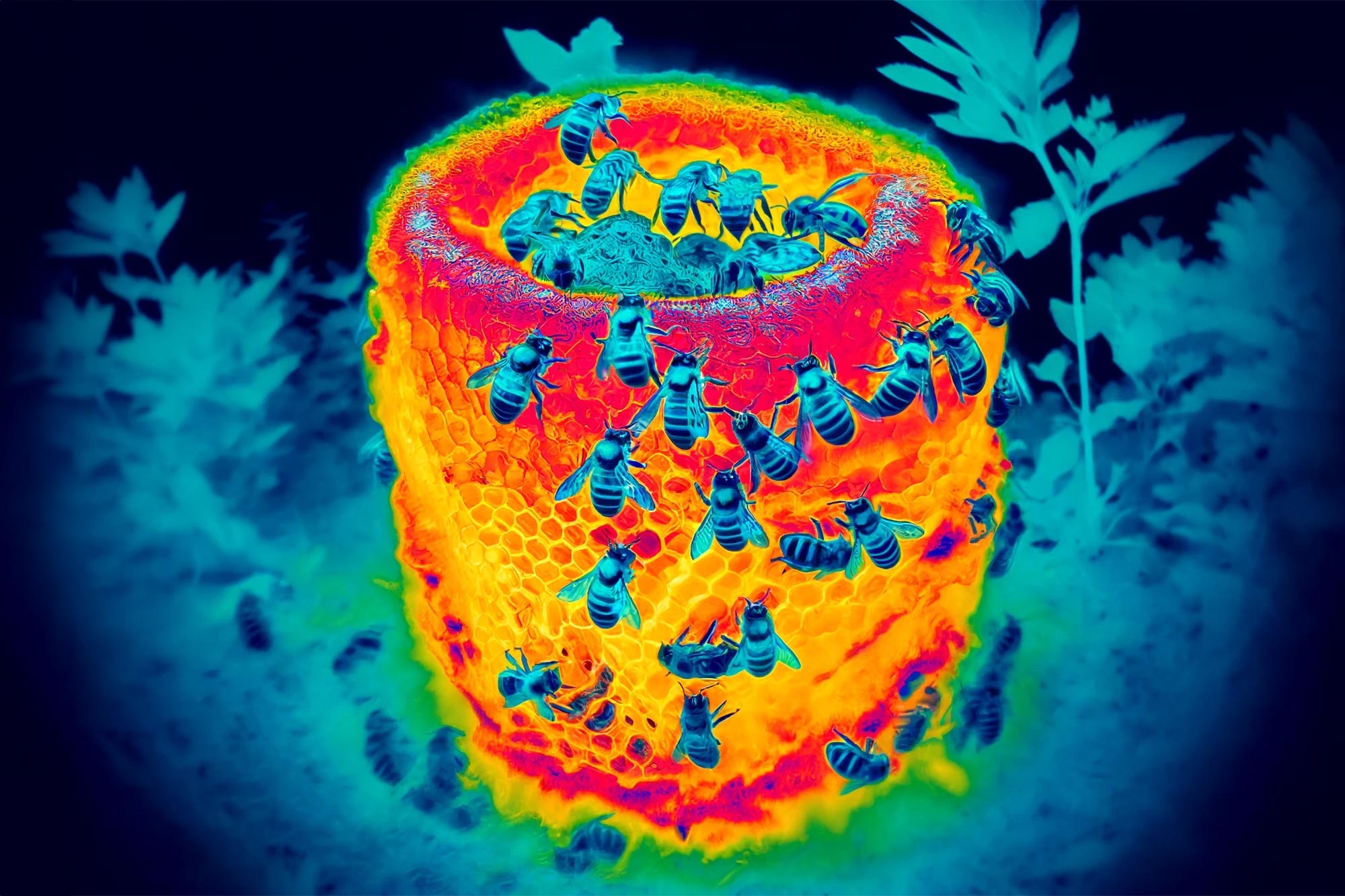
Wild bumblebees all over the world need a similar nest temperature — with global warming driving temperatures up, their nests could be too hot for them to thrive.
As a result of the climate crisis, global warming is driving up temperatures around the world — and bumblebees, like humans, are struggling to cope with homes that can’t beat the heat. In a new article published in Frontiers in Bee Science, scientists identify rising heat as a potential culprit for the decline in bumblebee populations worldwide, compromising bumblebees’ ability to construct livable nests in which healthy larvae can develop.
“The decline in populations and ranges of several species of bumblebees may be explained by issues of overheating of the nests and the brood,” said Dr Peter Kevan of the University of Guelph, Canada, lead author of the article. “The constraints on the survival of the bumblebee brood indicate that heat is likely a major factor, with heating of the nest above about 35 degrees Celsius being lethal, despite the remarkable capacity of bumblebees to thermoregulate.”
The Sting in the Tale
There are many bumblebee species around the world, living in many different environments. Lots of these species are in a decline linked to climate change, but identifying a causative factor has proven difficult. However, by reviewing the literature, Kevan and colleagues identified a critical commonality between these species, regardless of geographic range: the optimal temperature of their nests, 28-32 degrees Celsius.
“We can assume that the similarity reflects the evolutionary relatedness of the various species,” said Kevan.
Because this characteristic appears to be common between so many species, it may have limited evolutionary plasticity, meaning the bumblebees would find it hard to adapt to rising temperatures, and would struggle to remain within their thermal neutral zone — a point at which staying the right temperature requires minimal metabolic expenditure. Heat stress that takes a species out of this range is dangerous.
“Excessively high temperatures are more harmful to most animals and plants than cool temperatures. When conditions are cool, organisms that do not metabolically regulate their body temperatures simply slow down, but when temperatures get too high metabolic processes start to break down and cease,” said Kevan. “Death ensues quickly.”
Reviewing 180 years of literature, Kevan and colleagues found that bumblebees seem to be able to survive at up to 36 degrees Celsius and develop optimally at around 30-32 degrees Celsius — though this might differ between species and biogeographical conditions. While bumblebees have some behavioral adaptations which allow them to thermoregulate, this may not be enough to deal with climate change.
Additionally, the bumblebee colony also acts as a ‘superorganism’, where reproductive fitness is dependent on the collective survival and reproduction of the colony rather than individual bees. One bumblebee may cope better with the heat than another, but if the nest is too hot to raise healthy larvae the whole colony suffers, regardless of individual bumblebees’ adaptation.
On a Wing and a Prayer
“The effect of high nest temperatures has not been studied very much, which is surprising,” said Kevan. “We can surmise that nest temperatures above the mid-30s Celsius would likely be highly detrimental and that above about 35 Celsius death would occur, probably quite quickly.”
Studies of honeybees show that higher nest temperatures compromise bee queens’ strength and reproductive ability, and lead to smaller worker bees in poorer condition. If heat has a similar effect on bumblebees, so that colonies produce less healthy offspring at a higher temperature, then global warming could be directly leading to their decline.
To ensure that bumblebees continue to thrive, the scientists call for more research into what they say is an understudied aspect of bumblebee ecology: nest morphology, material properties, temperature, and thermoregulation. It may be possible for some bumblebee colonies to adapt their nest site choice and form or behavior to cool their nests. Ground-penetrating radar could help study ground-nesting species, while flow-through respirometry analysis of nests at different temperatures might help scientists gauge the stress placed on the bee colonies inside. We need both to understand how different colonies cope with the same conditions and how different species cope with different conditions, including whether some bumblebee species have broader thermal neutral zones, affording them more resilience.
“We hope that future scientists may take the ideas we present and apply them to their own research on bumblebee health and conversation,” concluded Kevan.
Reference: “Thermodynamics, thermal performance and climate change: temperature regimes for bumblebee (Bombus spp.) colonies as examples of superorganisms” by Peter G. Kevan, Pierre Rasmont and Baptiste Martinet, 6 March 2024, Frontiers in Bee Science.
DOI: 10.3389/frbee.2024.1351616
Never miss a breakthrough: Join the SciTechDaily newsletter.
Follow us on Google and Google News.
4 Comments
I’ve been following this with interest. So how is this a problem? Any HS science fair kid could solve it. Put hives under trees. Avoid direct sunlight. Add screened vents. Send me a Nobel Prize.
Wouldn’t the bees do what other life does and just migrate to a cooler climate?
It’s getting warmer almost everywhere, at least during summers. Bumblebee colonies would adapt if they could. Ambient temperature affects them, shade or no shade. A more artificially controlled environment for the colony (if that is possible) might help. I like bumblebees and hate to see them in trouble.
The bumblebees that I usually see around my home every spring did not return this year.