
Close Menu
    Facebook X (Twitter) Instagram
    SciTechDaily
    • Biology
    • Chemistry
    • Earth
    • Health
    • Physics
    • Science
    • Space
    • Technology
    Facebook X (Twitter) Pinterest YouTube RSS
    SciTechDaily
    Home»Space»Creating Chaos: Craters, Cracks, and Collapse on Mars
    Space

    Creating Chaos: Craters, Cracks, and Collapse on Mars

    By European Space Agency (ESA)December 28, 2020No Comments6 Mins Read
    Facebook Twitter Pinterest Telegram LinkedIn WhatsApp Email Reddit
    Share
    Facebook Twitter LinkedIn Pinterest Telegram Email Reddit
    Chaotic Terrain in Mars Pyrrhae Regio
    This image from ESA’s Mars Express shows craters, valleys, and chaotic terrain in Mars’ Pyrrhae Regio. This image comprises data gathered by ESA’s Mars Express using its High Resolution Stereo Camera (HRSC) on August 3, 2020 (orbit 20972). The ground resolution is approximately 16 m/pixel and the images are centered at about 322°E/16°S. This image was created using data from the nadir and color channels of the HRSC. The nadir channel is aligned perpendicular to the surface of Mars, as if looking straight down at the surface. North is to the right. Credit: ESA/DLR/FU Berlin, CC BY-SA 3.0 IGO

    Elevation can be deceiving in satellite imagery of Mars, even when differences are extreme – as demonstrated by this image of Pyrrhae Regio from ESA’s Mars Express. A chunk of terrain has collapsed and dropped more than four kilometers below its surroundings, illustrating the incredible contrast and dynamism seen across the Martian surface.

    This slice of Mars, seen here as imaged by Mars Express’ High Resolution Stereo Camera (HRSC), shows signs of various intriguing processes.

    A scattering of impact craters, formed as incoming bodies from space collided with Mars’ surface, can be seen to the left of the frame; the floor of the largest and uppermost basin spans about 40 kilometers (25 miles), and contains some fractures and markings that formed just after the crater itself. Hot, molten rock is thought to have been thrown up during the crater-forming collision, after which it cooled and settled to form the scar-like features visible here.

    Perspective View of Chaotic Terrain in Mars Pyrrhae Regio
    This image provides a perspective view of chaotic terrain in Mars’ Pyrrhae Regio. Chaotic terrain forms as a shifting subsurface layer of melting ice and sediment causes the surface above to collapse. Credit: ESA/DLR/FU Berlin, CC BY-SA 3.0 IGO

    Towards the middle of the frame, the surface is relatively smooth and featureless – however, two broad channels have worked their way through the landscape, and can be seen as meandering, branching indentations in the surrounding terrain. These channels are reminiscent of so-called ‘sapping valleys’ on Earth, which form as water consistently seeps and flows through sediment to carve out a natural drainage network.

    The valleys are attached at their rightward end to the real star of this image: a sunken, uneven, scarred patch of ground known as chaotic terrain.

    Chaotic terrain, as the name suggests, looks irregular and jumbled, and is thought to form as sub-surface ice and sediment begins to melt and shift. This shifting layer causes the surface above to collapse – a collapse that can happen quickly and catastrophically as water drains away rapidly through the regolith (the near-surface layer of rocky planets). Ice can be triggered to melt by heating events such as volcanic lava flows, subsurface magmatism, impacts by large meteorites, or changes in climate.
    Topographic View of Chaotic Terrain in Mars Pyrrhae Regio
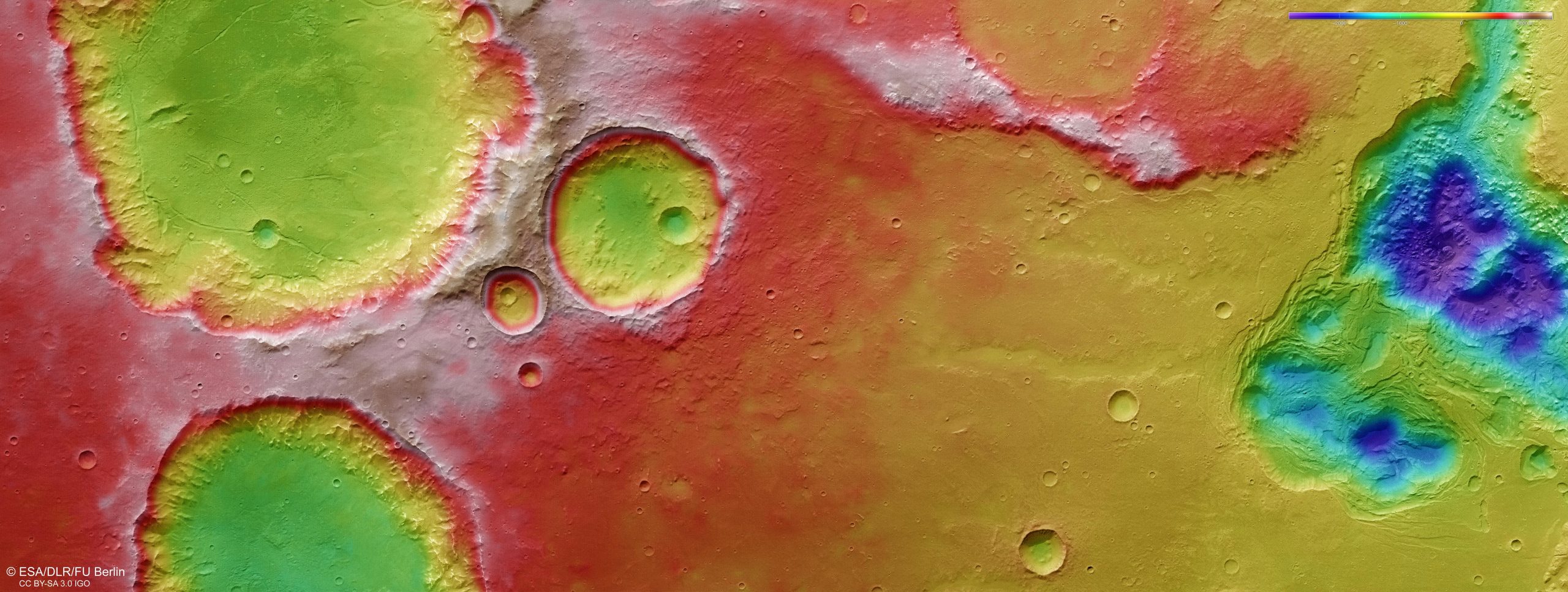
    This color-coded topographic image shows craters, valleys, and chaotic terrain in Mars’ Pyrrhae Regio, based on data gathered by the Mars Express High Resolution Stereo Camera (HRSC) during orbit 20972 (August 3, 2020). This view is based on a digital terrain model (DTM) of the region, from which the topography of the landscape can be derived; lower parts of the surface are shown in blues and purples, while higher altitude regions show up in whites, yellows, and reds, as indicated on the scale to the top right. North is to the right. Credit: ESA/DLR/FU Berlin, CC BY-SA 3.0 IGO

    In the chaotic terrain seen here, ice has melted, the resulting water drained away, and a number of disparate broken ‘blocks’ have been left standing in now-empty cavities (which once hosted ice). Remarkably, the floors of these cavities lie some four kilometers (2.5 miles) below the flatter ground near the craters to the left, as seen clearly in the associated topographic view – a colossal difference in height (for reference, the highest mountain peaks of the Pyrenees and the Alps top out at just over 3.4 km (2.1 mi) and 4.8 km (3 mi), respectively).
    Mars Pyrrhae Regio in Context

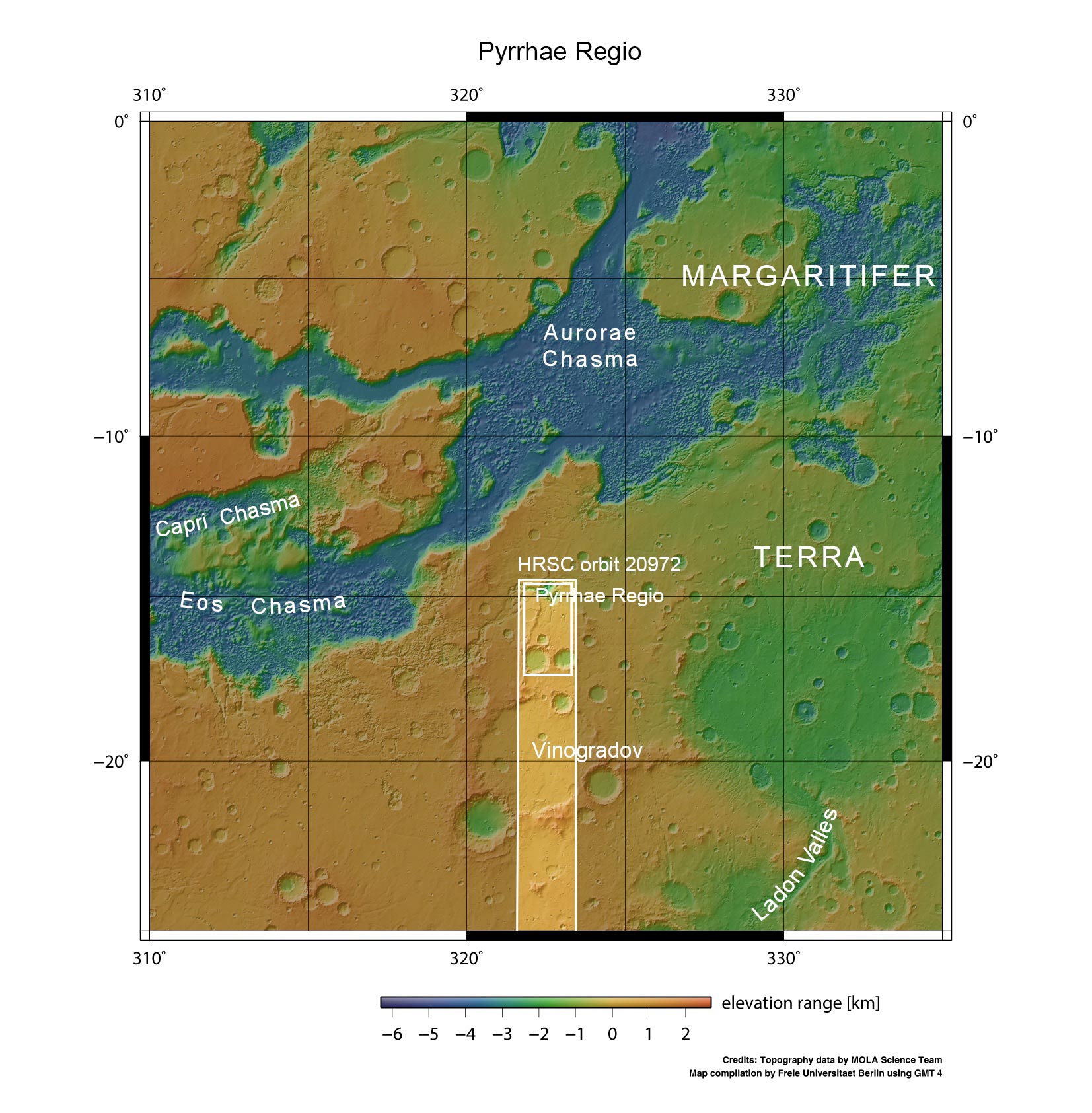
    This image from ESA’s Mars Express shows Mars’ Pyrrhae Regio in wider context. The area outlined by the bold white box indicates the area imaged by the Mars Express High Resolution Stereo Camera (HRSC) on August 3, 2020, during orbit 20972. Credit: NASA MGS MO-LA Science Team

    Considering the broader landscape containing and surrounding Pyrrhae Regio, the chaotic nature of this area is unsurprising. To the west of this patch of ground lies one of the most extreme features in the Solar System: a colossal canyon system named Valles Marineris.

    Valles Marineris is roughly ten times longer and five times deeper than the Grand Canyon on Earth, and comprises myriad smaller rifts, channels, outflows, fractures, and signs of flowing material (such as water, ice, lava, or debris). It is home to many substantial chaotic terrains, including Aurorae Chaos and Erythraeum Chaos.

    Valles Marineris is an unmissable scar on the face of Mars, and thought to have formed as the planet’s crust was stretched by nearby volcanic activity, causing it to rip and crack open before collapsing into the deep troughs we see today. These troughs have been further shaped and eroded by water flows, landslides, and other erosive processes, with spacecraft including Mars Express spying signs that water existed in parts of Valles Marineris in the relatively recent past (‘mere’ hundreds of millions of years ago).

    Mars Pyrrhae Regio in 3D
    This image shows craters, valleys, and chaotic terrain in Mars’ Pyrrhae Regio in 3D when viewed using red-green or red-blue glasses. This anaglyph was derived from data obtained by the nadir and stereo channels of the High Resolution Stereo Camera (HRSC) on ESA’s Mars Express during spacecraft orbit 20972 (August 3, 2020). It covers a part of the Martian surface centered at 322°E/16°S. North is to the right. Credit: ESA/DLR/FU Berlin, CC BY-SA 3.0 IGO

    As well as characterizing the complex processes at play in standout features such as Valles Marineris, Mars Express – in orbit around the Red Planet since December of 2003 – has spent years imaging Mars’ surface, mapping its minerals, identifying the composition and circulation of its tenuous atmosphere, probing beneath its crust, and exploring how phenomena such as the solar wind, a stream of charged particles emanating from the Sun, interacts in the martian environment.

    Never miss a breakthrough: Join the SciTechDaily newsletter.
    Follow us on Google and Google News.

    European Space Agency Mars Mars Express Popular
    Share. Facebook Twitter Pinterest LinkedIn Email Reddit

    Related Articles

    A Snaking Scar Across Mars: The Mystery of Aganippe Fossa

    Mars Express Discovers Mysterious Martian “Spiders”

    Mars Express Reveals Hidden Ice Reserves at Mars’s Equator

    Intriguing Martian Scars: An Ancient Crater Triplet on Mars

    Mars Express Spacecraft Has Discovered Liquid Water Ponds Buried Under the Martian Surface

    Mysteriously Long, Thin Cloud Returns on Mars – Not Linked to Volcanic Activity

    View a Stunning Flight Over Korolev Crater on Mars via Mars Express

    Moreux Crater: The Dark Dunes of Mars in Stunning Imagery From Mars Express Orbiter

    Nilosyrtis Mensae, Mars: Dramatically Different Regions of the Red Planet Come Together as One

    Leave A Reply Cancel Reply

    • Facebook
    • Twitter
    • Pinterest
    • YouTube

    Don't Miss a Discovery

    Subscribe for the Latest in Science & Tech!

    Trending News

    New Pill Lowers Stubborn Blood Pressure and Protects the Kidneys

    Humans May Have Hidden Regenerative Powers, New Study Suggests

    Scientists Just Solved the Mystery of Why Crabs Walk Sideways

    Doctors Are Surprised by What This Vaccine Is Doing to the Heart

    This Popular Supplement May Boost Your Brain, Not Just Your Muscles

    Scientists Say This Simple Supplement May Actually Reverse Heart Disease

    Warming Oceans Could Trigger a Dangerous Methane Surge

    This Simple Movement Could Be Secretly Cleaning Your Brain

    Follow SciTechDaily
    • Facebook
    • Twitter
    • YouTube
    • Pinterest
    • Newsletter
    • RSS
    SciTech News
    • Biology News
    • Chemistry News
    • Earth News
    • Health News
    • Physics News
    • Science News
    • Space News
    • Technology News
    Recent Posts
    • Scientists Discover Cheap Material That Kills Deadly Superbugs
    • This Magnetic Field Trick Creates Entirely New Forms of Matter
    • Astronomers Stunned by Ancient Galaxy With No Spin
    • Physicists May Be on the Verge of Discovering “New Physics” at CERN
    • AI Learns To Work Backward and Reveal Hidden Forces in Nature
    Copyright © 1998 - 2026 SciTechDaily. All Rights Reserved.
    • Science News
    • About
    • Contact
    • Editorial Board
    • Privacy Policy
    • Terms of Use

    Type above and press Enter to search. Press Esc to cancel.