

QUIONE, a unique quantum-gas microscope developed by ICFO researchers in Spain, utilizes strontium to simulate complex quantum systems and explore materials at the atomic level. It aims to solve problems beyond current computational capabilities and has already demonstrated phenomena like superfluidity.
Quantum physics needs high-precision sensing techniques to delve deeper into the microscopic properties of materials. From the analog quantum processors that have emerged recently, the so-called quantum-gas microscopes have proven to be powerful tools for understanding quantum systems at the atomic level. These devices produce images of quantum gases with very high resolution: they allow individual atoms to be detected.
Development of QUIONE
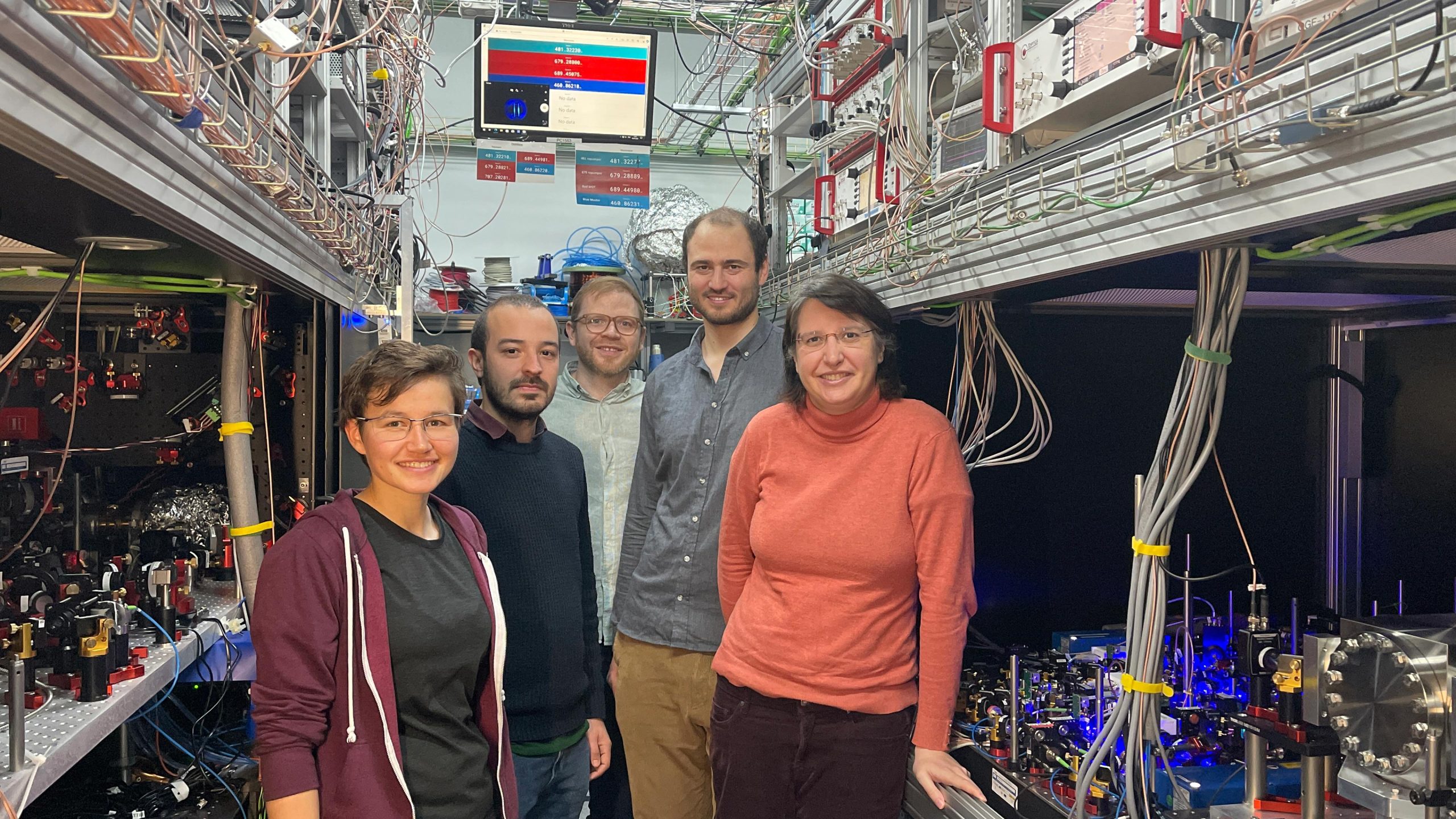
Now, ICFO researchers (Barcelona, Spain) Sandra Buob, Jonatan Höschele, Dr. Vasiliy Makhalov, and Dr. Antonio Rubio-Abadal, led by ICREA Professor at ICFO Leticia Tarruell, explain how they built their own quantum-gas microscope, named QUIONE after the Greek goddess of snow. The group’s quantum-gas microscope is the only one imaging individual atoms of strontium quantum gases in the world, as well as the first of its kind in Spain.
Beyond the impactful images in which individual atoms can be distinguished, the goal of QUIONE is quantum simulation. As ICREA Prof. Leticia Tarruell explains: “Quantum simulation can be used to boil down very complicated systems into simpler models to then understand open questions that current computers cannot answer, such as why some materials conduct electricity without any losses even at relatively high temperatures.”

The research of the group at ICFO in this area has received support at the national level (award from the Royal Spanish Society of Physics, and projects and grants from the BBVA Foundation, Ramón Areces Foundation, La Caixa Foundation, and Cellex Foundation) and European level (including an ERC project). In addition, QUIONE is co-financed by the Government of Catalonia, through the Secretariat of Digital Policies of the Department of Enterprise and Work, as part of the Catalan Government’s commitment to promote quantum technologies.
The singularity of this experiment lies in the fact that they have managed to bring the strontium gas to the quantum regime, place it in an optical lattice where the atoms could interact by collisions and then apply the single atom imaging techniques. These three ingredients altogether make ICFO’s strontium quantum-gas microscope unique in its kind.
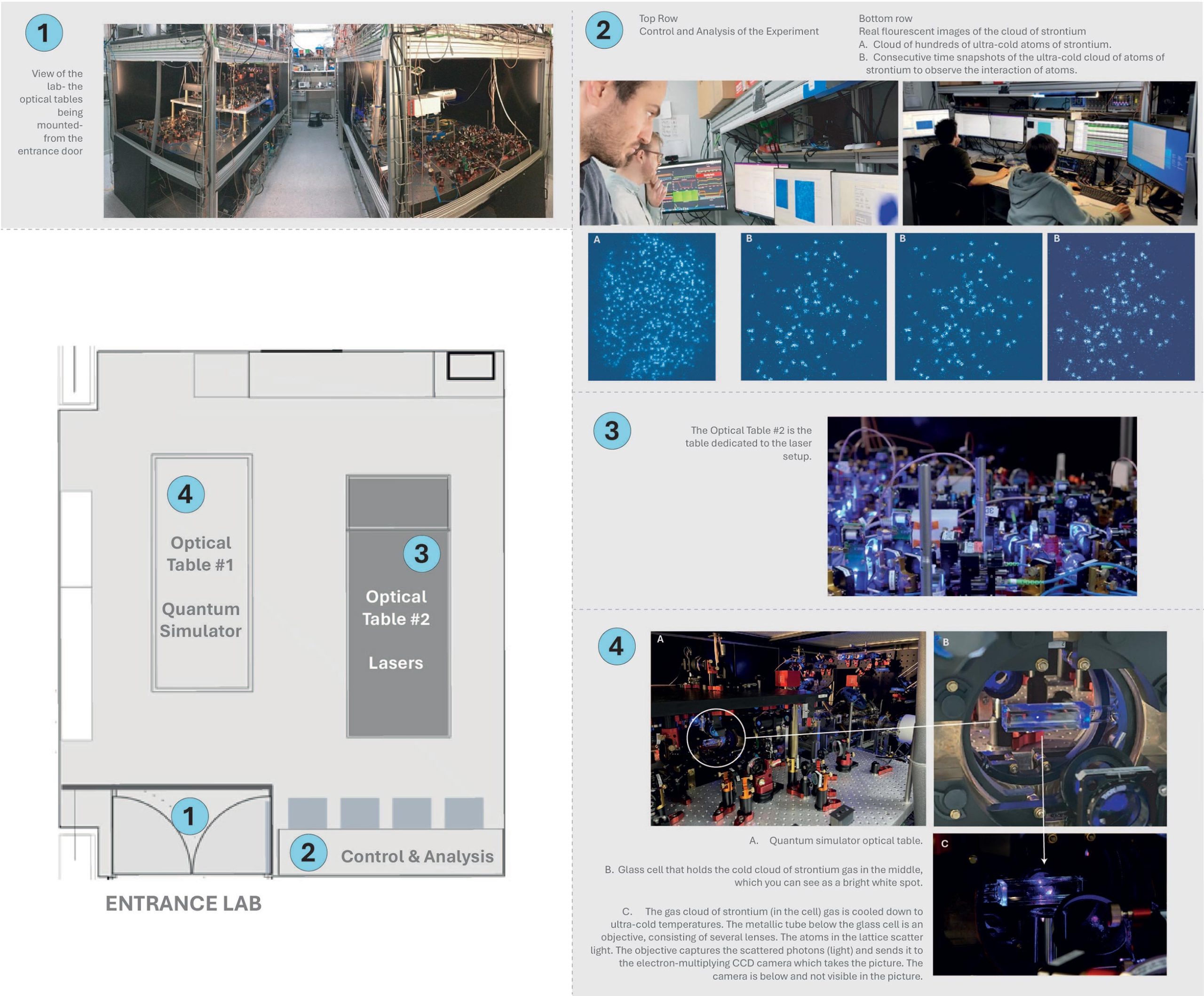
Why Strontium?
Until now, these microscope setups relied on alkaline atoms, like lithium and potassium, which have simpler properties in terms of their optical spectrum compared to alkaline-earth atoms such as strontium. This means that strontium offers more ingredients to play with in these experiments.
In fact, in recent years, the unique properties of strontium have made it a very popular element for applications in the fields of quantum computing and quantum simulation. For example, a cloud of strontium atoms can be used as an atomic quantum processor, which could solve problems beyond the capabilities of current classical computers.
All in all, ICFO researchers saw great potential for quantum simulation in strontium, and they set to work to build their own quantum-gas microscope. This is how QUIONE was born.
QUIONE, a Quantum Simulator of Real Crystals
To this end, they first lowered the temperature of the strontium gas. Using the force of several laser beams, the speed of atoms can be reduced to a point where they remain almost motionless, barely moving, reducing their temperature to almost absolute zero in just a few milliseconds. Then, the laws of quantum mechanics rule their behavior, and the atoms display new features like quantum superposition and entanglement.
After that, with the help of special lasers, the researchers activated the optical lattice, which keeps the atoms arranged in a grid along space. “You can imagine it like an egg carton, where the individual sites are actually where you put the eggs. But instead of eggs we have atoms and instead of a carton we have the optical lattice,” explains Sandra Buob, first author of the article.
The atoms in the egg cup interacted with each other, sometimes experiencing quantum tunneling to move from one place to another. This quantum dynamics between atoms mimics that of electrons in certain materials. Therefore, the study of these systems can help understand the complex behavior of certain materials, which is the key idea of quantum simulation.
As soon as the gas and the optical lattice were ready, the researchers took the images with their microscope and could finally observe their strontium quantum gas atom by atom. At this point, the construction of QUIONE had already been a success, but its creators wanted to get even more out of it.
Thus, in addition to the pictures, they took videos of the atoms and were able to observe that, while the atoms should remain still during the imaging, they sometimes jumped to a nearby lattice site. This can be explained by the phenomenon of quantum tunneling. “The atoms were “hopping” from one site to another. It was something very beautiful to see, as we were literally witnessing a direct manifestation of their inherent quantum behavior,” shares Buob.
Finally, the research group used their quantum-gas microscope to confirm that the strontium gas was a superfluid, a quantum phase of matter that flows without viscosity. “We suddenly switched off the lattice laser, so that the atoms could expand in space and interfere with each other. This generated an interference pattern, due to the wave-particle duality of the atoms in the superfluid. When our equipment captured it, we verified the presence of superfluidity in the sample,” explains Dr. Antonio Rubio-Abadal.
“It is a very exciting moment for quantum simulation,” shares ICREA professor Leticia Tarruell. “Now that we have added strontium to the list of available quantum-gas microscopes, we might be able to simulate more complex and exotic materials soon. Then new phases of matter are expected to arise. And we also expect to obtain much more computational power to use these machines as analog quantum computers.”
Reference: “A Strontium Quantum-Gas Microscope” by Sandra Buob, Jonatan Höschele, Vasiliy Makhalov, Antonio Rubio-Abadal and Leticia Tarruell, 18 April 2024, PRX Quantum.
DOI: 10.1103/PRXQuantum.5.020316
Never miss a breakthrough: Join the SciTechDaily newsletter.
Follow us on Google and Google News.
2 Comments
The what m hate squad hasn’t yet arrived in this article. I rather enjoyed this report. The strontium quantum has is very interesting. I was wondering what’s makes the atoms in the lattice a “gas”, tho, cuz it would be closer to a cubic solid when arranged in the optical lattice.
The quantum hate squad*