
Close Menu
    Facebook X (Twitter) Instagram
    SciTechDaily
    • Biology
    • Chemistry
    • Earth
    • Health
    • Physics
    • Science
    • Space
    • Technology
    Facebook X (Twitter) Pinterest YouTube RSS
    SciTechDaily
    Home»Earth»Ancient Source of Oxygen for Life Discovered Hidden Deep in the Earth’s Crust
    Earth

    Ancient Source of Oxygen for Life Discovered Hidden Deep in the Earth’s Crust

    By Newcastle UniversityAugust 8, 20222 Comments4 Mins Read
    Facebook Twitter Pinterest Telegram LinkedIn WhatsApp Email Reddit
    Share
    Facebook Twitter LinkedIn Pinterest Telegram Email Reddit
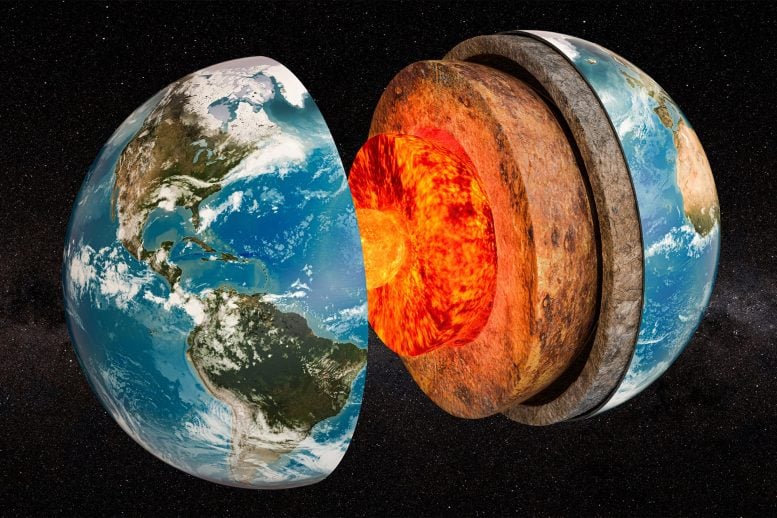
    Earth Core Mantle Crust
    Researchers have uncovered a source of oxygen that may have influenced the evolution of life before the advent of photosynthesis.

    Researchers discovered that water interacting with fractured rocks at high temperatures generates hydrogen peroxide, potentially influencing early life on Earth before photosynthesis.

    Scientists at Newcastle University have discovered a source of oxygen deep in the Earth’s crust that may have influenced the evolution of life before the advent of photosynthesis.

    The pioneering research project uncovered a mechanism that can generate hydrogen peroxide from rocks during the movement of geological faults. The study was led by Newcastle University’s School of Natural and Environmental Sciences and published today (August 8) in the journal Nature Communications.

    While hydrogen peroxide in high concentrations can be harmful to life, it can also provide a useful source of oxygen to microbes. This additional source of oxygen may have influenced the early evolution, and possibly even origin, of life in hot environments on the early Earth before the evolution of photosynthesis.

    Conditions of Subsurface Rock Fracturing
    Researchers were able to simulate some of the key conditions of subsurface rock fracturing using vials in the lab. Rocks representative of oceanic and continental crust were crushed under nitrogen, added to oxygen-free water, then heated. Credit: Jon Telling / Jordan Stone / Newcastle University

    In tectonically active regions, the movement of the Earth’s crust not only generates earthquakes but also riddles the subsurface with cracks and fractures. These are lined with highly reactive rock surfaces containing many imperfections, or defects. Water can then filter down and react with these defects on the newly fractured rock.

    Master’s student Jordan Stone simulated these conditions in the laboratory by crushing granite, basalt, and peridotite – rock types that would have been present in the early Earth’s crust. These were then added to water at varying temperatures under well-controlled oxygen-free conditions.

    History of Life and Oxygen
    The research investigates a source of reactive oxygen associated with geological faulting; a potential oxygen source prior to cyanobacteria oxygenating the Earth’s atmosphere. This reactive oxygen may have had a role in the evolution of life from an oxygen-free to an oxygenated world and contributed to prebiotic chemistry in subsurface fractures prior to the origin of life. Credit: Jon Telling / Jordan Stone / Newcastle University

    High Temperatures Key to Hydrogen Peroxide Generation

    The experiments revealed that substantial amounts of hydrogen peroxide – and as a result, potentially oxygen – were only generated at temperatures close to the boiling point of water. Importantly, the temperature of hydrogen peroxide formation overlaps the growth ranges of some of the most heat-loving microbes on Earth called hyperthermophiles, including evolutionary ancient oxygen-using microbes near the root of the Universal Tree of Life.

    Lead author Jordan Stone, who conducted this research as part of his Master of Research in Environmental Geoscience, said: “While previous research has suggested that small amounts of hydrogen peroxide and other oxidants can be formed by stressing or crushing of rocks in the absence of oxygen, this is the first study to show the vital importance of hot temperatures in maximizing hydrogen peroxide generation.”
    Jordan Stone
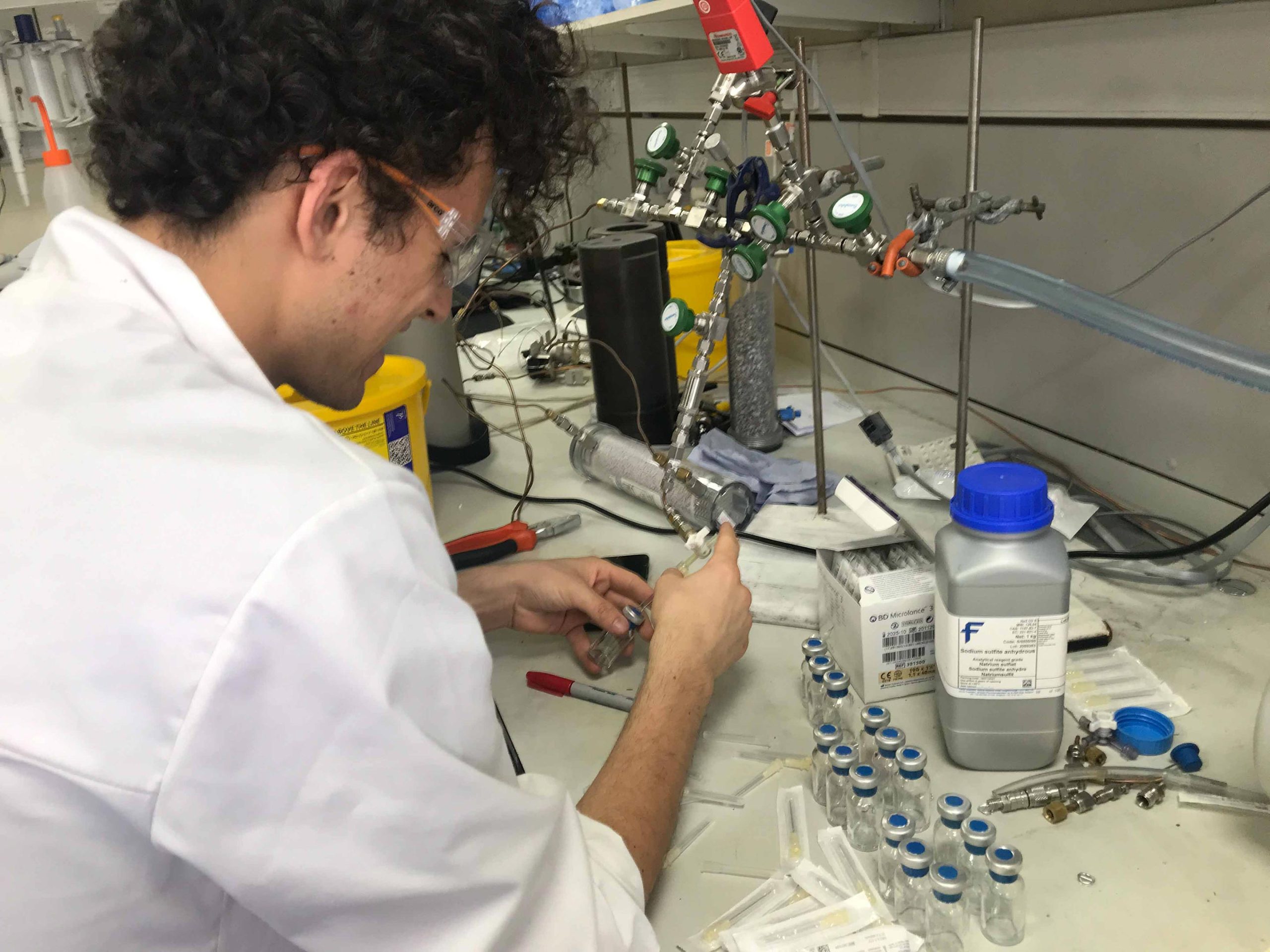
    Lead author Jordan Stone, who conducted this research as part of his MRes in Environmental Geoscience at Newcastle University, UK, sets up one of the experiments. Credit: Jon Telling / Jordan Stone / Newcastle University

    Principal Investigator Dr. Jon Telling, Senior Lecturer, added: “This research shows that defects on crushed rock and minerals can behave very differently to how you would expect more ‘perfect’ mineral surfaces to react. All these mechanochemical reactions need to generate hydrogen peroxide, and therefore oxygen, is water, crushed rocks, and high temperatures, which were all present on the early Earth before the evolution of photosynthesis and which could have influenced the chemistry and microbiology in hot, seismically active regions where life may have first evolved.”

    Reference: “Tectonically-driven oxidant production in the hot biosphere” by Jordan Stone, John O. Edgar, Jamie A. Gould and Jon Telling,  8 August 2022, Nature Communications.
    DOI: 10.1038/s41467-022-32129-y

    The work was supported through grants from the Natural Environmental Research Council (NERC) and the UK Space Agency. A major new follow-up project led by Dr. Jon Telling, funded by NERC, is underway to determine the significance of this mechanism for supporting life in the Earth’s subsurface.

    Never miss a breakthrough: Join the SciTechDaily newsletter.
    Follow us on Google and Google News.

    Evolution Newcastle University Oxygen Popular
    Share. Facebook Twitter Pinterest LinkedIn Email Reddit

    Related Articles

    The Great Oxidation Event: A 200-Million-Year Journey to Oxygenation

    A Slowdown in Earth’s Rotation Could Have Affected the Oxygen Content of the Atmosphere

    Remarkable New Species of Meat-Eating Jurassic Dinosaur Discovered in Utah

    Unraveling the Mystery of How Early Animals Survived Most Severe Ice Age

    Gap in Fossil Record Filled by Find From School Class Hike – Ancient Rhinos Roamed the Yukon

    It Really Was the Asteroid That Ended the Dinosaurs – Here’s How It Went Down

    MIT Study Suggests Complex Life on Earth Began 2.33 Billion Years Ago

    Could Life on Earth Have Originated from Somewhere Else?

    How Aerosol Particles Form in the Amazon

    2 Comments

    1. Clyde Spencer on August 8, 2022 8:15 am

      “All [that] these mechanochemical reactions need to generate hydrogen peroxide, and therefore oxygen, is water, crushed rocks, and high temperatures, which were all present on the early Earth before the evolution of photosynthesis and which could have influenced the chemistry and microbiology in hot, seismically active regions where life may have first evolved.”

      Reply
    2. Kimberly on August 13, 2022 2:06 pm

      $Mytimetoshine

      Reply
    Leave A Reply Cancel Reply

    • Facebook
    • Twitter
    • Pinterest
    • YouTube

    Don't Miss a Discovery

    Subscribe for the Latest in Science & Tech!

    Trending News

    Bone-Strengthening Discovery Could Reverse Osteoporosis

    Scientists Uncover Hidden Trigger Behind Stem Cell Aging

    Scientists Find Way to Reverse Fatty Liver Disease Without Changing Diet

    Could Humans Regrow Limbs? New Study Reveals Promising Genetic Pathway

    Scientists Reveal Eating Fruits and Vegetables May Increase Your Risk of Lung Cancer

    Scientists Reverse Brain Aging With Simple Nasal Spray

    Scientists Uncover Potential Brain Risks of Popular Fish Oil Supplements

    Scientists Discover a Surprising Way To Make Bread Healthier and More Nutritious

    Follow SciTechDaily
    • Facebook
    • Twitter
    • YouTube
    • Pinterest
    • Newsletter
    • RSS
    SciTech News
    • Biology News
    • Chemistry News
    • Earth News
    • Health News
    • Physics News
    • Science News
    • Space News
    • Technology News
    Recent Posts
    • What Makes Rubber So Strong? Scientists Finally Solve 100-Year-Old Mystery
    • Scientists Decode Mysterious Magnetic “Maze Domains” To Boost EV Efficiency
    • Scientists Say This Fungus Could Survive the Trip to Mars
    • The Universe Is Expanding Too Fast and Scientists Can’t Explain Why
    • Gaining Weight Young May Be More Dangerous Than You Think
    Copyright © 1998 - 2026 SciTechDaily. All Rights Reserved.
    • Science News
    • About
    • Contact
    • Editorial Board
    • Privacy Policy
    • Terms of Use

    Type above and press Enter to search. Press Esc to cancel.