
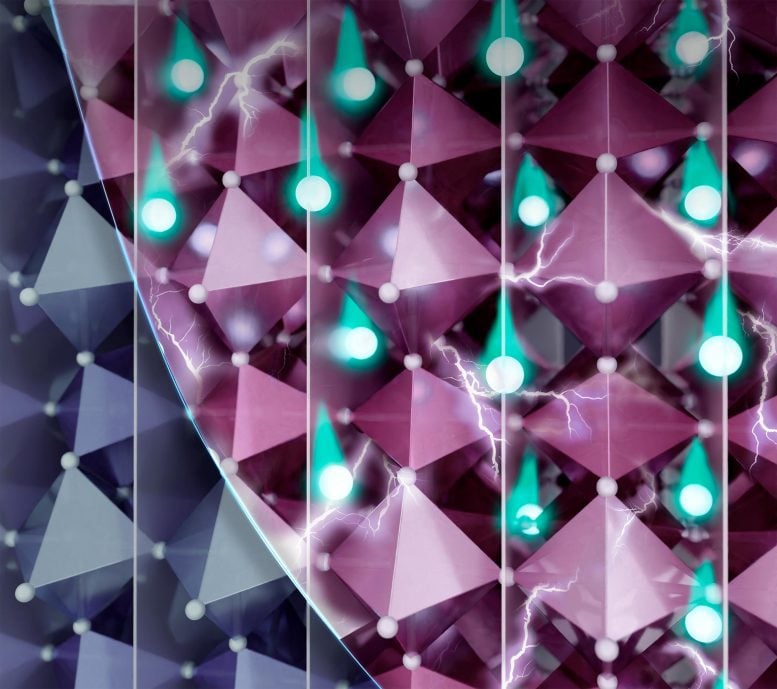
An international team finds new single-crystalline oxide thin films with fast and dramatic changes in electrical properties via Li-ion intercalation through engineered ionic transport channels.
Researchers have pioneered the creation of T-Nb2O5 thin films that enable faster Li-ion movement. This achievement, promising more efficient batteries and advances in computing and lighting, marks a significant leap forward in iontronics.
An international research team, comprising members from the Max Planck Institute of Microstructure Physics, Halle (Saale), Germany, the University of Cambridge, UK, and the University of Pennsylvania, USA, have reported an important breakthrough in materials science. They achieved the first realization of single-crystalline T-Nb2O5 thin films, exhibiting two-dimensional (2D) vertical ionic transport channels. This results in a swift and significant insulator-metal transition through Li-ion intercalation in the 2D channels.
Since the 1940s, scientists have investigated the potential of niobium oxide, specifically a form of niobium oxide known as T-Nb2O5, for advancing battery efficiency. This unique material possesses the ability to rapidly facilitate the movement of lithium ions, which are the charged particles integral to the functioning of batteries. A faster movement of lithium ions translates to quicker battery charging.
The Challenge and the Breakthrough
However, growing this niobium oxide material into thin, high-quality films to be used in practical applications has always posed a significant challenge. This stems from the complex structure of T-Nb2O and the existence of multiple similar forms, or polymorphs, of niobium oxide.
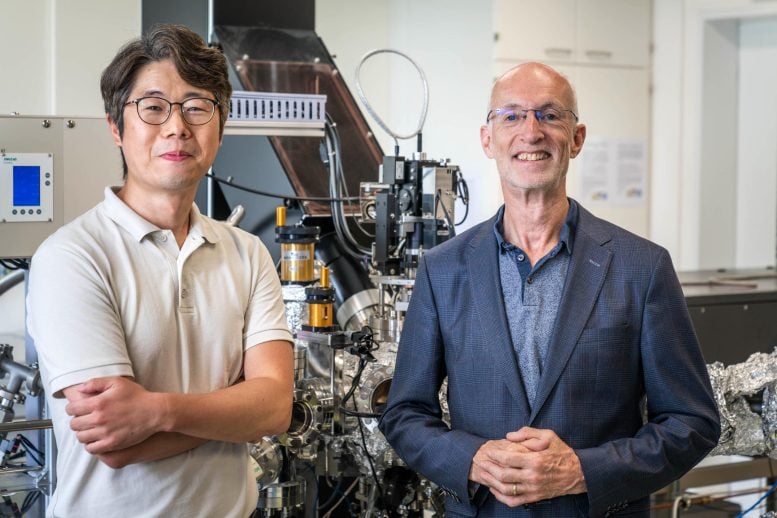
Now, in a paper published on July 27 in the journal Nature Materials, researchers from the Max Planck Institute of Microstructure Physics, University of Cambridge, and the University of Pennsylvania have successfully demonstrated the growth of high-quality, single-crystal thin films of T-Nb2O5, aligned in such a way that the lithium ions can move even faster along vertical ionic transport channels.
Observations and Implications
The T-Nb2O5 films undergo a significant electrical change at an early stage of Li insertion into the initially insulating films. This is a dramatic shift — the resistivity of the material decreases by a factor of 100 billion. The research team further demonstrate tunable and low voltage operation of thin film devices by altering the chemical composition of the ‘gate’ electrode, a component that controls the flow of ions in a device, further extending the potential applications.
The Max Planck Institute of Microstructure Physics group realized the growth of the single-crystalline T-Nb2O5 thin films, and showed how Li-ion intercalation can dramatically increase their electrical conductivity. Together with the University of Cambridge group multiple previously unknown transitions in the material’s structure were discovered as the concentration of lithium ions was changed. These transitions change the electronic properties of the material, allowing it to switch from being an insulator to a metal, meaning that it goes from blocking electric current to conducting it. Researchers from the University of Pennsylvania rationalized the multiple phase transitions they observed, as well as, how these phases might be related to the concentration of lithium ions and their arrangement within the crystal structure.
Collaboration and Future Prospects
The success of this research was contingent on the collaborative effort of the three international groups, each contributing their unique expertise: thin films from the Max Planck Institute of Microstructure Physics, batteries from the University of Cambridge, and theoretical insights from the University of Pennsylvania.
“In tapping into the potential of T-Nb2O5 to undergo colossal insulator–metal transitions, we have unlocked an exciting avenue for exploration for next-generation electronics and energy storage solutions,” says first author Hyeon Han of the Max Planck Institute of Microstructure Physics.
“What we have done is find a way to move lithium ions in a way that doesn’t disrupt the crystal structure of the T-Nb2O5 thin films, which means the ions can move significantly faster,” says Andrew Rappe of the University of Pennsylvania. “This dramatic shift enables a range of potential applications, from high-speed computing to energy-efficient lighting and more.”
Clare P. Grey of University of Cambridge comments that “The ability to control the orientation of these films allows us to explore anisotropic transport in this technologically-important class of materials, which is fundamental to our understanding of how these materials operate.”
“This research is a testament to the power of an interdisciplinary experiment-theory collaboration and an insatiable scientific curiosity,” says Stuart S. P. Parkin, of Max Planck Institute of Microstructure Physics. “Our understanding of T-Nb2O5 and similar complex materials has been substantially enhanced, leading we hope to a more sustainable and efficient future, by taking advantage of the very interesting field of iontronics that goes beyond today’s charge-based electronics.”
Reference: “Li iontronics in single-crystalline T-Nb2O5 thin films with vertical ionic transport channels” by Hyeon Han, Quentin Jacquet, Zhen Jiang, Farheen N. Sayed, Jae-Chun Jeon, Arpit Sharma, Aaron M. Schankler, Arvin Kakekhani, Holger L. Meyerheim, Jucheol Park, Sang Yeol Nam, Kent J. Griffith, Laura Simonelli, Andrew M. Rappe, Clare P. Grey and Stuart S. P. Parkin, 27 July 2023, Nature Materials.
DOI: 10.1038/s41563-023-01612-2
This research was supported by the European Union’s Horizon 2020 research and innovation program (Grant No 737109); an Alexander von Humboldt Professorship awarded to S.S.P.P.; the U.S. Department of Energy, Office of Science, Basic Energy Sciences (Award # DE-SC0019281); the Faraday Institution CATMAT project (FIRG016); the Office of Naval Research, (Grant N00014-20-1-2701); the National Energy Research Scientific Computing Center of the DOE and the High-Performance Computing Modernization Office (HPCMO) of the U.S. Department of Defense.
Never miss a breakthrough: Join the SciTechDaily newsletter.
Follow us on Google and Google News.