
Fundamental discovery and new technique could lead to better, safer rechargeable batteries.
UCLA researchers have made a groundbreaking discovery that could enhance the safety and efficiency of lithium-metal batteries. By preventing corrosion during the deposition of lithium, the researchers found that lithium atoms form a unique 12-sided shape, reducing the risk of explosions. This innovation could potentially revolutionize lithium battery technology, leading to improved safety and performance.
Rechargeable lithium-ion batteries power smartphones, electric vehicles, and storage for solar and wind energy, among other technologies.
They descend from another technology, the lithium-metal battery, that hasn’t been developed or adopted as broadly. There’s a reason for that: While lithium-metal batteries have the potential to hold about double the energy that lithium-ion batteries can, they also present a far greater risk of catching fire or even exploding.
Revolutionary Research on Lithium-Metal Batteries
Now, a study by members of the California NanoSystems Institute at UCLA reveals a fundamental discovery that could lead to safer lithium-metal batteries that outperform today’s lithium-ion batteries. The research was published on August 2 in the journal Nature.
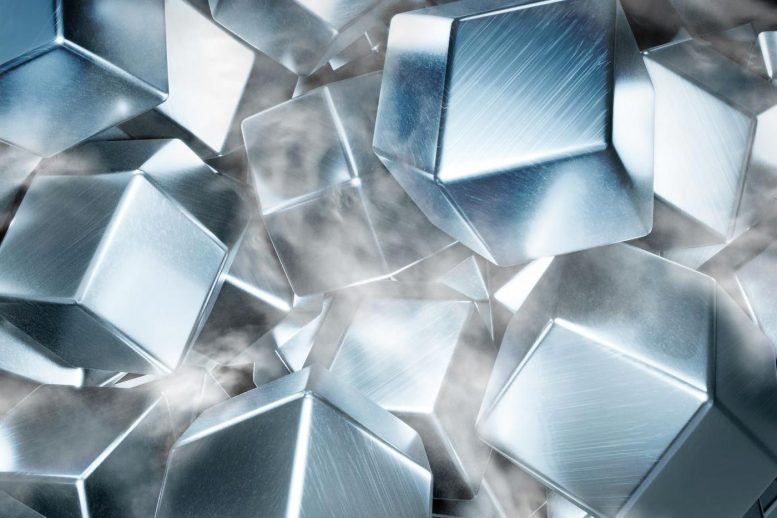
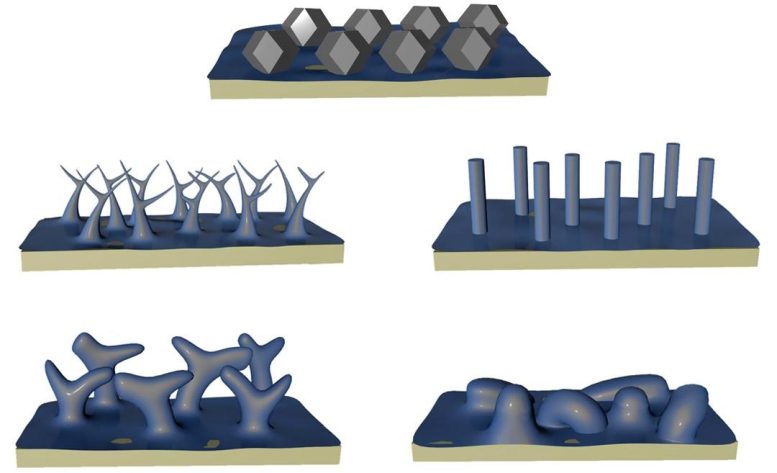
Metallic lithium reacts so easily with chemicals that, under normal conditions, corrosion forms almost immediately while the metal is being laid down on a surface such as an electrode. But the UCLA investigators developed a technique that prevents that corrosion and showed that, in its absence, lithium atoms assemble into a surprising shape — the rhombic dodecahedron, a 12-sided figure similar to the dice used in role-playing games like Dungeons and Dragons.
Understanding the Structural Aspects of Lithium-Metal Batteries
“There are thousands of papers on lithium metal, and most descriptions of the structure is qualitative, such as ‘chunky’ or ‘column-like,’” said Yuzhang Li, the study’s corresponding author, an assistant professor of chemical and biomolecular engineering at the UCLA Samueli School of Engineering and a member of CNSI. “It was surprising for us to discover that when we prevented surface corrosion, instead of these ill-defined shapes, we saw a singular polyhedron that matches theoretical predictions based on the metal’s crystal structure. Ultimately, this study allows us to revise how we understand lithium-metal batteries.”
Contrasting Lithium-Ion and Lithium-Metal Batteries
At tiny scales, a lithium-ion battery stores positively charged lithium atoms in a cage-like structure of carbon that coats an electrode. By contrast, a lithium-metal battery instead coats the electrode with metallic lithium. That packs 10 times more lithium into the same space compared to lithium-ion batteries, which accounts for the increase in both performance and danger.
The process for laying down the lithium coating is based on a 200-plus-year-old technique that employs electricity and solutions of salts called electrolytes. Often, the lithium forms microscopic branching filaments with protruding spikes. In a battery, if two of those spikes crisscross, it can cause a short circuit that could lead to an explosion.
Implications of the Discovery on Battery Safety and Performance
The revelation of the true shape of lithium — that is, in the absence of corrosion — suggests that the explosion risk for lithium-metal batteries can be abated, because the atoms accumulate in an orderly form instead of one that can crisscross. The discovery could also have substantial implications for high-performance energy technology.
“Scientists and engineers have produced over two decades’ worth of research into synthesizing metals including gold, platinum and silver into shapes such as nanocubes, nanospheres, and nanorods,” Li said. “Now that we know the shape of lithium, the question is, Can we tune it so that it forms cubes, which can be packed in densely to increase both the safety and performance of batteries?”
Reimagining the Lithium Deposition Process
Until now, the prevailing view had been that the choice of electrolytes in solution determines the shape that lithium forms on a surface — whether the structure resembles chunks or columns. The UCLA researchers had a different idea.
“We wanted to see if we could deposit lithium so quickly that we outpace the reaction that causes the corrosion film,” said UCLA doctoral student Xintong Yuan, the study’s first author. “That way, we could potentially see how the lithium wants to grow in the absence of that film.”
Refining the Lithium Deposition Technique
The researchers developed a new technique for depositing lithium faster than corrosion forms. They ran current through a much smaller electrode in order to push electricity out faster — much like the way that partially blocking the nozzle of a garden hose causes water to shoot out more forcefully.
A balance was required, however, because speeding up the process too much would lead to the same spiky structures that cause short circuits; the team addressed that issue by adjusting the shape of their tiny electrode.
They laid down lithium on surfaces using four different electrolytes, comparing results between a standard technique and their new method. With corrosion, the lithium formed four distinct microscopic shapes. However, with their corrosion-free process, they found that the lithium formed minuscule dodecahedrons — no bigger than 2 millionths of a meter, or about the average length of a single bacterium — in all four cases.
Unraveling the Shape of Lithium Using Cryo-EM
The researchers were able to see the shape of lithium thanks to an imaging technique called cryo-electron microscopy, or cryo-EM, which beams electrons through frozen samples in order to show details down to the atomic level while inhibiting damage to the samples.
Cryo-EM has become ubiquitous in biosciences for determining the structures of proteins and viruses. Use for materials science is growing, and the UCLA researchers had two key advantages.
First, when Li was a graduate student, he demonstrated that cryo-EM can be used to analyze lithium, which falls to pieces when exposed to an electron beam at room temperature. (His study was published in 2017 in the journal Science.) Second, the team performed experiments at CNSI’s Electron Imaging Center for Nanomachines, which is home to several cryo-EM instruments that have been customized to accommodate the types of samples used in materials research.
Reference: “Ultrafast deposition of faceted lithium polyhedra by outpacing SEI formation” by Xintong Yuan, Bo Liu, Matthew Mecklenburg and Yuzhang Li, 2 August 2023, Nature.
DOI: 10.1038/s41586-023-06235-w
Never miss a breakthrough: Join the SciTechDaily newsletter.
Follow us on Google and Google News.