
Long-distance gene control first emerged around 650 to 700 million years ago, significantly earlier than scientists had previously believed.
Life depends on timing. Every cell must turn genes on and off at just the right moment. Even the simplest forms of life have mastered this, usually with switches located right next to the genes they control. This basic method of gene regulation is thought to be as ancient as life itself.
But new research reveals a far more complex system that may have evolved much earlier than scientists believed. A study published in Nature by researchers at the Centre for Genomic Regulation (CRG) and the Centre Nacional d’Anàlisi Genòmica (CNAG) shows that long-distance gene control likely appeared between 650 and 700 million years ago. This pushes the timeline back by about 150 million years, suggesting this advanced mechanism was already in place at the dawn of animal life.
This process, known as distal regulation, works by folding strands of DNA and proteins into intricate loops. These loops allow far-off sections of DNA to reach across the genome and activate genes from a distance. Scientists believe this breakthrough helped early multicellular animals reuse existing genes in new ways, making it possible to create different cell types and tissues without needing entirely new genetic instructions.
The Ancestral Genetic Swiss Knife
The critical innovation likely originated in a sea creature, the common ancestor of all extant animals. The ancient animal evolved the ability to fold DNA in a controlled manner, creating loops in three-dimensional space that brought far-flung bits of DNA in direct contact with each other.
“This creature could repurpose its genetic toolkit in different ways, like a Swiss knife, enabling it to refine and explore innovative survival strategies. We did not expect this layer of complexity to be so ancient,” says Dr. Iana Kim, first author of the study and postdoctoral researcher with dual affiliation between the Centre for Genomic Regulation (CRG) and the Centre Nacional d’Anàlisis Genòmica (CNAG).
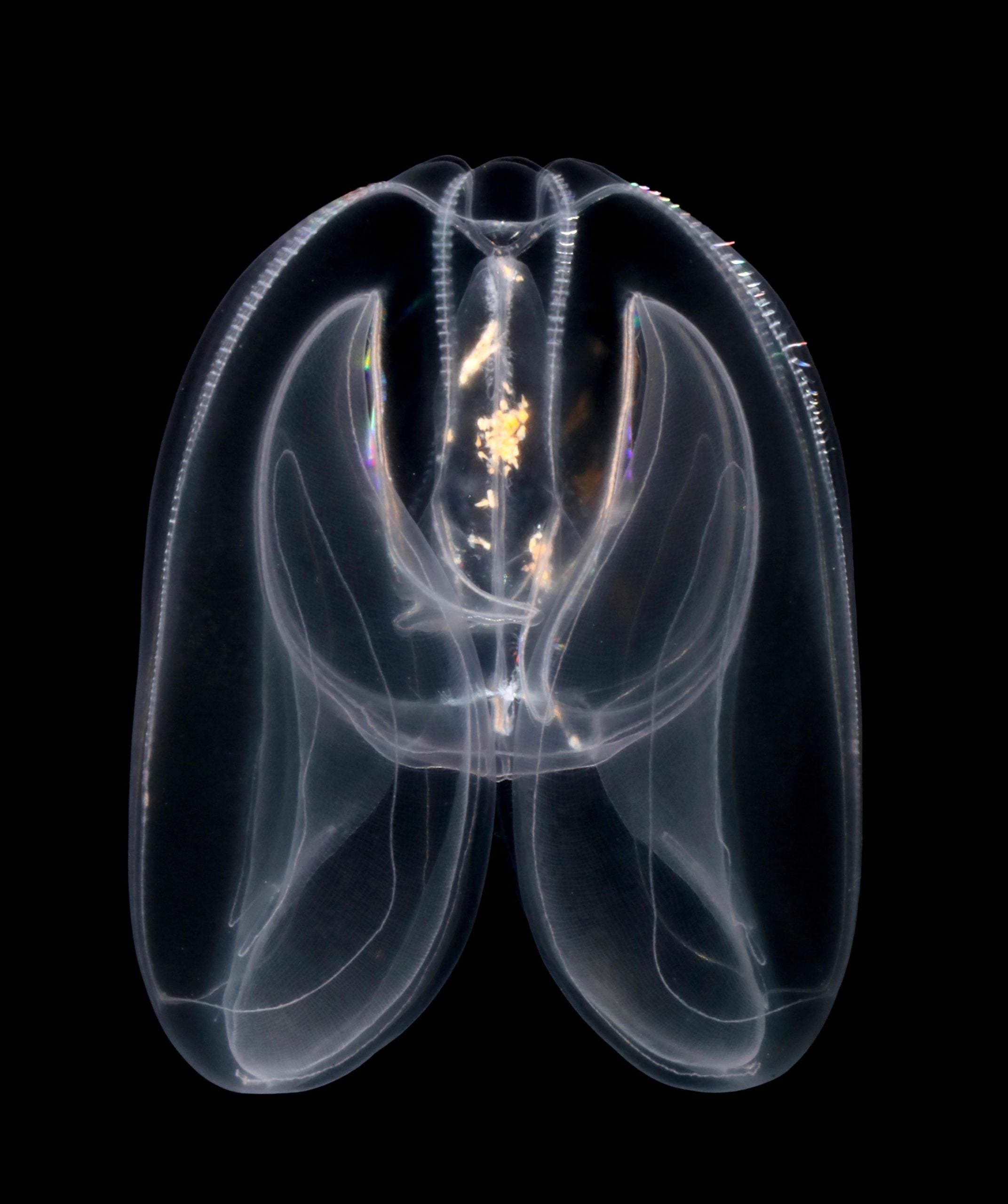
The authors of the study made the discovery by exploring the genomes of many of the oldest branches on the animal family tree, including comb jellies like the ‘sea walnut’ (Mnemiopsis leidyi), placozoans, cnidarians, and sponges. They also studied single-celled relatives that are not animals but share a recent common ancestor.
“You can discover a lot of new biology by looking at weird sea creatures. So far, we had been comparing genome sequences, but thanks to new methods we can now analyze which gene regulation mechanisms control genome function across species,” explains ICREA Research Professor Arnau Sebe-Pedrós, corresponding author of the study and Group Leader at the Centre for Genomic Regulation.
The Power of 3D Genomics
The team used a technique called Micro-C to map how DNA physically folds inside the cells of each of the 11 different species they studied. For scale, each human cell nucleus packs about two meters of DNA. The researchers sifted through 10 billion pieces of sequencing data to build each species’ 3D genome map in detail.
While there was no evidence of distal regulation in the single-celled relatives of animals, early-branching animals like comb jellies, placozoans, and cnidarians had many loops. The sea walnut alone had over four thousand loops genome-wide. The finding is surprising given its genome is around just 200 million DNA letters long. In comparison, the human genome is 3.1 billion letters long, and our cells can have tens of thousands of loops.
Until now, distal regulation was thought to have first appeared in the last common ancestor of bilaterians, a group of many different types of animals that first appeared on Earth around 500 million years ago. However, comb jellies are descended from life forms that diverged early from other animal lineages around 650 to 700 million years ago.
Whether comb jellies are older than sponges in the tree of life is a longstanding debate in evolutionary biology circles, but the study demonstrates that distal regulation arose at least one hundred and fifty million years earlier than previously thought.
A New Player in Genetic Architecture
The study made another surprising discovery. Many animals are vertebrates. In their cells, loops are controlled by CTCF, an architectural protein that defines boundaries and compartmentalizes genes into different local neighborhoods. It is a foundational unit of genomic architecture in mammals, birds, reptiles, amphibians, and fish. However, the genomes of the early-branching animals do not encode any equivalent protein to CTCF. Instead, the authors discovered that comb jellies use a different architectural protein belonging to the same structural family. The discovery shatters the assumption that advanced genomic, distal regulation requires CTCF.
“It is impressive that the same problem has been solved using different tools. Thanks to this work, we now know that you can use two different proteins to bring distal DNA pieces together in space, forming a loop. Isn’t evolution marvelous?” says ICREA Research Professor Marc A. Marti-Renom, Group Leader at the Centre Nacional d’Anàlisi Genomic and the Centre for Genomic Regulation.
Like sponges and comb jellies, humans are also made of the same building blocks of DNA. Today, our bodies rely on the ancient innovation of distal regulation to help create different types of cells from the same DNA, producing everything from brain cells to immune cells. When these contacts go wrong, diseases can arise.
By tracing distal regulation to animals that lived many hundreds of millions of years ago, researchers can begin to piece together how the earliest versions of genomic regulation took shape, providing new clues about the fundamental principles that govern our cells and bodies today. This can help us understand where the system is robust and where it’s prone to failure, potentially guiding new medical insights or therapies.
Reference: “Chromatin loops are an ancestral hallmark of the animal regulatory genome” by Iana V. Kim, Cristina Navarrete, Xavier Grau-Bové, Marta Iglesias, Anamaria Elek, Grygoriy Zolotarov, Nikolai S. Bykov, Sean A. Montgomery, Ewa Ksiezopolska, Didac Cañas-Armenteros, Joan J. Soto-Angel, Sally P. Leys, Pawel Burkhardt, Hiroshi Suga, Alex de Mendoza, Marc A. Marti-Renom and Arnau Sebé-Pedrós, 7 May 2025, Nature.
DOI: 10.1038/s41586-025-08960-w
Never miss a breakthrough: Join the SciTechDaily newsletter.
Follow us on Google and Google News.