
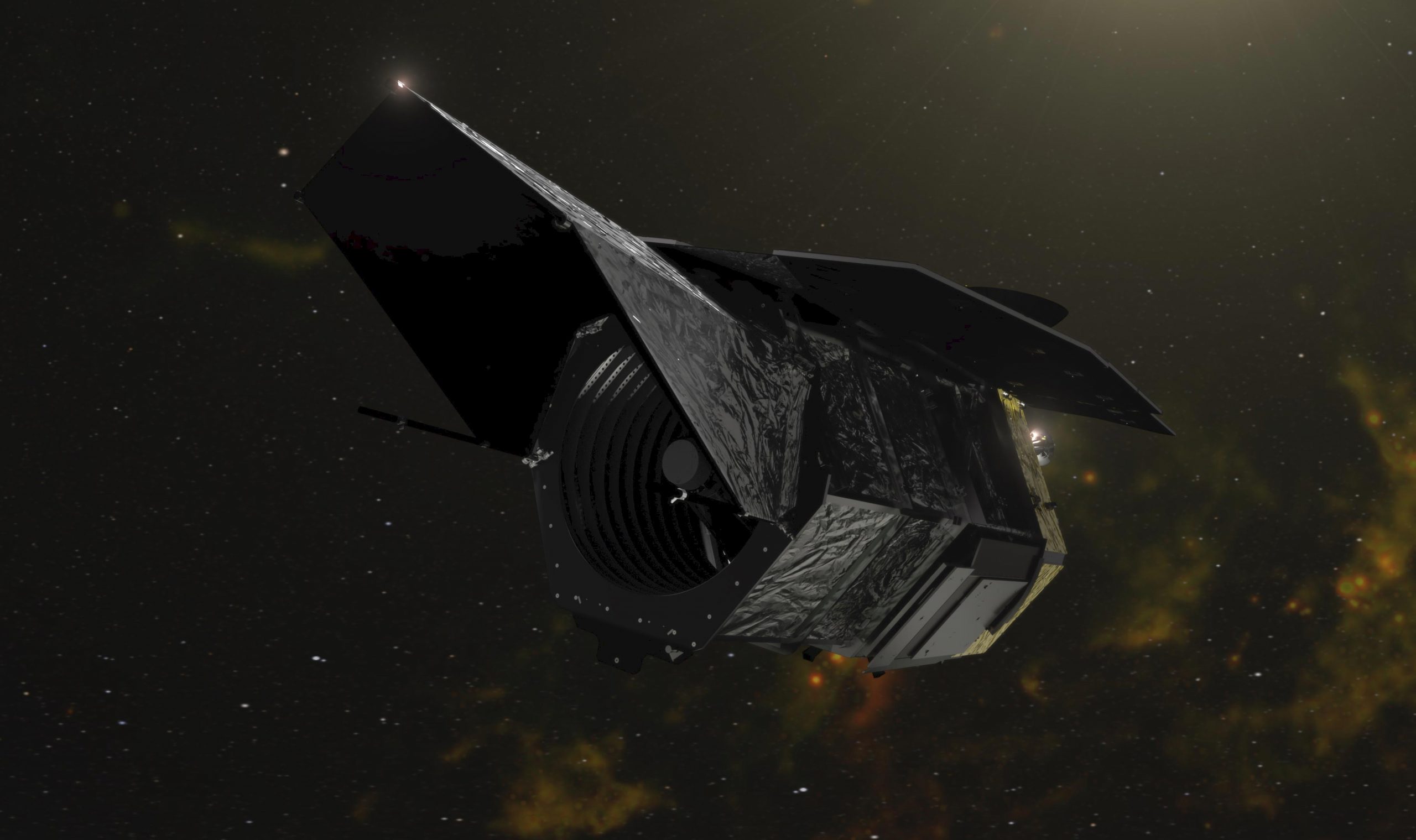
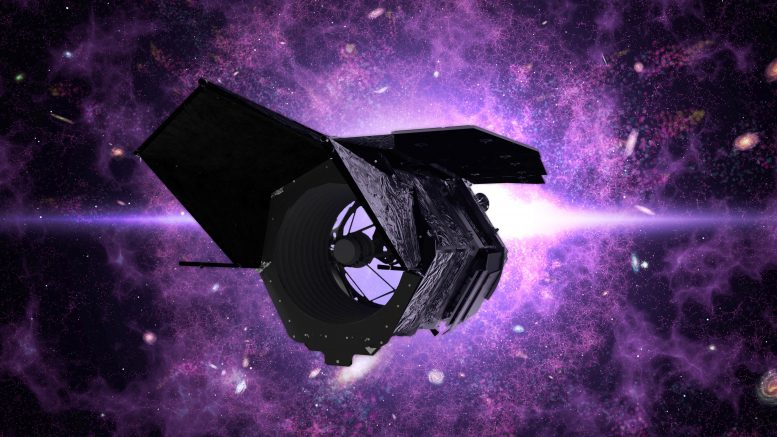
New simulations show that NASA’s Nancy Grace Roman Space Telescope will be able to reveal myriad rogue planets – freely floating bodies that drift through our galaxy untethered to a star. Studying these island worlds will help us understand more about how planetary systems form, evolve, and break apart.
Astronomers discovered planets beyond our solar system, known as exoplanets, in the 1990s. We quickly went from knowing of only our own planetary system to realizing that planets likely outnumber the hundreds of billions of stars in our galaxy. Now, a team of scientists is finding ways to improve our understanding of planet demographics by searching for rogue worlds.
“As our view of the universe has expanded, we’ve realized that our solar system may be unusual,” said Samson Johnson, a graduate student at Ohio State University in Columbus who led the research effort. “Roman will help us learn more about how we fit in the cosmic scheme of things by studying rogue planets.”
The findings, published in the Astronomical Journal, center on the Roman Space Telescope’s ability to locate and characterize isolated planets. Astronomers have only tentatively discovered a few of these nomad worlds so far because they are so difficult to detect.
Finding galactic nomads
Roman will find rogue planets by conducting a large microlensing survey. Gravitational lensing is an observational effect that occurs because the presence of mass warps the fabric of space-time. The effect is extreme around very massive objects, like black holes and entire galaxies. Even solitary planets cause a detectable degree of warping, called microlensing.
This animation shows how gravitational microlensing can reveal island worlds. When an unseen rogue planet passes in front of a more distant star from our vantage point, light from the star bends as it passes through the warped space-time around the planet. The planet acts as a cosmic magnifying glass, amplifying the brightness of the background star. Credit: NASA’s Goddard Space Flight Center/CI Lab
If a rogue planet aligns closely with a more distant star from our vantage point, the star’s light will bend as it travels through the curved space-time around the planet. The result is that the planet acts like a natural magnifying glass, amplifying light from the background star. Astronomers see the effect as a spike in the star’s brightness as the star and planet come into alignment. Measuring how the spike changes over time reveals clues to the rogue planet’s mass.
“The microlensing signal from a rogue planet only lasts between a few hours and a couple of days and then is gone forever,” said co-author Matthew Penny, an assistant professor of physics and astronomy at Louisiana State University in Baton Rouge. “This makes them difficult to observe from Earth, even with multiple telescopes. Roman is a game-changer for rogue planet searches.”
Microlensing offers the best way to systematically search for rogue planets – especially those with low masses. They don’t shine like stars and are often very cool objects, emitting too little heat for infrared telescopes to see. These vagabond worlds are essentially invisible, but Roman will discover them indirectly thanks to their gravitational effects on the light of more distant stars.
Lessons from cosmic castaways
Johnson and co-authors showed that Roman will be able to detect rogue planets with masses as small as Mars. Studying these planets will help narrow down competing models of planetary formation.
The planet-building process can be chaotic, since smaller objects collide with one another and sometimes stick together to form larger bodies. It’s similar to using a piece of playdough to pick up other pieces. But occasionally collisions and close encounters can be so violent that they fling a planet out of the gravitational grip of its parent star. Unless it manages to drag a moon along with it, the newly orphaned world is doomed to wander the galaxy alone.
This illustration shows a rogue planet drifting through the galaxy alone. Credit: NASA/JPL-Caltech/R. Hurt (Caltech-IPAC)
Rogue planets may also form in isolation from clouds of gas and dust, similar to how stars grow. A small cloud of gas and dust could collapse to form a central planet instead of a star, with moons instead of planets surrounding it.
Roman will test planetary formation and evolution models that predict different numbers of these isolated worlds. Determining the abundance and masses of rogue planets will offer insight into the physics that drives their formation. The research team found that the mission will provide a rogue planet count that is at least 10 times more precise than current estimates, which range from tens of billions to trillions in our galaxy. These estimates mainly come from observations by ground-based telescopes.
Since Roman will observe above the atmosphere, nearly a million miles away from Earth in the direction opposite the Sun, it will yield far superior microlensing results. In addition to providing a sharper view, Roman’s perspective will allow it to stare at the same patch of sky continuously for months at a time. Johnson and his colleagues showed that Roman’s microlensing survey will detect hundreds of rogue planets, even though it will search only a relatively narrow strip of the galaxy.
Part of the study involved determining how to analyze the mission’s future data to obtain a more accurate census. Scientists will be able to extrapolate from Roman’s rogue planet count to estimate how common these objects are throughout the entire galaxy.
“The universe could be teeming with rogue planets and we wouldn’t even know it,” said Scott Gaudi, a professor of astronomy at Ohio State University and a co-author of the paper. “We would never find out without undertaking a thorough, space-based microlensing survey like Roman is going to do.”
For more on this research, read Rogue Planets Could Outnumber the Stars.
Reference: “Predictions of the Nancy Grace Roman Space Telescope Galactic Exoplanet Survey. II. Free-floating Planet Detection Rates” by Samson A. Johnson, Matthew Penny, B. Scott Gaudi, Eamonn Kerins, Nicholas J. Rattenbury, Annie C. Robin, Sebastiano Calchi Novati and Calen B. Henderson, 21 August 2020, Astronomical Journal.
DOI: 10.3847/1538-3881/aba75b
The Nancy Grace Roman Space Telescope is managed at Goddard, with participation by NASA’s Jet Propulsion Laboratory and Caltech/IPAC in Pasadena, the Space Telescope Science Institute in Baltimore, and a science team comprising scientists from research institutions across the United States.
Never miss a breakthrough: Join the SciTechDaily newsletter.
Follow us on Google and Google News.
14 Comments
Couldn’t Rogue planets potentially harbour life? heated by internal activity utilised from the gravity of other rogues? Not unlike ice moons with underground oceans in our solar system.
As I understand it, the “moons with underground oceans” you’re talking about are all heated by tidal forces from the Gas Giants they orbit. That wouldn’t work on Rogues; no partner, no tidal forces, they’d radiate their core heat faster than Mars. (Caveat: I Am Not An Astronomer)
That’s a pity(if you’re right). As you may know, Proxima Centauri is 4+/-1 light years away – It sounds like there are a large amount of Rogues closer.
That could have had huge implications for life.
There potentially could be binary rogues. Then there’s the heat generated by radioactive decay in the core of the planet.
Internal radiation could heat the rogue planets. In addition, large rogue planets might have accompanying moons that could be heated with tidal action. Having a series of planets or moons between us and the next star might allow humans (or their robot explorers) to “island-hop” their way across the cosmos.
Some of them may be binaries too.
In any case, if they ar so common there will be an appreciable proportion that have life right now even the heat sources will vanish fast in general
“ar so common” = are so common.
“even the heat sources” = even if the heat sources.
Ugh. Yeah. It has humans in it, so yeah. That’s unusual.
So are elephants, the trunk evolved once. Not something that is tied to evolution of humans but of complex traits.
Could unveil, not UNVEILED. Thanks for wasting my time.
Yes, very misleading headline.
How does the survey distinguish between rogue objects of regular matter, black holes, and primordial black holes?
I say objects of regular matter because they cannot be planets by definition as they have no orbital plane.
The difference between a rocky planet (such as Mars) and an equivalent-mass black hole may be very subtle; only relativistic effects in the time of light travel from the fluctuations in brightness of the background star seem likely to be observable, and these may be too difficult to tease out. The constraints on rogue planets and planet-sized black holes (primordial, presumably, as stellar-mass ones couldn’t have had enough time to boil away via Hawking radiation) will likely overlap, but clever people will work on working out the statistics of each population.
They would be more like astrophysical planets (large enough to be hydrostatically rounded and differentiated), but you are right. “Rogue planets” is a handy nick, however.
Dominic covered the rest. I would just add that the observed inflation seem to exclude the proposed formation pathway for primordial black holes. You would want to have amplitudes of density perturbations exceed 0.1 when leaving inflation [ https://arxiv.org/abs/1309.4201 ], but the observed fluctuations eventually grew [!] to 10^-5 amplitude at the release of the cosmic background radiation 400 kyrs later. So personally I don’t understand why we are still discussing these things (but that’s me) – they seem to have lost their attraction at the same time that big bang cosmology evolved to modern inflationary hot big bang cosmology over 4 decades ago.