
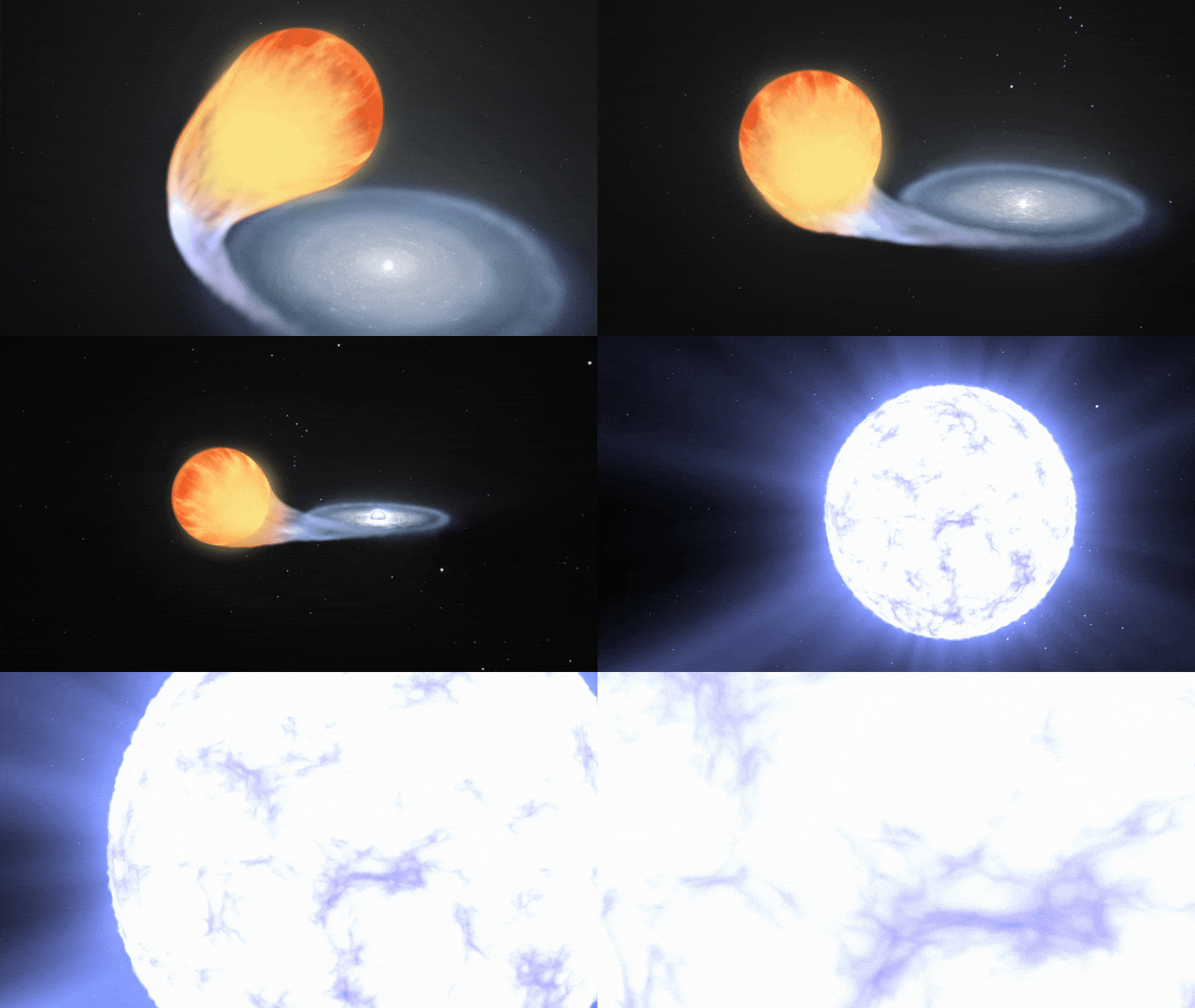
The Nancy Grace Roman Space Telescope will observe thousands of distant type Ia supernovae to explore cosmic expansion, investigate dark energy’s nature, and improve our understanding of dark matter.
NASA’s upcoming Nancy Grace Roman Space Telescope will see thousands of exploding stars called supernovae across vast stretches of time and space. Using these observations, astronomers aim to shine a light on several cosmic mysteries, providing a window onto the universe’s distant past and hazy present.
Roman’s supernova survey will help clear up clashing measurements of how fast the universe is currently expanding, and even provide a new way to probe the distribution of dark matter, which is detectable only through its gravitational effects. One of the mission’s primary science goals involves using supernovae to help pin down the nature of dark energy – the unexplained cosmic pressure that’s speeding up the expansion of the universe.
Space’s Biggest Mystery
“Dark energy makes up the majority of the cosmos, but we don’t actually know what it is,” said Jason Rhodes, a senior research scientist at NASA’s Jet Propulsion Laboratory in Southern California. “By narrowing down possible explanations, Roman could revolutionize our understanding of the universe – and dark energy is just one of the many topics the mission will explore!”
Roman will use multiple methods to investigate dark energy. One involves surveying the sky for a special type of exploding star, called a type Ia supernova.
NASA’s upcoming Nancy Grace Roman Space Telescope will see thousands of exploding stars called supernovae across vast stretches of time and space. Using these observations, astronomers aim to shine a light on several cosmic mysteries, providing a window onto the universe’s distant past and hazy present. Credit: NASA’s Goddard Space Flight Center/CI Labs
Many supernovae occur when massive stars run out of fuel, rapidly collapse under their own weight, and then explode because of strong shock waves that propel out of their interiors. These supernovae occur about once every 50 years in our Milky Way galaxy. But evidence shows that type Ia supernovae originate from some binary star systems that contain at least one white dwarf – the small, hot core remnant of a Sun-like star. Type Ia supernovae are much rarer, happening roughly once every 500 years in the Milky Way.
In some cases, the dwarf may siphon material from its companion. This ultimately triggers a runaway reaction that detonates the thief once it reaches a specific point where it has gained so much mass that it becomes unstable. Astronomers have also found evidence supporting another scenario, involving two white dwarfs that spiral toward each other until they merge. If their combined mass is high enough that it leads to instability, they, too, may produce a type Ia supernova.
These explosions peak at a similar, known intrinsic brightness, making type Ia supernovae so-called standard candles – objects or events that emit a specific amount of light, allowing scientists to find their distance with a straightforward formula. Because of this, astronomers can determine how far away the supernovae are by simply measuring how bright they appear.
Mapping Expansion Through Receding Supernovae
Astronomers will also use Roman to study the light of these supernovae to find out how quickly they appear to be moving away from us. By comparing how fast they’re receding at different distances, scientists will trace cosmic expansion over time. This will help us understand whether and how dark energy has changed throughout the history of the universe.
“In the late 1990s, scientists discovered that the expansion of the universe was speeding up using dozens of type Ia supernovae,” said Daniel Scolnic, an assistant professor of physics at Duke University in Durham, North Carolina, who is helping design Roman’s supernova survey. “Roman will find them by the thousands, and much farther away than the majority of those we’ve seen so far.”
Previous type Ia supernova surveys have concentrated on the relatively nearby universe, largely due to instrument limitations. Roman’s infrared vision, gigantic field of view, and exquisite sensitivity will dramatically extend the search, pulling the cosmic curtains far enough aside to allow astronomers to spot thousands of distant type Ia supernovae.
The mission will study dark energy’s influence in detail over more than half of the universe’s history, when it was between about four and 12 billion years old. Exploring this relatively unprobed region will help scientists add crucial pieces to the dark energy puzzle.
“Type Ia supernovae are among the most important cosmological probes we have, but they’re hard to see when they’re far away,” Scolnic said. “We need extremely precise measurements and an incredibly stable instrument, which is exactly what Roman will provide.”
Hubble Constant Hubbub
In addition to providing a cross-check with the mission’s other dark energy surveys, Roman’s type Ia supernova observations could help astronomers examine another mystery. Discrepancies keep popping up in measurements of the Hubble constant, which describes how fast the universe is currently expanding.
Predictions based on early universe data, from about 380,000 years after the big bang, indicate that the cosmos should currently expand at about 42 miles per second (67 kilometers per second) for every megaparsec of distance (a megaparsec is about 3.26 million light-years). But measurements of the modern universe indicate faster expansion, between roughly 43 to 47 miles per second (70 to 76 kilometers per second) per megaparsec.
Roman will help by exploring different potential sources of these discrepancies. Some methods to determine how fast the universe is now expanding rely on type Ia supernovae. While these explosions are remarkably similar, which is why they’re valuable tools for gauging distances, small variations do exist. Roman’s extensive survey could improve their use as standard candles by helping us understand what causes the variations.
The mission should reveal how the properties of type Ia supernovae change with age, since it will view them across such a vast sweep of cosmic history. Roman will also spot these explosions in various locations in their host galaxies, which could offer clues to how a supernova’s environment alters its explosion.
Illuminating Dark Matter
In a 2020 paper, a team led by Zhongxu Zhai, a postdoctoral research associate at Caltech/IPAC in Pasadena, California, showed that astronomers will be able to glean even more cosmic information from Roman’s supernova observations.
“Roman will have to look through enormous stretches of the universe to see distant supernovae,” said Yun Wang, a senior research scientist at Caltech/IPAC and a co-author of the study. “A lot can happen to light on such long journeys across space. We’ve shown that we can learn a lot about the structure of the universe by analyzing how light from type Ia supernovae has been bent as it traveled past intervening matter.”
Anything with mass warps the fabric of space-time. Light travels in a straight line, but if space-time is bent – which happens near massive objects – light follows the curve. When we look at distant type Ia supernovae, the warped space-time around intervening matter – such as individual galaxies or clumps of dark matter – can magnify the light from the more distant explosion.
By studying this magnified light, scientists will have a new way to probe how dark matter is clustered throughout the universe. Learning more about the matter that makes up the cosmos will help scientists refine their theoretical model of how the universe evolves.
By charting dark energy’s behavior across cosmic history, homing in on how the universe is expanding today, and providing more information on mysterious dark matter, the Roman mission will deliver an avalanche of data to astronomers seeking to solve these and other longstanding problems. With its ability to help solve so many cosmic mysteries, Roman will be one of the most important tools for studying the universe we’ve ever built.
The Nancy Grace Roman Space Telescope is managed at NASA’s Goddard Space Flight Center in Greenbelt, Maryland, with participation by NASA’s Jet Propulsion Laboratory and Caltech/IPAC in Southern California, the Space Telescope Science Institute in Baltimore, and science teams comprising scientists from various research institutions.
Never miss a breakthrough: Join the SciTechDaily newsletter.
Follow us on Google and Google News.
4 Comments
Light travels in a straight line unless spacetime is bent. As time passes space is more bent by the separation due to concentrations of matter and dark matter into filaments and voids. Thus by following the increasingly contorted line of spacetime the universe appears to be expanding faster.
I would love to know if there are corresponding, measurable events like gamma ray bursts or super novae that occur in different parts of the universe. So, same type of events and same times but in different locales of the universe.
About 12 to 18 years ago, there was a chronicled event of gamma ray bursts.same time.widely apart.same measurement……………..too interesting not to associate with maybe a lensing quality to the Uni and perhaps a characteristic of dark matter.
EPHEMERIS:From the Greek EPHEMEROUS:Lasting only a day; i.e.: short-lived; an insect having a terrestrial adult stage, usually lasting less than two days.
EPHEMERIS: A table or data file giving the calculated positions of a celestial object at regular intervals throughout a period.
FIX: To still an ongoing process; To repair; To impale an entomological specimen on a pin.
“It” is all in the language that we use as Science attempts to FIX the Universe. APPARENTLY it is a UNIVERSE where our BIASES prevail: Hubble’s (whomever he was) “CONSTANT” has been repeatedly “updated”. Hmm… maybe it’s not a constant. Logic would suggest as much.
From the Chinese Logicians School: An arrow, launched from a bow is neither IN FLIGHT nor AT REST, nor does it reach its intended target. Indeed: passing through space/time, the distance to the target is constantly halved; an infinite PROCESS of division. IT IS STILLED PROCESS. So much for The Maths. Get REAL: If the target for an arrow is your HEART ❤️, don’t stand there contemplating The Physics! GET OUT OF THE WAY!
This principle especially applies to Celestial Mechanics: The TARGET for our speculations ISN’T “THERE” ANYMORE. We view the World, The Solar System, the Universe and our SELVES from what is; despite our device(s) [i.e.: Science]; a single point, albeit a POINT that is (likewise) in motion. In the THEATRE OF THE REAL, Cowboys and “girls” (please forgive: dramatic license in-play): Hitting a moving target from a moving “target” (two cowpokes exchanging gunfire on horseback) is a function of CHANCE with a low PROBABILITY of success, UNLESS! one is using a 30 cal CHAIN GUN. Most UNWIELDY on horseback (or Humvee) but POTENTIALLY more effective. THUS: the value of INVENTION, beyond the THEORETICAL.
MY POINT? (Aside from the one on my head?): Can we PLEASE stop stating THEORY as FACT!? BIG BANG! Hubble’s “CONSTANT”; BOTH HOBBLE our perceptions in a VAIN attempt to fit what we SEE into what we THINK we see. It is CONSUMMATE VANITY to stifle Science to the task of EMPTYING THE OCEAN UNIVERSE with a TEASPOON WIT, or CONTAIN THE DELUGE of Contradictions in a PAPER CUP. You HOLD the CARTFULL of biased ASSUMPTIONS before the HORSE of our PERCEPTION (a Horse of a different COLOR) when you TOE or TOW the ORTHODOX (i.e.: FIXED) LINE: In a sense, TAILORING a UNIVERSAL FABRIC to fit a single-breasted, worsted wool monkey suit 🐒 Paradigm (that WORD! UP!) that has been out of FASHION since the Victorian Age. The POLYESTER “LEISURE SUIT” popularized in the 1970s is no better, even with a pair of “PLATFORM” shoes, “EARTH” Shoes or another recut platform of assumption(s). Which is to say: What’s the NEXT Fashion Statement, FLAT EARTH FLATS?
GET REAL. Everything is in motion, following the “cutting” edge of a Universal Fabric. “Dark” [spare me!] ENERGY/MATTER [spare me!]!? What’s the DIFF? Let’s split hairs so we can reassemble them in our own image and likeness.
Wisdom of the Age: I THINK NOT, therefore I AM…
Sincerely yours,
Alfred E. (for Energy) Neuman
Don’t get MAD the stars in the field will figure out the stars in our field of view in my view anyway although I must admit my scope is limited.