
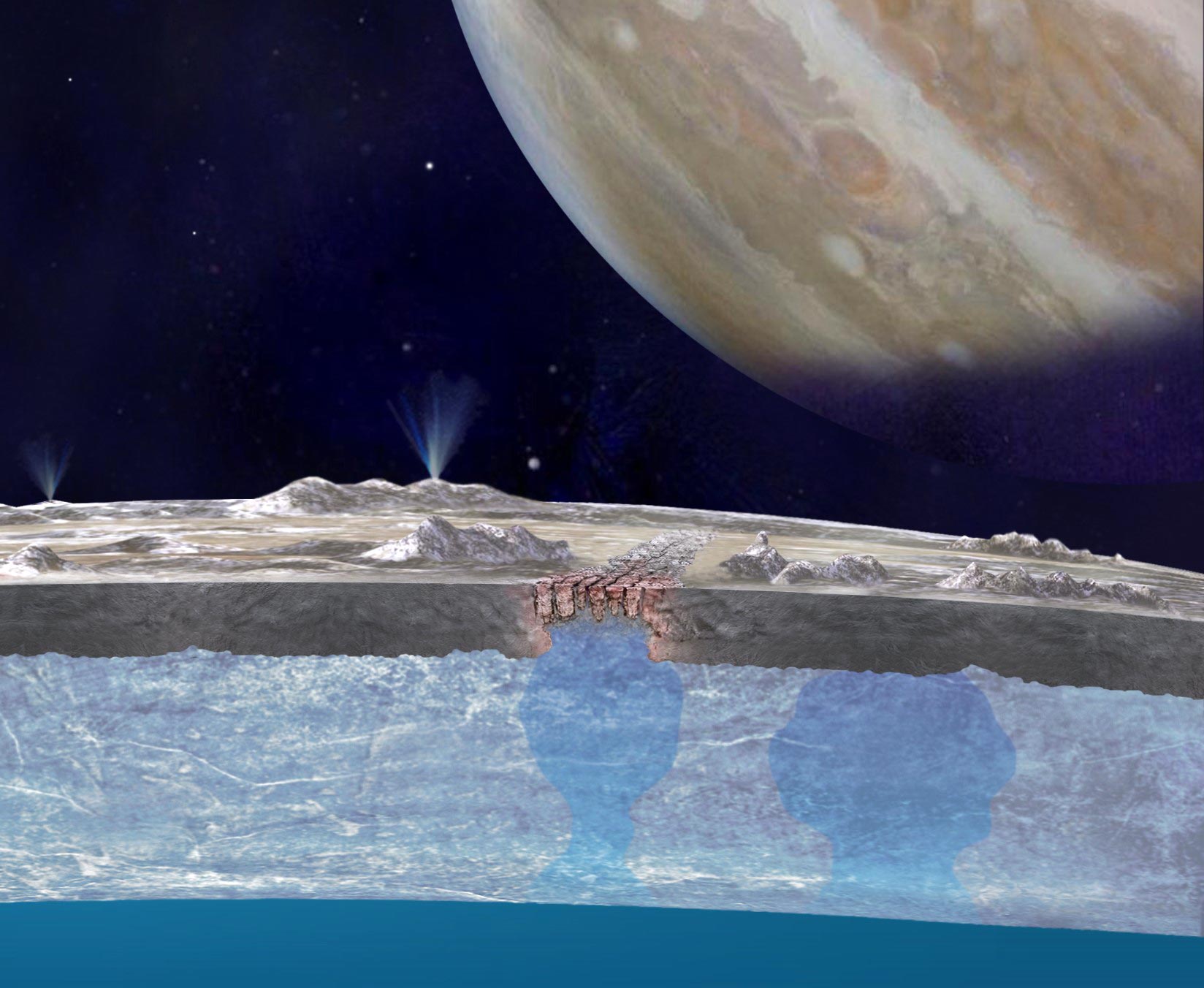
New research suggests that oxygen from Europa’s surface may reach its subsurface ocean via briny pools in the icy shell, possibly supporting life. NASA’s Europa Clipper mission, set to launch in 2024, will carry instruments designed to explore this oxygen transport and assess the moon’s habitability.
Jupiter’s moon Europa is a prime candidate in the search for life. The frozen moon has a subsurface ocean, and evidence indicates it’s warm, salty, and rich in life-enabling chemistry.
New research shows that the moon is pulling oxygen down below its icy shell, where it could be feeding simple life.
Whether or not Europa can sustain life in its subsurface ocean is highly debatable, and the debate is essentially stuck in neutral until NASA sends the Europa Clipper there. The mission to Europa has to be meticulously designed, and NASA bases part of the design on what specific questions scientists want the Clipper to address. We can’t send a spacecraft to Europa and tell it to find life.
NASA designs missions with big questions in mind, but they can only answer smaller, specific questions. So scientists are studying different aspects of Europa and performing simulations to fine-tune the questions they need the mission to ask.
Oxygen is at the heart of one of those questions. It might be the final piece in understanding Europa’s habitability.
Europa’s Potential Ingredients for Life
Europa has, or we think it has, most of what life needs to sustain itself. Water is the prime ingredient, and it has an abundance of water in its subsurface ocean. Europa has more water than Earth’s oceans. It also has the required chemical nutrients. Life needs energy, and Europa’s energy source is tidal flexing from Jupiter, which heats its interior and stops the ocean from freezing solid. These are pretty well-established facts to most scientists.
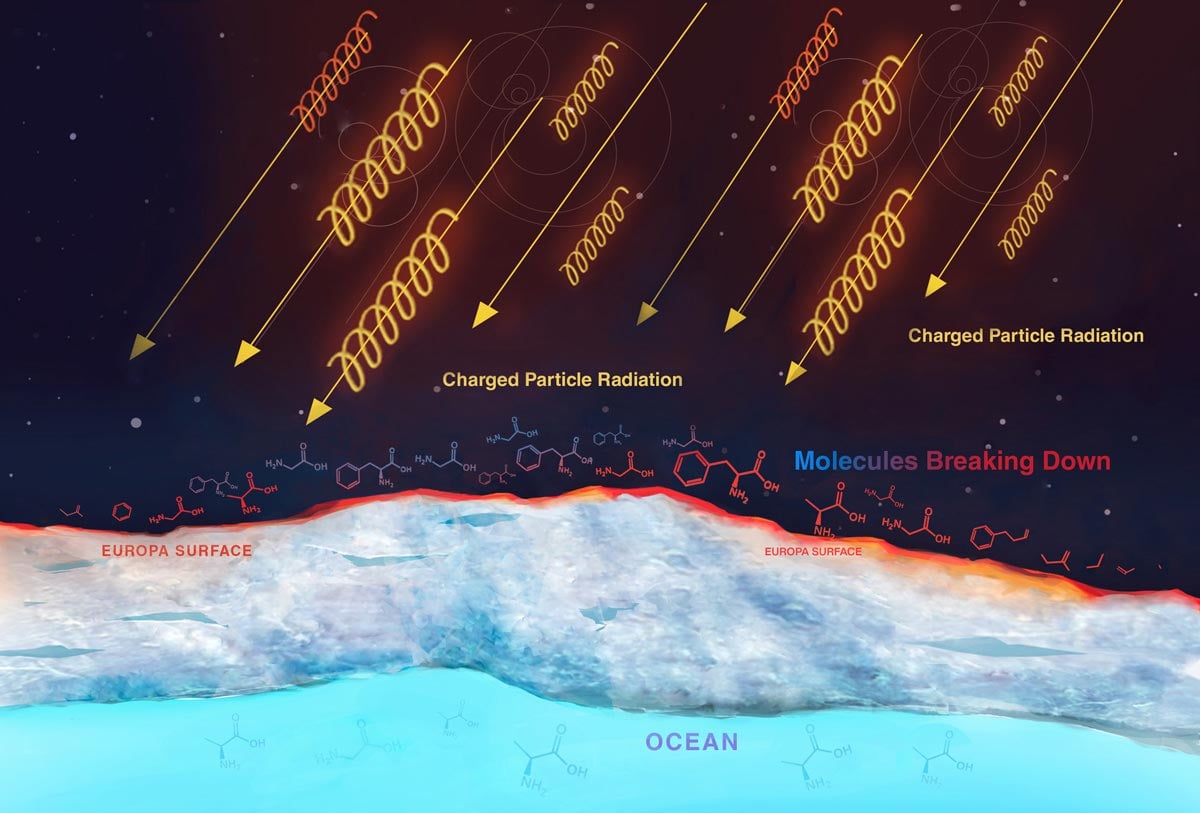
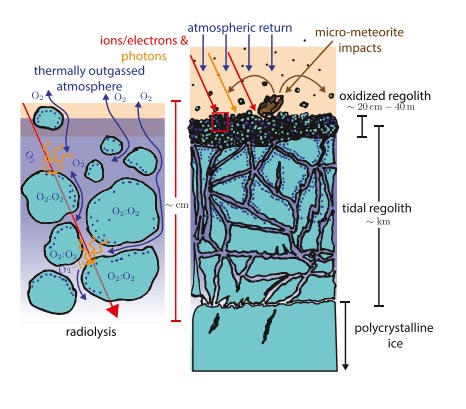
The frozen moon also has oxygen at its surface, another intriguing hint of habitability. The oxygen is generated when sunlight and charged particles from Jupiter strike the moon’s surface. But there’s a problem: Europa’s thick ice sheet is a barrier between oxygen and the ocean. Europa’s surface is frozen solid, so any life would have to be in its vast ocean.
How can oxygen make its way from the surface to the ocean?
Briny Pools and Oxygen Transport
According to a new research letter, pools of saltwater in Europa’s icy shell could be transporting the oxygen from the surface to the ocean. The research letter is “Downward Oxidant Transport Through Europa’s Ice Shell by Density-Driven Brine Percolation,” published in the journal Geophysical Research Letters. The lead author is Marc Hesse, a professor at the UT Jackson School of Geosciences Department of Geological Sciences.
These briny pools exist in places in the shell where some ice melts due to convection currents in the ocean. Europa’s famous and photogenic chaos terrain forms above these pools.
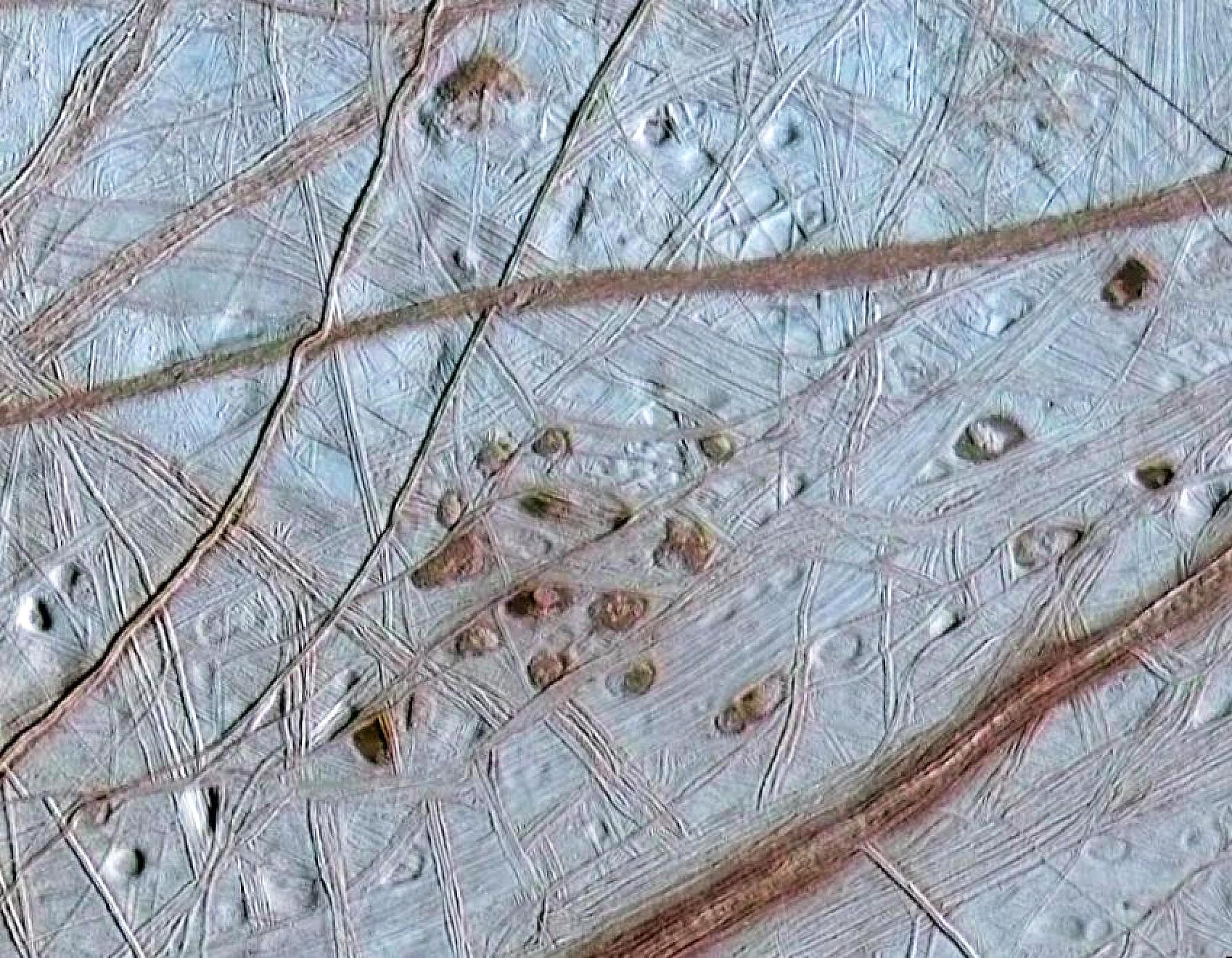
Chaos terrain covers about 25% of Europa’s frozen surface. Chaos terrain is where ridges, cracks, faults, and plains are jumbled together. There’s no clear understanding of the exact causes of chaos terrain, though it’s likely related to uneven subsurface heating and melting. Some of Europa’s most iconic images highlight this strangely beautiful feature.
Scientists think Europa’s ice sheet is about 15 to 25 km (10 to 15 miles) thick. A 2011 study found that chaos terrain on Europa may be located above vast lakes of liquid water as little as 3 km (1.9 miles) below the ice. These lakes aren’t directly connected to the subsurface ocean but can drain into them. According to this new study, the briny lakes can mix with surface oxygen and over time, can deliver large quantities of oxygen to the deeper subsurface ocean.
“Our research puts this process into the realm of the possible,” said Hesse. “It provides a solution to what is considered one of the outstanding problems of the habitability of the Europa subsurface ocean.”
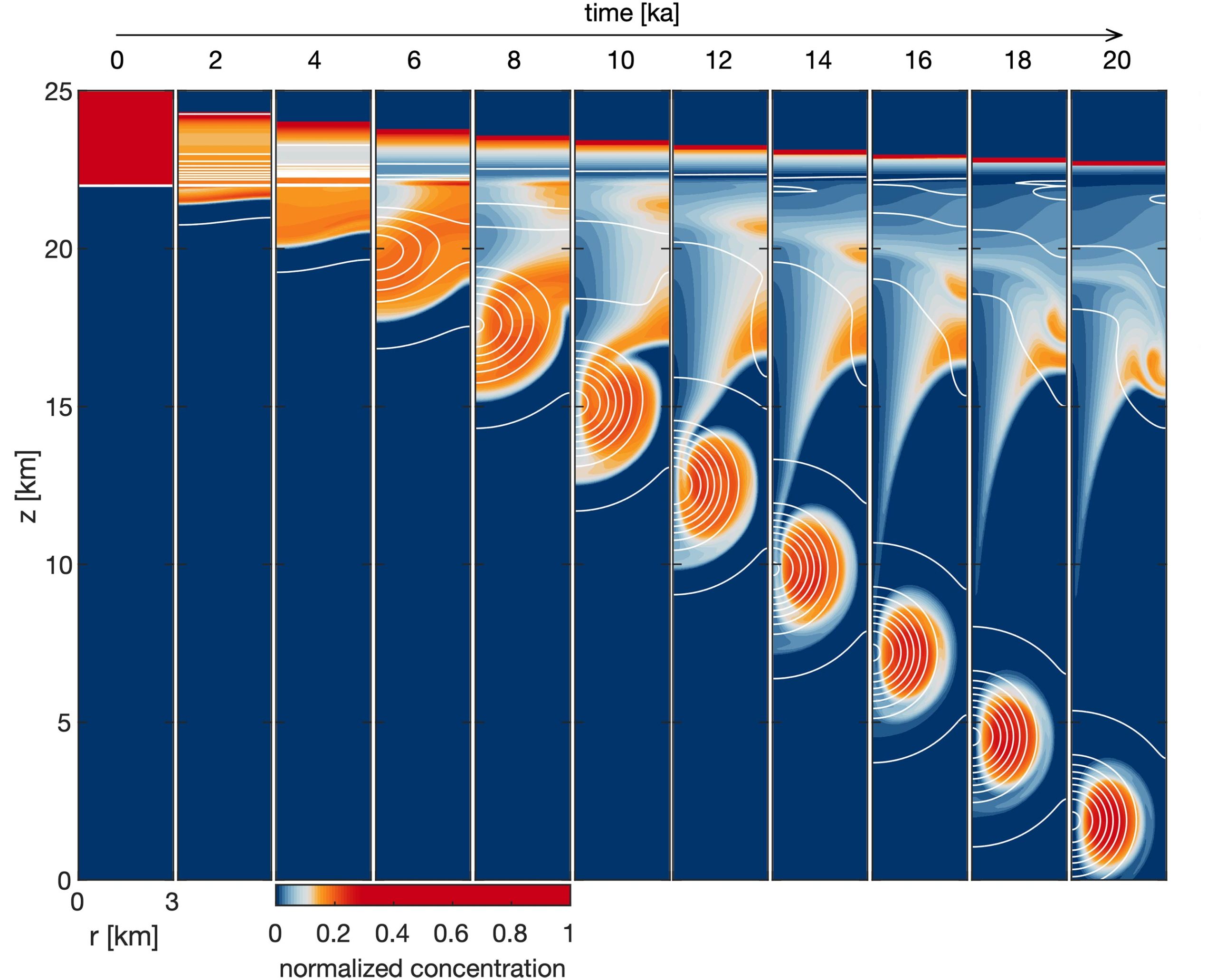
The researchers showed how oxygen is transported through the ice in their simulation. The oxygen-laden brine moves to the subsurface ocean in a porosity wave. A porosity wave transports the brine through the ice by momentarily widening the pores in the ice before quickly sealing up again. Over thousands of years, these porosity waves transport the oxygen-rich brine to the ocean.
Chaos Terrain and Tidal Heating’s Role in Oxygen Movement
The relationship between chaos terrain and oxygen transport is not completely clear. But scientists think that convective upwellings caused by tidal heating partially melt the ice, manifesting as the jumbled chaos terrain on the surface. The ice under the brine must be molten or partially molten for the oxygen-rich brine to drain into the ocean. “For these brines to drain, the underlying ice must be permeable and thus partially molten. Previous studies show that tidal heating increases the temperature of upwellings in the convecting portion of Europa’s ice shell to the melting point of pure ice,” the authors write.
“Given that chaotic terrains likely form over diapiric upwellings, it is plausible that the underlying ice is partially molten,” the letter says. The presence of NaCl in the connecting ice likely increases the melt.
Europa’s surface is bitterly cold but not cold enough to refreeze so quickly that oxygen can’t be transported in brines. At the moon’s poles, the temperature never rises above minus 220 C (370 F). But the model’s results “… demonstrate that refreezing at the surface is too slow to arrest the drainage of the brine and prevent oxidant delivery to the internal ocean.” Though Europa’s surface ice is frozen solid, the ice under it is convective, which delays freezing. And some research shows that the seafloor may be volcanic.

The study says that about 86% of the oxygen taken up at Europa’s surface makes it to the ocean. Over the moon’s history, that percentage could have shifted widely. But the highest estimate produced by the researchers’ model creates an oxygen-rich ocean very similar to Earth’s. Could something be living under the ice?

“It’s enticing to think of some kind of aerobic organisms living just under the ice,” said co-author Steven Vance, a research scientist at NASA’s Jet Propulsion Laboratory (JPL) and the supervisor of its Planetary Interiors and Geophysics Group.
Kevin Hand is one of the many scientists keenly interested in Europa, its potential for life, and the upcoming Europa Clipper mission. Hand is a NASA/JPL scientist whose work focuses on Europa. He’s hopeful that Hesse and his fellow researchers have solved the problem of oxygen in the frozen moon’s oceans.
“We know that Europa has useful compounds like oxygen on its surface, but do those make it down into the ocean below, where life can use them?” he asked. “In the work by Hesse and his collaborators, the answer seems to be yes.”
What questions can the Europa Clipper ask that might confirm these findings?
TEuropa Clipper’s Mission and Objectives
he Clipper is the first mission dedicated to Europa. We think we know many things about Europa that we haven’t been able to confirm. The Clipper is designed to address three larger objectives:
- Investigate the ocean’s composition to determine if it has the necessary components to sustain life.
- Investigate the moon’s geology to understand how the surface formed, including the chaos terrain.
- Determine the ice shell’s thickness and if there’s liquid water within and beneath it. They also will determine how the ocean interacts with the surface: Does anything in the ocean rise through the shell to the top? Does any material from the surface work its way down into the ocean?
That last point speaks to the potential transport of oxygen from the surface to the ocean. The Europa Clipper will carry ten instruments that will work together to address these questions.
The MAss SPectrometer for Planetary EXploration/Europa (MASPEX) is particularly interesting when it comes to oxygen transport on Europa.
“MASPEX will gain crucial answers from gases near Europa, such as the chemistry of Europa’s surface, atmosphere, and suspected ocean,” the instrument’s web page explains. “MASPEX will study how Jupiter’s radiation alters Europa’s surface compounds and how the surface and ocean exchange material.”
MASPEX, and the rest of Europa Clipper’s instruments, might confirm oxygen transport from the surface to the ocean, where life could use it if life exists there. But we’ll have to wait a while. Europa Clipper is scheduled to launch in October 2024 and won’t reach the Jupiter system until 5.5 years later. Once there, its science phase is expected to last four years. So it could be 2034 before we have all the data.
In the meantime, research like this will whet our appetites.
Adapted from an article originally published on Universe Today.
For more information see “Chaos Terrains” Could Be Shuttling Oxygen to Ocean on Jupiter’s Moon Europa.
Reference: “Downward Oxidant Transport Through Europa’s Ice Shell by Density-Driven Brine Percolation” by Marc A. Hesse, Jacob S. Jordan, Steven D. Vance and Apurva V. Oza, 10 February 2022, Geophysical Research Letters.
DOI: 10.1029/2021GL095416
Never miss a breakthrough: Join the SciTechDaily newsletter.
Follow us on Google and Google News.
2 Comments
“Lime and limpid green, a second scene
Now fights between the blue you once knew
Floating down, the sound resounds
Around the icy waters underground.”
“Astronomy Domine” by Pink Floyd
Interesting