
An unusual surge in plant productivity may signal impending severe soil water loss. NASA satellites track this subtle glow, offering early warnings of potential flash droughts across diverse landscapes.
Flaring up rapidly and with little warning, the drought that gripped much of the United States in the summer of 2012 was one of the most extensive the country had seen since the yearslong Dust Bowl of the 1930s. The “flash drought,” stoked by extreme heat that baked the moisture from soil and plants, led to widespread crop failure and economic losses costing more than $30 billion.
While archetypal droughts may develop over seasons, flash droughts are marked by rapid drying. They can take hold within weeks and are tough to predict. In a recent study, a team led by scientists from NASA’s Jet Propulsion Laboratory (JPL) in Southern California was able to detect signs of flash droughts up to three months before onset. In the future, such advance notice could aid mitigation efforts.
How did they do it? By following the glow.
A Signal Seen From Space
During photosynthesis, when a plant absorbs sunlight to convert carbon dioxide and water into food, its chlorophyll will “leak” some unused photons. This faint glow is called solar-induced fluorescence, or SIF. The stronger the fluorescence, the more carbon dioxide a plant is taking from the atmosphere to power its growth.
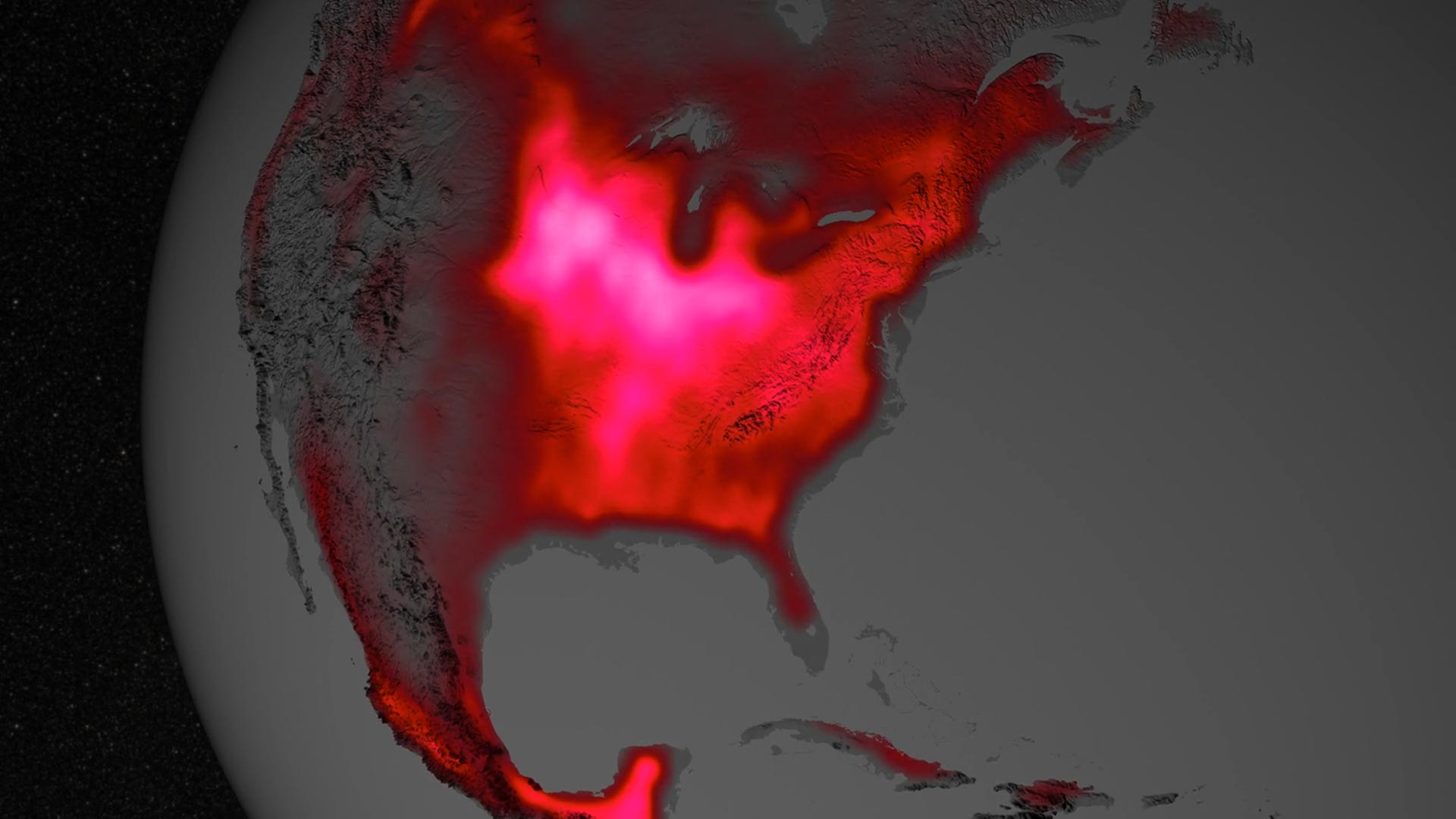
While the glow is invisible to the naked eye, it can be detected by instruments aboard satellites such as NASA’s Orbiting Carbon Obsevatory-2 (OCO-2). Launched in 2014, OCO-2 has observed the U.S. Midwest aglow during the growing season.
Growing plants emit a form of light detectable by NASA satellites orbiting hundreds of miles above Earth. Parts of North America appear to glimmer in this visualization, depicting an average year. Gray indicates regions with little or no fluorescence; red, pink, and white indicate high fluorescence. Credit: NASA’s Scientific Visualization Studio
The researchers compared years of fluorescence data to an inventory of flash droughts that struck the U.S. between May and July from 2015 to 2020. They found a domino effect: In the weeks and months leading up to a flash drought, vegetation initially thrived as conditions turned warm and dry. The flourishing plants emitted an unusually strong fluorescence signal for the time of year.
But by gradually drawing down the water supply in the soil, the plants created a risk. When extreme temperatures hit, the already low moisture levels plummeted, and flash drought developed within days.
The team correlated the fluorescence measurements with moisture data from NASA’s SMAP satellite. Short for Soil Moisture Active Passive, SMAP tracks changes in soil water by measuring the intensity of natural microwave emissions from Earth’s surface.
The scientists found that the unusual fluorescence pattern correlated extremely well with soil moisture losses in the six to 12 weeks before a flash drought. A consistent pattern emerged across diverse landscapes, from the temperate forests of the Eastern U.S. to the Great Plains and Western shrublands.
For this reason, plant fluorescence “shows promise as a reliable early warning indicator of flash drought with enough lead time to take action,” said Nicholas Parazoo, an Earth scientist at JPL and lead author of the recent study.
Jordan Gerth, a scientist with the National Weather Service Office of Observations who was not involved in the study, said he was pleased to see work on flash droughts, given our changing climate. He noted that agriculture benefits from predictability whenever possible.
While early warning can’t eliminate the impacts of flash droughts, Gerth said, “farmers and ranchers with advanced operations can better use water for irrigation to reduce crop impacts, avoid planting crops that are likely to fail, or plant a different type of crop to achieve the most ideal yield if they have weeks to months of lead time.”
Tracking Carbon Emissions
In addition to trying to predict flash droughts, the scientists wanted to understand how these impact carbon emissions.
By converting carbon dioxide into food during photosynthesis, plants and trees are carbon “sinks,” absorbing more CO2 from the atmosphere than they release. Many kinds of ecosystems, including farmlands, play a role in the carbon cycle — the constant exchange of carbon atoms between the land, atmosphere, and ocean.
The scientists used carbon dioxide measurements from the OCO-2 satellite, along with advanced computer models, to track carbon uptake by vegetation before and after flash droughts. Heat-stressed plants absorb less CO2 from the atmosphere, so the researchers expected to find more free carbon. What they found instead was a balancing act.
Warm temperatures prior to the onset of flash drought tempted plants to increase their carbon uptake compared to normal conditions. This anomalous uptake was, on average, sufficient to fully offset decreases in carbon uptake due to the hot conditions that ensued. The surprising finding could help improve carbon cycle model predictions.
Celebrating its 10th year in orbit this summer, the OCO-2 satellite maps natural and human-made carbon dioxide concentrations and vegetation fluorescence using three camera-like spectrometers tuned to detect the unique light signature of CO2. They measure the gas indirectly by tracking how much reflected sunlight it absorbs in a given column of air.
Reference: “Antecedent Conditions Mitigate Carbon Loss During Flash Drought Events” by Nicholas Parazoo, Mahmoud Osman, Madeleine Pascolini-Campbell and Brendan Byrne, 24 April 2024, Geophysical Research Letters.
DOI: 10.1029/2024GL108310
Never miss a breakthrough: Join the SciTechDaily newsletter.
Follow us on Google and Google News.