
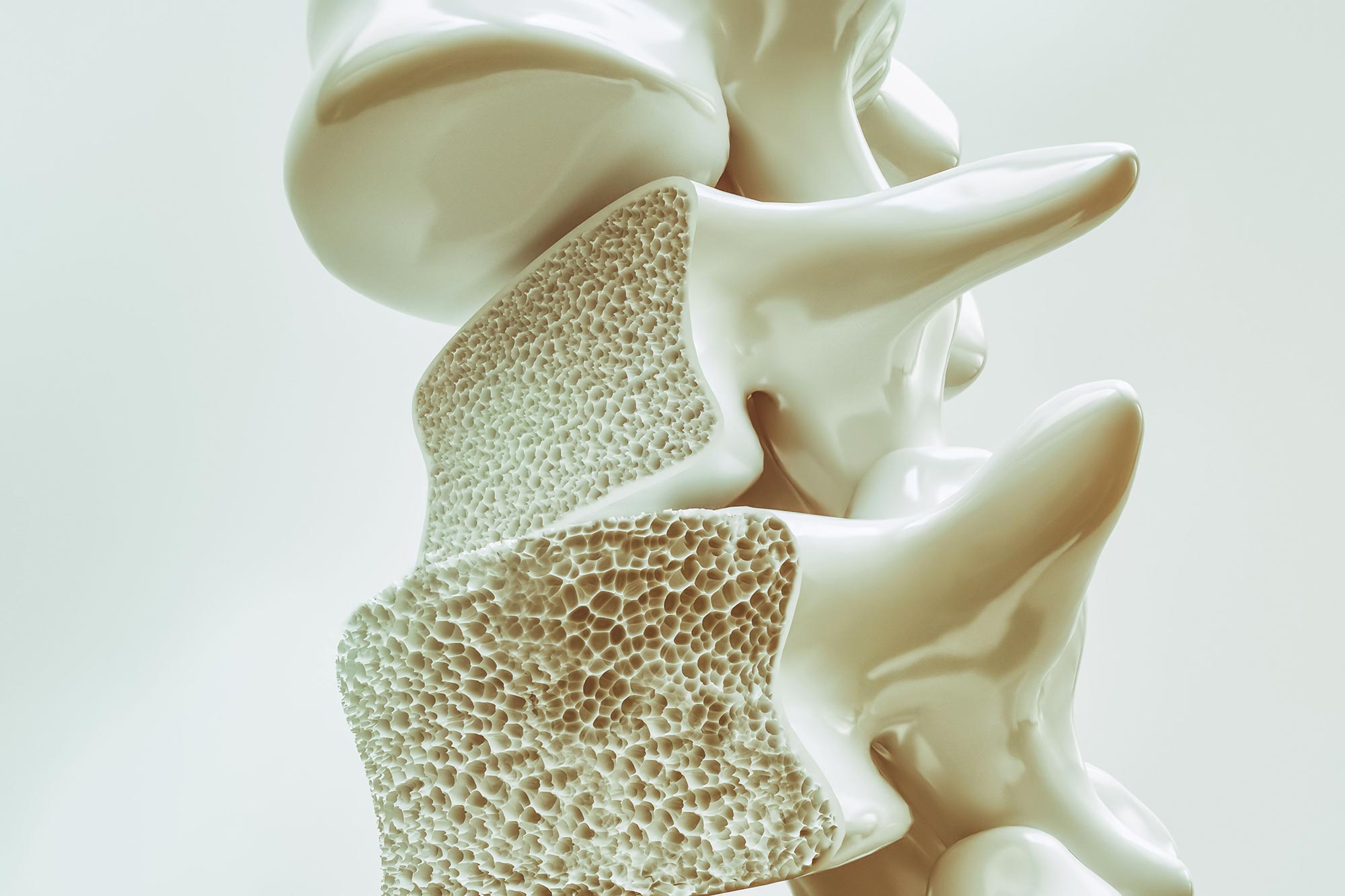
Dr. Christine Swanson, MD, MCR, is investigating the link between inadequate sleep and bone disease.
During the University of Colorado Department of Medicine’s annual Research Day on April 23, faculty member Christine Swanson, MD, MCR, presented her National Institutes of Health-funded clinical research on whether adequate sleep can help prevent osteoporosis.
“Osteoporosis can occur for many reasons such as hormonal changes, aging, and lifestyle factors,” said Swanson, an associate professor in the Division of Endocrinology, Metabolism, and Diabetes. “But some patients I see don’t have an explanation for their osteoporosis.
“Therefore, it’s important to look for novel risk factors and consider what else changes across the lifespan like bone does — sleep is one of those,” she added.
How bone density and sleep change over time
In people’s early- to mid-20s, they reach what is called peak bone mineral density, which is higher for men than it is for women, Swanson said. This peak is one of the main determinants of fracture risk later in life.
After reaching this peak, a person’s bone density remains roughly stable for a couple of decades. Then, when women enter the menopausal transition, they experience accelerated bone loss. Men also experience bone density decline as they age.
Sleep patterns also evolve over time. As people get older, their total sleep time decreases, and their sleep composition changes. For instance, sleep latency, which is the time it takes to fall asleep, increases with age. On the other hand, slow-wave sleep, which is deep restorative sleep, decreases as we age.
“And it’s not just sleep duration and composition that change. Circadian phase preference also changes across the lifespan in both men and women,” Swanson said, referring to people’s preference for when they go to sleep and when they wake up.
How can sleep relate to our bone health?
Genes that control our internal clock are present in all of our bone cells, Swanson said.
“When these cells resorb and form bone, they release certain substances into the blood that let us estimate how much bone turnover is going on at a given time,” she said.
These markers of bone resorption and formation follow a daily rhythm. The amplitude of this rhythm is larger for markers of bone resorption — which refers to the process of breaking down bones — than it is for markers of bone formation, she said.
“This rhythmicity is likely important for normal bone metabolism and suggests that sleep and circadian disturbance could directly affect bone health,” she said.
Researching the connection between sleep and bone health
To further understand this relationship, Swanson and colleagues researched how markers of bone turnover responded to cumulative sleep restriction and circadian disruption.
For this study, participants lived in a completely controlled inpatient environment. The participants did not know what time it was, and they were put on a 28-hour schedule instead of a 24-hour day.
“This circadian disruption is designed to simulate the stresses endured during rotating night shift work and is roughly equivalent to flying four time zones west every day for three weeks,” she said. “The protocol also caused participants to get less sleep.”
The research team measured bone turnover markers at the beginning and end of this intervention and found significant detrimental changes in bone turnover in both men and women in response to sleep and circadian disruption. The detrimental changes included declines in markers of bone formation that were significantly greater in younger individuals in both sexes compared to the older individuals.
In addition, young women showed significant increases in the bone resorption marker.
If a person is forming less bone while still resorbing the same amount — or even more — then, over time, that could lead to bone loss, osteoporosis, and increased fracture risk, Swanson said.
“And sex and age may play an important role, with younger women potentially being the most susceptible to the detrimental impact of poor sleep on bone health,” she said.
Research in this area is ongoing, she added.
Never miss a breakthrough: Join the SciTechDaily newsletter.
Follow us on Google and Google News.
1 Comment
As a now eighty year old former industrial electrician who more often than desired (except for financial reasons) worked a lot of overtime, seven-day weeks and various shifts, mostly troubleshooting breakdowns on production lines, I can attest to shift work being disruptive and stressful, especially when required to work the ‘graveyard’ shift (great difficulty sleeping during the day). However, most of my problems with sleep began with formerly undiagnosed food allergies aggravated with toxic FDA approved food additives, namely added MSG since 1980, resulting in me learning of my multiple very, very mild food allergies in late 1981.
Never tested for any “…bone turnover markers…,” by 2013 ultrasound bone density testing indicated I was already ‘at moderate risk of osteoporosis,’ primarily for two reasons: 1) allergen avoidance practices and 2) standard blood serum testing for calcium is unreliable (learned in late 2010). By mid-March of 2021 supplementation with high dose liquid calcium carbonate (now known by me to bind with phosphorus causing it to be excreted) capsules resulted in another ultrasound in 2023 advising ‘requires further attention,’ due to a new to me very serious phosphorus deficiency, again for two reasons: 1) no doctor ever informed me that calcium carbonate binds with phosphorus and none of the three healthcare providers I went to for check-ups even tested me for phosphorus, for about a decade. I think to best answer the question “How can sleep relate to our bone health?,” researchers should first rule-out the possibility of very, very mild allergy reactions aggravated (or not) with toxic food additives causing nutritional losses, insomnia and poor sleep, especially in mothers (e.g., higher calcium demands during pregnancy). Also, it probably would be a good idea to suggest that the NIH review it’s funded research of all chronic diseases for the commonalities of food allergies and toxic food additives.