

Close Menu
    Facebook X (Twitter) Instagram
    SciTechDaily
    • Biology
    • Chemistry
    • Earth
    • Health
    • Physics
    • Science
    • Space
    • Technology
    Facebook X (Twitter) Pinterest YouTube RSS
    SciTechDaily
    Home»Health»Highly Contagious Coronavirus Variant Spread Across the Globe – Undetected for Months – Before Its Discovery
    Health

    Highly Contagious Coronavirus Variant Spread Across the Globe – Undetected for Months – Before Its Discovery

    By University of Texas at AustinApril 1, 2021No Comments4 Mins Read
    Facebook Twitter Pinterest Telegram LinkedIn WhatsApp Email Reddit
    Share
    Facebook Twitter LinkedIn Pinterest Telegram Email Reddit
    Infectious Disease Testing
    A highly contagious SARS-CoV-2 variant B117 (501Y) had spread across the globe undetected for months when scientists discovered it

    B117 Spread in U.S. Months Before Detection

    A highly contagious SARS-CoV-2 variant was unknowingly spreading for months in the United States by October 2020, according to a new study from researchers with The University of Texas at Austin COVID-19 Modeling Consortium. Scientists first discovered it in early December in the United Kingdom, where the highly contagious and more lethal variant is thought to have originated. The journal Emerging Infectious Diseases, which has published an early-release version of the study, provides evidence that the coronavirus variant B117 (501Y) had spread across the globe undetected for months when scientists discovered it.

    “By the time we learned about the U.K. variant in December, it was already silently spreading across the globe,” said Lauren Ancel Meyers, the director of the COVID-19 Modeling Consortium at The University of Texas at Austin and a professor of integrative biology. “We estimate that the B117 variant probably arrived in the U.S. by October of 2020, two months before we knew it existed.”
    SARS-CoV-2 Variants
    A highly contagious SARS-CoV-2 variant was unknowingly spreading for months in the United States by October 2020, according to a new study from researchers with The University of Texas at Austin COVID-19 Modeling Consortium. Credit: Jenna Luecke/University of Texas at Austin

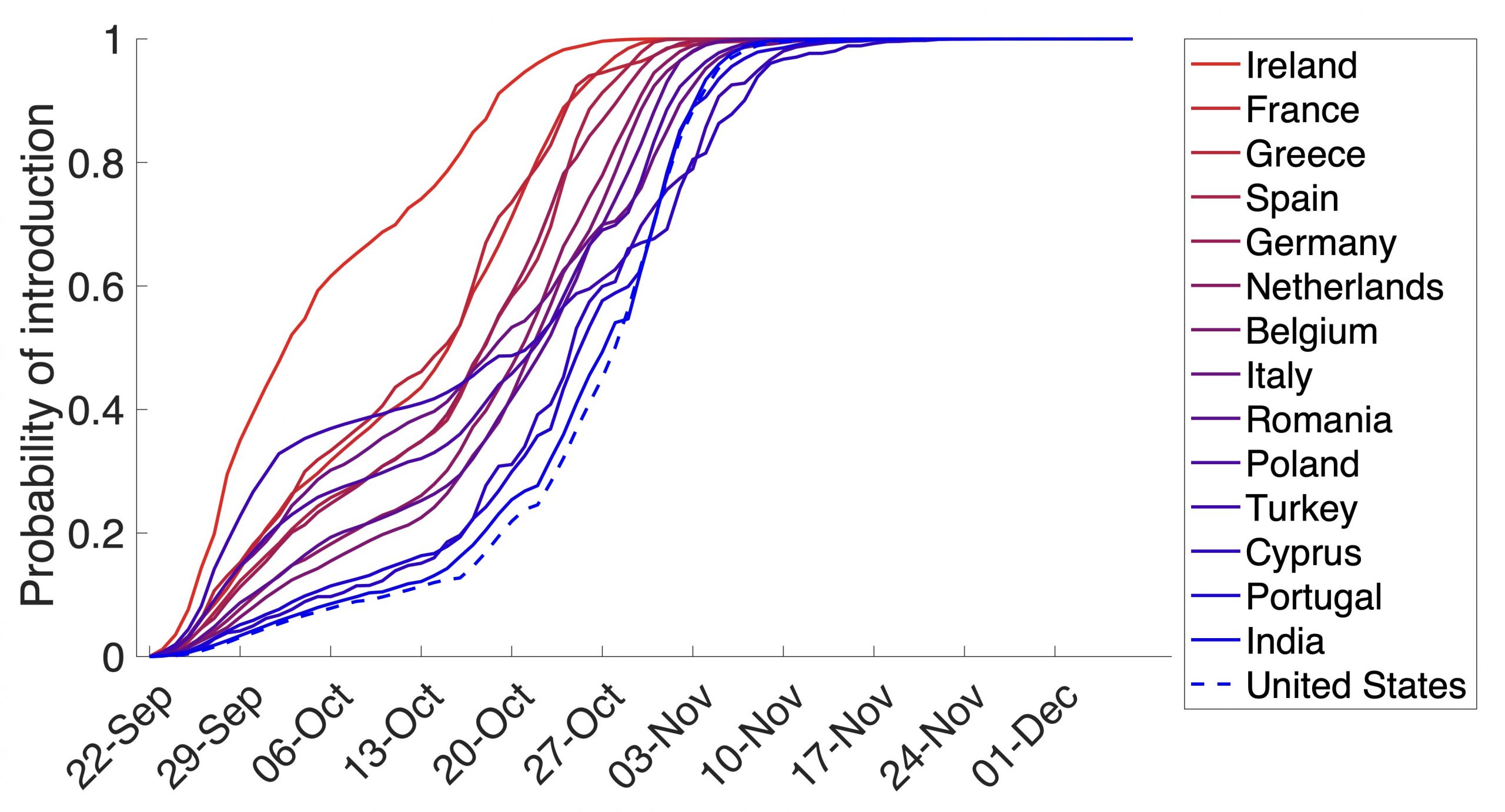
    Analyzing data from 15 countries, researchers estimated the chance that travelers from the U.K. introduced the variant into 15 countries between September 22 and December 7, 2020. They found that the virus variant had almost certainly arrived in all 15 countries by mid-November. In the U.S., the variant probably had arrived by mid-October.

    The Need for Robust Genetic Surveillance

    “This study highlights the importance of laboratory surveillance,” Meyers said. “Rapid and extensive sequencing of virus samples is critical for early detection and tracking of new variants of concern.”

    In conjunction with the paper’s publication, consortium members developed a new tool that decision-makers anywhere in the United States can use in planning for genetic sequencing that helps to detect the presence of variants. To help the U.S. expand national surveillance of variants, the new online calculator indicates the number of virus samples that must be sequenced in order to detect new variants when they first emerge. For example, if the goal is to detect an emerging variant by the time it is causing 1 out of every 1,000 new COVID-19 infections, approximately 3,000 SARS-CoV-2 positive specimens per week need to be sequenced.
    Arrival of the Coronavirus Variant B117
    Analyzing data from 15 countries, researchers estimated the chance that travelers from the U.K. introduced the variant into 15 countries between September 22 and December 7, 2020. They found that the coronavirus variant B117 (501Y) had almost certainly arrived in all 15 countries by mid-November. In the U.S., the variant probably had arrived by mid-October. Credit: University of Texas COVID-19 Modeling Consortium

    “Health officials are looking for better ways to manage the unpredictability of this virus and future variants,” said Spencer Woody, a postdoctoral fellow at the UT COVID-19 Modeling Consortium. “Our new calculator determines how many positive SARS-CoV-2 specimens must be sequenced to ensure that new threats are identified as soon as they start spreading.”

    He explained that the calculator has a second feature. “It also helps labs figure out how quickly they will detect new variants, given their current sequencing capacity.”

    “We created this tool to support federal, state, and local health officials in building credible early warning systems for this and future pandemic threats,” Meyers said.

    More detailed information on the calculator is here.

    Reference: “Risk for International Importations of Variant SARS-CoV-2 Originating in the United Kingdom” by Zhanwei Du, Lin Wang, Bingyi Yang, Sheikh Taslim Ali, Tim K. Tsang, Songwei Shan, Peng Wu, Eric H.Y. Lau, Benjamin J. Cowling and Lauren Ancel Meyers, 24 March 2021, Emerging Infectious Diseases.
    DOI: 10.3201/eid2705.210050

    In addition to Meyers, authors of the Emerging Infectious Disease paper are Zhanwei Du, Bingyi Yang, Sheikh Taslim Ali, Tim K. Tsang, Songwei Shan, Peng Wu, Eric H.Y. Lau and Benjamin J. Cowling of the WHO Collaborating Centre for Infectious Disease Epidemiology and Control in Hong Kong and Lin Wang of the University of Cambridge.

    The research was funded by Hong Kong’s Health and Medical Research Fund, the National Institutes of Health and the Centers for Disease Control and Prevention.

    Meyers holds the Denton A. Cooley Centennial Professorship at The University of Texas at Austin.

    Never miss a breakthrough: Join the SciTechDaily newsletter.
    Follow us on Google and Google News.

    COVID-19 Evolution Infectious Diseases Popular Public Health University of Texas at Austin Virology
    Share. Facebook Twitter Pinterest LinkedIn Email Reddit

    Related Articles

    Increased Infectivity Drives COVID Evolution – Mutations That Allow the Virus To Escape Vaccines Become Dominant

    What Is Causing All These New Coronavirus Variants? Is It the COVID–19 Vaccines?

    UK, South African, Brazilian: A Virologist Explains Each COVID Variant

    SARS-CoV-2 Could Evolve Resistance, Rendering COVID-19 Vaccines Ineffective

    Coronavirus Mutation Concern Verified by Largest COVID-19 Viral Sequence Analysis in U.S.

    It’s Evolving: Coronavirus Genetic Mutation May Have Made COVID-19 More Contagious

    Far-UVC Light Safely Kills 99.9% of Airborne Coronaviruses

    How COVID-19 Kills: New Study Explains the Mechanisms of the New Coronavirus

    Vitamin D Linked to Low Coronavirus Death Rate

    Leave A Reply Cancel Reply

    • Facebook
    • Twitter
    • Pinterest
    • YouTube

    Don't Miss a Discovery

    Subscribe for the Latest in Science & Tech!

    Trending News

    289-Million-Year-Old Reptile Mummy Reveals Origin of Human Breathing System

    New Brain Discovery Challenges Long-Held Theory of Teenage Brain Development

    Scientists Discover Plants “Scream” – We Just Couldn’t Hear Them Until Now

    Scientists Discover a Surprising Reason Intermittent Fasting Extends Life

    This Simple Fruit Wash Could Make Produce Safer and Last Days Longer

    Scientists Say Adding This Unusual Seafood to Your Diet Could Reverse Signs of Aging

    Scientists Say a Hidden Structure May Exist Inside Earth’s Core

    Doctors Surprised by the Power of a Simple Drug Against Colon Cancer

    Follow SciTechDaily
    • Facebook
    • Twitter
    • YouTube
    • Pinterest
    • Newsletter
    • RSS
    SciTech News
    • Biology News
    • Chemistry News
    • Earth News
    • Health News
    • Physics News
    • Science News
    • Space News
    • Technology News
    Recent Posts
    • Missing Medieval Relic of Legendary English King Found After Being Missing for 40 Years
    • New Study Challenges Long-Held Assumptions About Cancer and Aging
    • Major Review Finds Alzheimer’s Amyloid Drugs Offer No Real Benefit
    • Could This New Weight-Loss Pill Disrupt the Entire Market? Here’s What You Should Know About Orforglipron
    • Nearly 1 in 5 Gray Whales That Enter San Francisco Bay Die There
    Copyright © 1998 - 2026 SciTechDaily. All Rights Reserved.
    • Science News
    • About
    • Contact
    • Editorial Board
    • Privacy Policy
    • Terms of Use

    Type above and press Enter to search. Press Esc to cancel.