
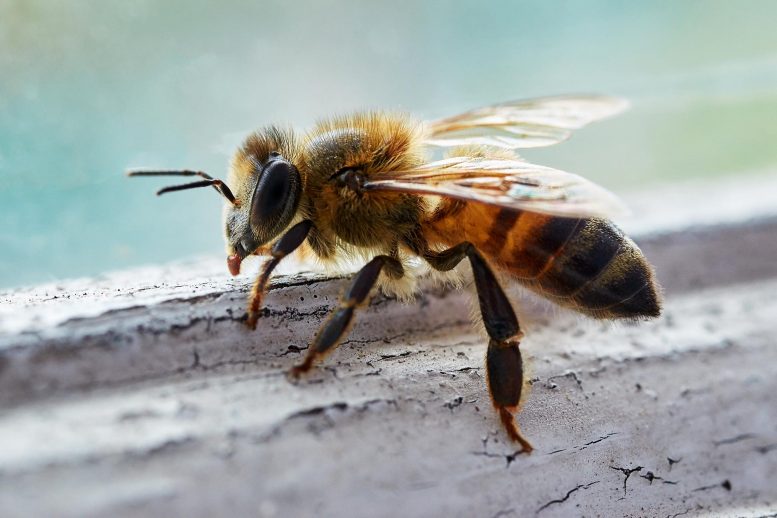
Researchers found higher venom quality linked to more aggressive bee behavior and optimal temperature ranges.
Researchers at Curtin revealed how behavioral and ecological factors influence the quality of bee venom, a product widely known for its effective treatment of degenerative and infectious diseases such as Parkinson’s and osteoarthritis.
The study, published in PLOS, analyzed – for the first time – protein diversity in bee venom produced by the western honeybee in the marri ecosystem in southern-western Australia.
Richer Protein Profiles Found in Aggressive Bees
Lead researcher Dr. Daniela Scaccabarozzi, from Curtin’s School of Molecular and Life Sciences and research consultant at ChemCentre, said the research would be of substantial benefit to both human health and the lucrative beekeeping business, where bee venom is being sold for up to $300 per gram.
“We found there are 99 bee venom proteins of which about one-third had been formerly identified. The more proteins found in the venom, the higher the potential quality and effect,” Dr. Scaccabarozzi said.
“To understand the protein diversity of bee venom and find out what drivers impacted this, the multidisciplinary research team looked at a range of factors including the behavioral patterns of the bees.
“A compelling behavioral factor was revealed by the association between docile and active bees. Interestingly, we discovered that the ‘angry bees’ that reacted intensively to our stimulating devices produced a richer, more protein-dense bee venom.
“The overall quantity of venom released by bees relies on the alarm pheromone secretion that induces other bees to aggressively react by stinging. This may be a result of changes in genetics that can provoke aggression in bees.”
Dr. Scaccabarozzi said the team also confirmed that temperature impacted the protein composition of the bee venom.
“High temperatures can be detrimental to bees’ activity in and out of the colonies. Of the 25 hives tested, we discovered that the sites with higher temperatures recorded lower venom production,” Dr. Scaccabarozzi said.
“This met our expectation that seasonal factors do cause a change in the protein profile of bee venom. The optimal range for high protein diversity varies from 33 to 36˚C (91 to 97˚F).”
Influence of Climate and Flora on Venom Profiles
Further findings also revealed that geographical location had an impact on the composition of bee venom, as well as what stage the flowers were at during harvest when they were consumed by the bees.
Dr. Scaccabarozzi said further research would help beekeepers collect a standardized quality of venom to meet growing demand in clinical and therapeutic fields, as well as help design cost-effective strategies for bee venom harvest to secure its position in the global market.
Bee venom from domesticated bees (Apis Mellifera Ligustica) was collected over the flowering season of Corymbia Calophylla (Marri) from 25 hives near Harvey in south-western Australia.
Reference: “Factors driving the compositional diversity of Apis mellifera bee venom from a Corymbia calophylla (marri) ecosystem, Southwestern Australia” by Daniela Scaccabarozzi, Kenneth Dods, Thao T. Le, Joel P. A. Gummer, Michele Lussu, Lynne Milne, Tristan Campbell, Ben Pan Wafujian and Colin Priddis, 30 June 2021, PLOS ONE.
DOI: 10.1371/journal.pone.0253838
The research project was managed by ChemCentre through a multidisciplinary Curtin research team, in conjunction with industry partner Australian Natural Biotechnology.
This study was funded by the Western Australian Department of Primary Industries Regional Development, Export Competitiveness Grants and by the Fight Food Waste Cooperative Research Centre (CRC).
Never miss a breakthrough: Join the SciTechDaily newsletter.
Follow us on Google and Google News.
1 Comment
The study would suggest then that being stung by a bee on a yearly basis, would have a beneficial effect overall, all for free as well.