
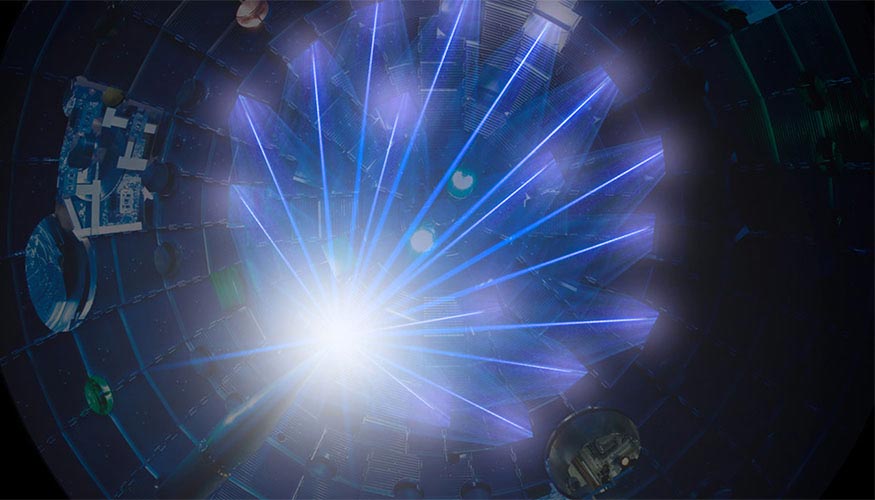
U.S. fusion energy efforts gain momentum, with LLNL and NIF at the center of a national plan for clean power by 2040.
An influential Department of Energy (DOE) advisory committee has recommended that the nation move aggressively toward the deployment of fusion energy, including investments in technology and equipment to support one of the core missions of LLNL’s National Ignition Facility (NIF) — laying the groundwork for the development of inertial fusion energy (IFE).
The report, Powering the Future: Fusion & Plasmas, was issued in December by the Fusion Energy Science Advisory Committee (FESAC). It was quickly followed by a February National Academies of Sciences, Engineering, and Medicine (NASEM) report calling for aggressive action to build a U.S. pilot fusion power plant as soon as 2035.
LLNL’s Role in Shaping Fusion’s 10-Year Strategy
The FESAC report, two years in the making, provides a decade-long vision for U.S. fusion energy and plasma science under the DOE Office of Science’s Fusion Energy Sciences (FES) program. NIF&PS physicist Tammy Ma, a member of FESAC and the report subcommittee, said LLNL was a major participant in the plasma physics community planning process that laid the foundation for the report’s 10-year strategic plan.
Both the FESAC and NASEM reports focus on the development of magnetic fusion energy (MFE) technology, exemplified by the ITER experiment in France; the United States is one of 35 nations participating in ITER, which is more than 70 percent complete and aiming for first plasma operations in 2025.
The reports, however, acknowledge the need for simultaneous pursuit of other government and private fusion technologies, including IFE, and the FESAC report notes the “enormous progress” NIF has made toward ignition. Both reports call for partnerships with federal, international and private investors and outline opportunities for growth in fusion and plasma research, which NIF is intently pursuing (see “10-Year Report Highlights NIF’s Contributions to Plasma Science.”)
“FES historically has funded the MFE research in the U.S., previously funded IFE, and supported the academic high energy density physics research in the U.S.,” Ma said. “While the total funds LLNL receives each year from FES is small compared to what we receive from NNSA (the National Nuclear Security Administration), the path that FES charts has always had a significant influence on the trajectory of fusion and plasma research at the Lab.
“This report now establishes a strong and coordinated plan for fusion energy and plasma science for the next 10 years in the U.S., and LLNL has an important role to play,” she said.
Budget-Sensitive Roadmap for Fusion Advancement
The FESAC report includes recommendations to FES and prioritizations for a research and technology development portfolio under three budget scenarios: constant, modest (2 percent) growth, and unconstrained.
Points and recommendations in the report relevant to LLNL’s work include:
- Restart an IFE program, even under the no-growth budget scenario.
- Continue robust funding of the high energy density laboratory plasmas (HEDLP) program that is co-sponsored with NNSA.
- Complete the design and construction of the Matter in Extreme Conditions
- (MEC) upgrade at SLAC National Accelerator Laboratory, which LLNL is supporting.
- Coordinate a High-Intensity Laser Research Initiative (FES in collaboration with other federal agencies).
- Pursue the development of a multi-petawatt (quadrillion-watt) laser facility and a U.S. high-repetition-rate high-intensity laser facility similar to the High-Repetition-Rate Advanced Petawatt Laser System (HAPLS), designed and developed by the NIF&PS Advanced Photon Technologies Program; HAPLS was delivered to the Extreme Light Infrastructure Beamlines Facility in the Czech Republic in June 2017.
- Strongly support LaserNetUS, with aggressive upgrades if budgets allow; LLNL’s Jupiter Laser Facility is a member of LaserNetUS, an effort to restore high-intensity laser research in the U.S.
- Pursue a fusion pilot plant in the U.S. by 2040.
- Strongly pursue alternate and innovative fusion concepts.
- Construct and design a mid-scale Z-pinch pulsed-power facility, preferably in partnership with other agencies; LLNL is currently developing a number of advanced diagnostics for the Z Machine at Sandia National Laboratories.
- Provide support for a robust public-private-partnership program.
“Even under the constant budget scenario,” Ma said, “provisions are made to ensure that these activities are supported somehow. New facilities cannot be built, but it is recommended to pursue pre-conceptual design activities and technology development.”
The DOE-sponsored NASEM report, Bringing Fusion to the U.S. Grid, describes the scientific and technical innovations required if fusion is to play a role in the timely transition to a low-carbon economy by 2050. The NASEM plan calls for production of a pilot plant design by 2028 and the addition of fusion energy to the electric grid in the 2035 to 2040 timeframe.
Virtually inexhaustible fusion energy could provide a source of clean, carbon-free baseline electricity for the U.S. grid, the report said, playing a key role as the nation decarbonizes its electricity-generation infrastructure. Fusion uses abundant hydrogen fuels and creates no long-lived or high-level radioactive waste. It is inherently safe and ideally complements other renewable sources of energy.
Never miss a breakthrough: Join the SciTechDaily newsletter.
Follow us on Google and Google News.
5 Comments
Is it just me or does that picture with the lasers look like the death star?
Why is Geothermal Energy technology not being funded at levels like this as well? I know its not as exciting as high powered lasers and balls of plasma, but with the decline of exploration and extraction of oil resources, repurposing and retooling idle drill rigs to drill a few miles into the Earth to harness the power of a planet seems like a much more attainable goal. Harnessing fusion is “sexy” but why continue to throw money after money into an empty hole, when that same hole would yeild an abundant, reliable and renewable source of energy via geothermal energy. Let’s be smart and use all our (Earth’s) resources effectively for the good of all humanity. Geothermal energy has to be a bigger part of the solution!
Geothermal has real limits to it’s exploitation, after heat is pumped up for awhile, the ground structure cools off, and less heat can be pumped up. This is covered in the book by Dr David Mackay, “Without the hot air” a very good textbook on energy for modern civilization.
It’s always about energy density, and geothermal energy density isn’t that great. Even ground source heating has limits esp in dense urban situations, unless it is matched to AC use putting back in the summer what is taken in the winter.
Our best bet is fission with Molten Salt reactors, completely walk away safe, no pressure, all the physicas works with the design instead of against, and the new best bit is completely variable electricity output on demand from hot salt storage tanks but fed by constant heat production. Moltex is one exasmple, Terrapower is another.
Has anyone considered using the attractive force of gluons to counteract the repulsive force of electrons to support fusion? It’s probably just a huge coincidence, but some guy went online and suggested exactly that in December of 2019 and just a few weeks later, a company called TAE Technologies started talking about a new design they were working on. On April 8, 2021, they announced encouraging results but would not say what their secret sauce was.
Rumor has it that TAE stole the designs and is in fact downplaying their recent successes. Big things happening.
S.R. Hadden no that is not likely to be real, as Gluons have zero charge and thus are next to impossible to manipulate. I can’t think of any advantage to using them anyway, the Gluon energy is only a couple of MeV which is many orders of magnitude less than the energy required to generate fusion