
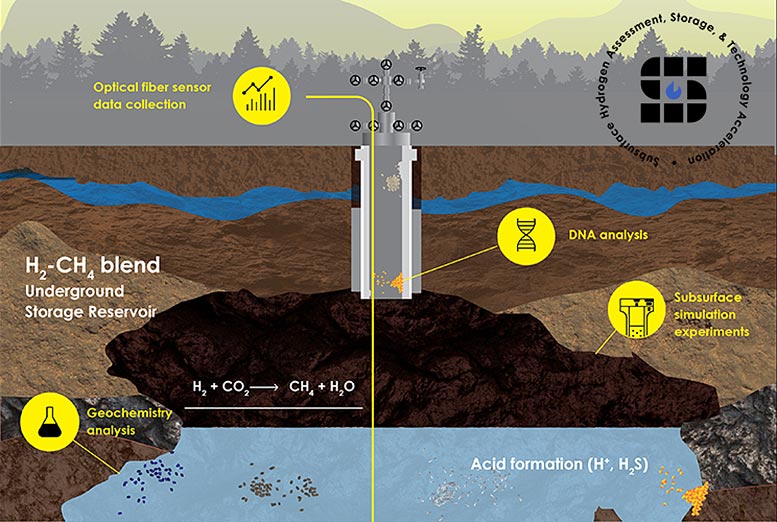
Lawrence Livermore National Laboratory, along with PNNL and NETL, has launched the SHASTA Project to investigate the potential for large-scale hydrogen storage in geologic formations.
A team of Lawrence Livermore National Laboratory (LLNL) researchers, in partnership with two other national laboratories, has launched a project studying the viability of large-scale hydrogen storage in geologic formations.
Researchers from LLNL, Pacific Northwest Laboratory (PNNL) and the National Energy Technology Laboratory (NETL) will receive up to $6.75 million over the next three years from the Department of Energy’s Office of Fossil Energy and Carbon Management (FECM).
“This is an exciting project for us because it addresses a timely and critical component of a low-carbon energy future,” said LLNL reservoir engineer and principal investigator Joshua White.
“At the same time, the required expertise builds on LLNL’s decades of experience working in the subsurface on related technologies such as geologic carbon storage, natural gas storage, and geothermal energy.”
Hydrogen Storage in Mixed-Gas Reservoirs
Called the SHASTA Project (Subsurface Hydrogen Assessment, Storage, and Technology Acceleration), a key component of the effort involves studying the safety and efficiency of storing blended mixtures of hydrogen and natural gas in subsurface reservoirs.
White and fellow LLNL reservoir engineer Nicola Castelletto will focus on conducting subsurface modeling work, while Lab geochemist Megan Smith will study high-pressure, high-temperature experimental opportunities.
Hydrogen is emerging as a low-carbon fuel option for transportation, electricity generation, manufacturing applications, and clean energy technologies that will accelerate the United States’ transition to a low-carbon economy.
However, a key challenge is to ensure the safe and effective storage of hydrogen. Large-scale hydrogen storage will be required as the nation transitions to a virtually carbon- and emissions-free clean energy economy. Domestically, however, large-volume underground hydrogen storage has been demonstrated as safe and effective only in salt dome structures or caverns.
Not all regions have the proper geological prerequisites for salt cavity storage; however, FECM is exploring storage opportunities in these areas, including in porous media, which are similar to underground natural gas storage reservoirs.
The recently announced project will determine the technical feasibility of hydrogen storage in subsurface systems and quantify the operational risks associated with storage in those systems.
It also will develop technologies and tools that will reduce those risks. At the same time, the research effort will establish the technical basis for using the much larger capacities available in porous media storage, as well as the ability to re-use existing natural gas storage infrastructure for the hydrogen economy.
Leveraging Existing Infrastructure for Hydrogen Economy
Finally, the project could help accelerate and expand the use of hydrogen by leveraging existing facilities (e.g., existing natural gas storage reservoirs) at storage sites across the United States.
It will address critical technological hurdles; conduct research to demonstrate the feasibility of emergent technology; and develop tools and technologies to support industry and enable the advancement of subsurface hydrogen storage.
Key questions researchers will address include:
- How can the technical and operational risks associated with subsurface hydrogen storage be mitigated so that operations are protective of humans and the environment?
- How can emerging technologies be leveraged to enable a smart, safe and efficient hydrogen subsurface storage system (e.g., sensors, reservoir simulators and screening tools)?
- What technical, operational and economic insights are needed to enable large-scale subsurface storage for pure hydrogen or hydrogen-natural gas blends?
Both field experiments and simulations will be conducted to study pure hydrogen and blended hydrogen impacts on underground storage systems. The research will focus on quantifying materials compatibility, investigating core- and reservoir-scale performance and characterizing microbial interactions.
Never miss a breakthrough: Join the SciTechDaily newsletter.
Follow us on Google and Google News.
2 Comments
This technology would be in direct competition with industrial CO2 capture and geological storage, already an expensive and risky process that won’t even be able to store just one part-per-million by 2050, if ever. One earthquake or volcanic eruption and the results would be a disaster. Better to rethink this plan than forge ahead.
thank you