
Close Menu
    Facebook X (Twitter) Instagram
    SciTechDaily
    • Biology
    • Chemistry
    • Earth
    • Health
    • Physics
    • Science
    • Space
    • Technology
    Facebook X (Twitter) Pinterest YouTube RSS
    SciTechDaily
    Home»Science»A Mathematical Equation Can Uncover Your Preferences via Brain Activity and Mood
    Science

    A Mathematical Equation Can Uncover Your Preferences via Brain Activity and Mood

    By Society for NeuroscienceSeptember 21, 2021No Comments2 Mins Read
    Facebook Twitter Pinterest Telegram LinkedIn WhatsApp Email Reddit
    Share
    Facebook Twitter LinkedIn Pinterest Telegram Email Reddit
    Brain Activity Concept
    The research team created a mathematical equation to gauge how intrinsic and extrinsic rewards affect participants’ mood in a moment, offering a potential way to assess preferences without direct questioning.

    A mathematical equation can assess how you feel about experiences using your mood and brain activity.

    People can struggle to accurately assess how they feel about something, especially something they feel social pressure to enjoy, like waking up early for a yoga class. How they really feel can be gleaned from their mood and their brain activity in reward regions, according to new research published in JNeurosci.

    Chew, Blain et al. measured participants’ mood with repeated questions and their brain activity with fMRI as they earned two types of rewards. Participants chose a box to earn points tied to how much money they would earn at the end of the task — an extrinsic reward. Then they played a game where they navigated a cursor through on-screen barriers. They did not earn anything for playing the game beyond their own satisfaction with doing well — an intrinsic reward. The participants answered questions about how they felt throughout the study.
    vmPFC Brain Activity
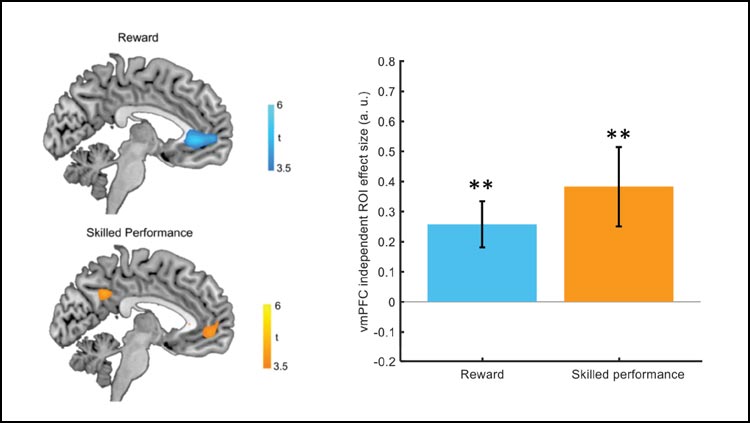
    Activity in vmPFC shows modulation by both reward magnitude and skilled performance. Credit: Chew, Blain, et al., JNeurosci 2021

    The research team developed a mathematical equation to determine how much intrinsic and extrinsic rewards contributed to the participants’ mood in a particular moment. Most people felt happier after earning more points or successfully completing the game, but the contribution of either reward to happiness varied from person to person. People whose happiness was more swayed by intrinsic rewards had more activity in their ventromedial prefrontal cortex, a reward area, during intrinsic rewards compared to extrinsic rewards, and vice versa. These results provide a potential avenue to assess preferences without outright asking.

    Reference: “A neurocomputational model for intrinsic reward” by Benjamin Chew, Bastien Blain, Raymond J Dolan and Robb B Rutledge, 20 September 2021, JNeurosci.
    DOI: 10.1523/JNEUROSCI.0858-20.2021

    Never miss a breakthrough: Join the SciTechDaily newsletter.
    Follow us on Google and Google News.

    Behavioral Science Brain Mathematics Neuroscience Society for Neuroscience
    Share. Facebook Twitter Pinterest LinkedIn Email Reddit

    Related Articles

    New Research Reveals Why We Help Some People but Not Others

    How (and Where) the Brain Analyzes Math and Language When Spoken

    Brain Activity Reveals When White Lies Are Selfish

    Neuroscientists Track How Bad Moods Develop and Persist in the Brain

    Musicians Have Brains With Stronger Connections Than Non-musicians

    Infant Brain Circuitry Shaped by Language Exposure

    “Area 32” – How the Brain Balances Emotion and Reason

    Why Time Sometimes Flies or Drags: How the Brain Creates the Experience of Time

    Scientists Can See the Bias in Your Brain – Even Before You Make Your Decision

    Leave A Reply Cancel Reply

    • Facebook
    • Twitter
    • Pinterest
    • YouTube

    Don't Miss a Discovery

    Subscribe for the Latest in Science & Tech!

    Trending News

    Millions of People Have Osteopenia Without Realizing It – Here’s What You Need To Know

    Researchers Discover Boosting a Single Protein Helps the Brain Fight Alzheimer’s

    World-First Study Reveals Human Hearts Can Regenerate After a Heart Attack

    Why Your Dreams Feel So Real Sometimes and So Strange Other Times

    This Simple Home Device May Boost Brain Power in Adults Over 40

    Enormous Prehistoric Insects Puzzle Scientists

    Scientists Develop Bioengineered Chewing Gum That Could Help Fight Oral Cancer

    After 37 Years, the World’s Longest-Running Soil Warming Experiment Uncovers a Startling Climate Secret

    Follow SciTechDaily
    • Facebook
    • Twitter
    • YouTube
    • Pinterest
    • Newsletter
    • RSS
    SciTech News
    • Biology News
    • Chemistry News
    • Earth News
    • Health News
    • Physics News
    • Science News
    • Space News
    • Technology News
    Recent Posts
    • Researchers Discover Natural Compound That Disarms Deadly Superbug
    • New Research Reveals That Your Morning Coffee Activates an Ancient Longevity Switch
    • Researchers Identify the Most Common Recessive Neurodevelopmental Disorder Ever Discovered
    • This Is What Makes You Irresistible to Mosquitoes
    • Shockingly Powerful Giant Octopuses Ruled the Seas 100 Million Years Ago
    Copyright © 1998 - 2026 SciTechDaily. All Rights Reserved.
    • Science News
    • About
    • Contact
    • Editorial Board
    • Privacy Policy
    • Terms of Use

    Type above and press Enter to search. Press Esc to cancel.