

Berkeley Lab co-led collaboration with DESY and TU Freiberg brings us a step closer to more efficient photovoltaics and solar fuel systems.
In the past 50 years, scientists have made great advances in photovoltaic technologies that convert sunlight into electricity, and artificial photosynthesis devices that convert sunlight and water into carbon-free fuels. But the current state-of-the-art of these clean energy sources still lack the efficiency to compete with electricity or transportation fuel derived from petroleum.
Now, scientists at Berkeley Lab, DESY, the European XFEL, and the Technical University Freiberg, Germany, have reported in Nature Communications their discovery of a hidden charge-generating pathway that could help researchers develop more efficient ways to convert sunlight into electricity or solar fuels like hydrogen.
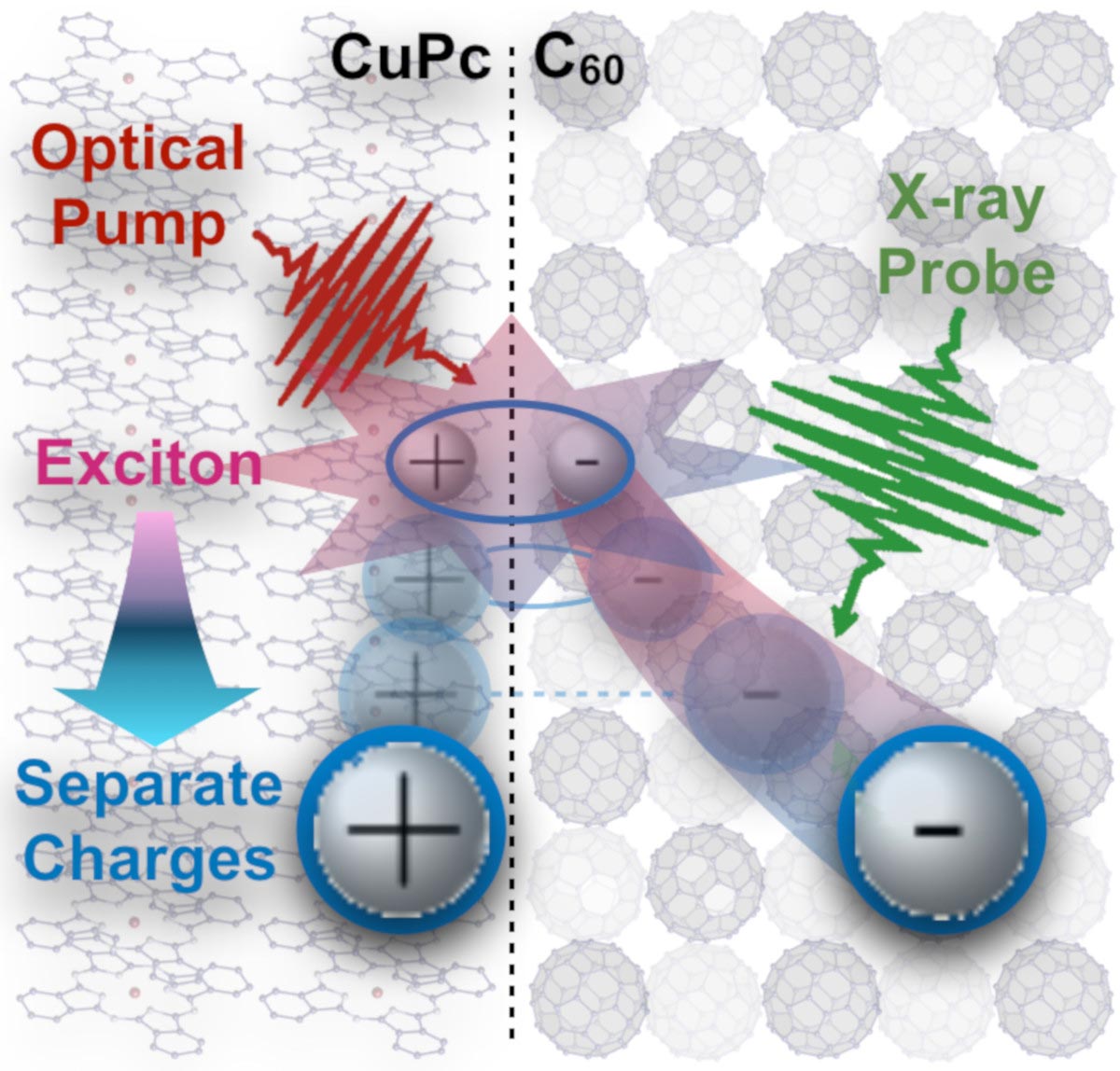
With help from DESY’s free-electron laser FLASH, the researchers shone ultrashort infrared and X-ray laser flashes on a copper-phthalocyanine:fullerene (CuPc:C60) material to study the charge generation mechanisms with a time resolution of 290 femtoseconds (290 quadrillionths of a second).
Probing Charge Generation in Real Time
Combining the ultrashort pulses of light with a technique called time-resolved X-ray photoemission spectroscopy (TRXPS) allowed the researchers to observe and count in real time how many of the infrared photons absorbed by CuPc:C60 formed useful separate charges, and how many of the absorbed photons only led to heating the material.
Their unique approach unveiled an unknown pathway in CuPc:C60 that turns up to 22% of absorbed infrared photons into separate charges, said Oliver Gessner, a senior scientist in Berkeley Lab’s Chemical Sciences Division and co-author of the current study.
Previous studies of CuPc:C60 typically assessed the system’s efficiency by measuring the total amount of charges or hydrogen or oxygen produced when using the material in a photovoltaic or photocatalytic device. “That, however, only tells you how efficient the entire process is, from the light absorption until water is split,” Gessner said. “But there’s a lot that’s happening in between in these systems that isn’t well understood – and if we don’t understand these in-between steps, we can’t develop more efficient light harvesting systems. Our study will help people develop better models and theories so we can get there.”
Reference: “Direct observation of charge separation in an organic light harvesting system by femtosecond time-resolved XPS” by Friedrich Roth, Mario Borgwardt, Lukas Wenthaus, Johannes Mahl, Steffen Palutke, Günter Brenner, Giuseppe Mercurio, Serguei Molodtsov, Wilfried Wurth, Oliver Gessner and Wolfgang Eberhardt, 19 February 2021, Nature Communications.
DOI: 10.1038/s41467-021-21454-3
Never miss a breakthrough: Join the SciTechDaily newsletter.
Follow us on Google and Google News.
20 Comments
If the US per capita energy use of 10KW is imagined as solar panels per person, a 250W panel with a capacity factor of 14% in the US NE, and 20% in best souther states, you get 35-50W per panel avg year round without storage. So that is about 200-300 panels per person. Most of that peak energy will not be used for grid use but converted into synfuels and that becomes the storage needed for winter use at a very low conversion rate maybe 16% efficiency round trip from summer to winter as electricty.
So who thinks a solar only powered economy is great if it starts with 200-300 panels per person that last only 20 years. Plus all the other stuff that goes with it, inverters 10yrs or so. This could be done on an incremental scale by adding 1 panel per month per person to the system forever. Nevermind, we are told panels will be almost free in the future. And if they get so low priced, who will want to recycle the eWaste stream..
On the huge scale imagined, there is absolutely nothing clean about solar energy when we admit our per “capita energy use”, see wikipedia for tables.
Actually, the average capacity factor across the US is 24.9%. Also, 250 W panels are at the low end, with newer panels producing up to 400 W. And the 10KWhr avg US electric consumption is per household, not per capita. So re-calculating… that’s between 40 and 64 panels per person (depending newer vs older panels). Some battery storage is helpful, but better still is interconnection of the major grids so that, for example, the early evening on the east coast can get power from afternoon solar in the west. Finally, solar is becoming so cheap (and prices are still falling fast) that it makes sense to over-build. Now build out the next cheapest source, wind, and the grid to distribute the power, and you can easily power the country with 100% renewable energy.
Thanks. And Trina Solar is coming out with panels that are over 600 watt
Lets see the renewable industry design and build a big black box with electrical power output of say 1MWe for a year (so 31.6TJe) but matches grid demand exactly over the year. You can use solar panels, wind, hydro, batteries and hydrogen production and as much land as you want but absolutely no fossil inputs. When you are done, tells us the cost, the land use, the panel, turbine, lithium, platinum inputs, expected lifetime, the recycling after that and all the other details. Assume the US/EU avg annual solar wind cycles and capacity factors. The US economy is about 3TW of primary power equiv to 1TWe as electrical, so we need 1M of these boxes. Good luck with your assignment.
A single Moltex $1B 1GWe Molten Salt power plant will match 1000 of these black box equivalents on a few acres of land so your capital budget is $M or so. One of these 2GWthermal reactor blocks can fit on the back of a semi truck. Canada has just funded the first small scale model of this reactor.
To start things off, a 10KW solar system search gives me $3/W on solar estimate.org. So a 225W panel with inverter in the US NE makes 1GJe/yr for $700 or so. So 31,600*700 is $22M. We haven’t even normalized the output to match the grid yet. It will be cold at night and all through winter. By the time the box is finished, the cost will be atleast 3-4 as much. The land use will be about 5sq m per panel so 150k sq m or 0.15 sq km. And 0.15M sq km for the 1TWe out from 8M sq km US area. Assuming the battery effect uses over production and peak energy to hydrogen storage, the land use will likely double.
The 10KW is as primary energy use (so actually power), not to be confused with 10KWhr/day (e) per household. Look at the LLNL Energy Flow Graph and the Per Capita Energy use by country on wikipedia.
“… interconnection of the major grids so that, for example, the early evening on the east coast can get power from afternoon solar in the west.”
What do you suppose the transmission losses will be for obtaining energy from 2 or 3 time zones to the west? Who is going to supply “the west” with power in early evening? I don’t think that you have really thought this through!
John, 10 kW per capita is primary energy supply, i.e. before all inefficiencies and losses. Your 200 panels would deliver 10kW net usable electricity per person after losses, way too much!
E.g. I commute 350 mi/wk, burn 10 gallons gas (add 20% losses from well to tank) that’s 400 kWh/wk or 2.4kW of that 10kW per capita. But that 350 mi could be done for 100 kWh/wk by electric car so 0.6kW or 12 panels. Even less by train.
… when I remember, that looks bit,what, what, what…
“…clean energy sources still lack the efficiency to compete with electricity…derived from petroleum.”
This is patently false. Commercial wind and solar are the cheapest sources of electricity, and have been for a couple of years now. Even adding battery storage to provide “near firm” power from wind and solar, they are cheaper than petroleum based sources. It’s great that research to improve solar efficiency is moving forward, but misrepresenting the current state of the industry isn’t necessary to make that work valuable.
Dan,
You claimed, “Commercial wind and solar are the cheapest sources of electricity, …”
Do you have a citation to back up your claim? I’m skeptical because European countries that have made strong commitments to ‘renewable’ energy sources are paying a lot more for electricity than the typical American depending on fossil fuels.
https://www.statista.com/statistics/263492/electricity-prices-in-selected-countries/
Compare Germany with China.
Dan we’re loving your responses! Facts ftw
John,
“Lets see the renewable industry design and build a big black box…”
Interesting
Here are the people to contact to get that done-
https://www.energy.gov/eere/eere-leadership
Try Becca Jones-Albertus
the address pattern is [email protected]
You think it would be possible to use a reversed laser type system for homeowners that this little unit could track the Sun at various points of season and transfer that high impact energy into a very concentrated light beam that excels in harnessing solar power without the need for large panels or farms.
You shouldn’t comment on things that require math. And with Led , proper home insulation , battery storage and low energy use appliances it shouldn’t more that 20 panels.
After reading a few comments here there is one factor missed in the equation. Most devices use low power then why not change the houses to dc when we already have solar system installation? A house nearly completely on dc makes more sense to do and only use ac for cooking stove and few other appliances. This would significantly decrease energy consumption and carbon emissions.
For one, you are all wrong. The time it takes to define this construct is overcome by your fixation on being right. You only need to look to conical bypass electrodynamic thermo motors. These are like your mom on steroids. Never mind her penchant to fart, give her a burrito and enjoy the show. Conversely we could entertain your nonsense and patronize the local taco truck and bathe in the fumes a plenty! I believe it was the ancient Gamonean geno-philosopher who stated “better to have not written your epithet than conjugate verbs for a day”. Try that on for size you narcissistic fruit bodied loom bender!
John, 10 kW per capita is primary energy supply, i.e. before all inefficiencies and losses. Your 200 panels would deliver 10kW net usable electricity per person after losses.
Don’t you mean, comical bypass electrodynamics thermo GYROS? Sheesh, what a dumb ass… huh huhhhh…
My town and neighbors are using 1000 watt panels on projects just completed in Alberta. They just started making 2 sided panels as well that make electricity on both sides increasing efficiency and watts.
Commenters arguing about the current viability of solar power are completely missing the point of this article. Solar’s imperfect current state is not a legitimate reason to abandon it, as evidenced by this new research. “It doesn’t work now, so there’s no way it could ever work and no reason to try,” is a really short-sighted outlook. That’s like if we had given up on ICE’s because the first ones weren’t better than a steam locomotive. Stop fighting to keep fossil fuels and start helping to make their replacement better.
If charge separation is taking place, such layers are known to only occur within a plasma and are known by various names, double layers, field aligned currents.