
Writing a commentary in the 50th-anniversary issue of Cell, Fu Qiaomei and E. Andrew Bennett, both of the Institute of Vertebrate Paleontology and Paleoanthropology (IVPP) of the Chinese Academy of Sciences, explored the contribution of paleogenomics to our understanding of the evolution of modern humans.
Given her numerous contributions to the field of human evolution through the analysis of both archaic and early modern human genomes, Prof. Fu was invited by the journal Cell to write a commentary reviewing what we have learned about the evolution of modern human identity from ancient DNA.
The article, “Ancient genomes and the evolutionary path of modern humans,” was published on February 29, 2024.
The Quest for Human Origins
The central role of human origin stories in belief systems around the world attests to humans’ enduring fascination with our beginnings. Archeological and paleoanthropological findings have helped to describe the earliest appearances of the modern human form and the beginning of behaviors that set us apart from other living creatures. The sequencing of the first human genome more than 20 years ago brought the power of comparative genomics to questions about the differences between humans and great apes. But modern humans and chimpanzees, our closest living relatives, are separated by roughly six million years of evolution, making such approaches inadequate for studies closer in time to the appearance of modern human qualities.
Likewise, the 1,000 Genomes Project has allowed us to appreciate the expanse of modern human genetic diversity, but admixture and an incomplete understanding of the genetic structure of prehistoric populations have limited our exploration of deeper events using only modern genomes. The recent availability of early modern human genomic data as well as archaic genomic data from Neanderthals and Denisovans has given us the means to better trace the genetic changes underlying the origin of modern humans.
In their commentary, the authors recapped our current understanding, based on the fields of paleoanthropology and archeology, of the evolution of modern human morphology and behavior. They later summarized contributions to our understanding of “being human” from the field of paleogenomics. Fu and Bennett decided to divide these contributions into two distinct approaches: a direct approach that attempts to identify modern human-specific genetic changes based on direct comparisons of modern and archaic human genome sequences, and a more indirect approach whereby researchers attempt to reconstruct the life history of archaic and early modern human populations from ancient DNA.
Their article notes that both of these investigative methods have the power to explore different aspects of emerging modern human populations; however, each has its own specific set of complications to overcome.
The sequence-based approach can theoretically identify genetic changes common to all modern humans that distinguish them from Neanderthals and Denisovans, but the utility of this approach is currently limited by our incomplete understanding of the genetic diversity of archaic and early modern human populations. For example, expanded sequencing of modern genomes from diverse parts of Africa has revealed that some alleles previously found only in archaic genomes are also present in modern populations.
Population Studies and Genetic Diversity
In contrast, the indirect approach attempts to decipher signals left in ancient genomes that can help us better understand past behaviors and population characteristics, such as population size, family structure, and mating practices, as well as adaptation to changing climates, local pathogens, and lifestyle innovations. These details, inaccessible using previous methods, add a new dimension to our understanding of human origins.
The authors reviewed several studies and concluded that, despite the paucity of data currently available, some differences between early modern humans and archaic populations have emerged. Although both early modern human and Neanderthal populations appear to have practiced female exogamy, where female mates were chosen from outside closely related groups, early modern humans appear to have maintained greater genetic diversity than their archaic counterparts, with their immediate ancestors being more distantly related to each other.
Although no single genetic cause has been found to explain why modern human populations expanded while archaic populations contracted and disappeared, Fu and Bennett discussed how several individual fitness advantages can arise from belonging to a larger and better-connected population network.
Taken together, these population-level advantages, called “Allee effects” in population biology, can lead to improved success in activities such as resource exploitation, defense, and mate selection, and may have been sufficient to explain the different outcomes of early modern and archaic human populations. The commentary also points out that despite this success, much genomic diversity has also been lost along the way, and ancient DNA studies have identified several distinct modern human populations in the past that have left no descendants among present-day humans.
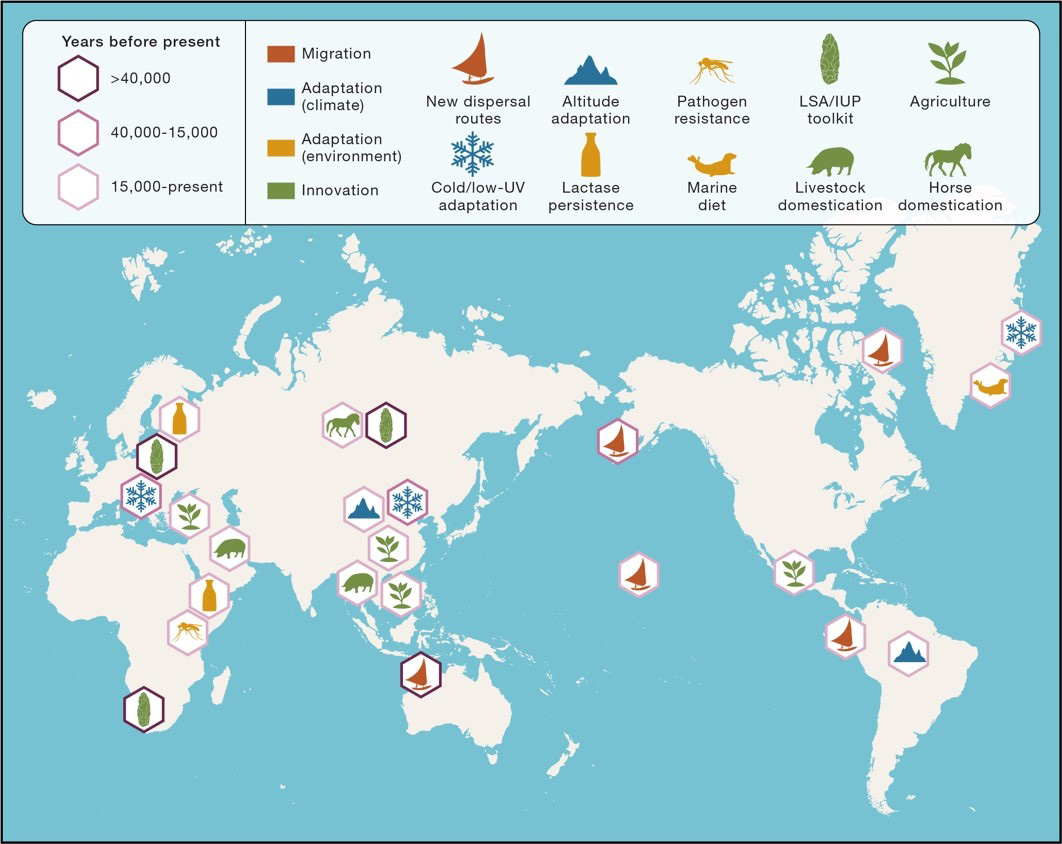
Ancient genetic data has also helped to describe the origin of human adaptation to local environments, such as the EDAR variant that appeared in northern East Asia during the last Ice Age, or the likely introgression of the EPAS1 allele from Denisovans, which aids survival at high altitudes. Similar adaptations to local diets and pathogens have been documented, as have adaptations to new innovations, such as lactase persistence after cattle domestication. The increased mobility and adaptability of modern human populations since they left Africa has ensured that much ancient genomic data remains to be discovered and studied.
By integrating the latest findings from ancient DNA with those emerging from paleoanthropology and archeology, Fu and Bennett’s commentary has expanded and updated the discussion of human origins.
Reference: “Ancient genomes and the evolutionary path of modern humans” by E. Andrew Bennett and Qiaomei Fu, 29 February 2024, Cell.
DOI: 10.1016/j.cell.2024.01.047
Never miss a breakthrough: Join the SciTechDaily newsletter.
Follow us on Google and Google News.
2 Comments
“Africa has revealed that some alleles previously found only in archaic genomes are also present in modern populations.”
Science will slowly uncover what Theology has been telling us from the beginning.
Dear chart makers, please, for the sake of us color impaired folks, use shapes or shading, rather than just colors to distinguish things on a chart.