

A team of astronomers studying two incredibly distant galaxies discovered a record-breaking array of molecules hidden in their star-forming clouds.
Astonishing details about two distant galaxies from the early universe have been uncovered by a team of scientists. These galaxies are home to some of the most active star-forming regions ever observed. By using powerful telescopes to break their light into individual colors, the researchers detected signals from a wide variety of molecules, more than ever found at such extreme distances. This remarkable discovery opens a new window into the chemistry and behavior of the universe’s most energetic galaxies in their youth, offering exciting clues about how stars and galaxies formed in the cosmos’s earliest days.
Unveiling the Nature of Early Galaxies
Long ago, when the universe was still in its cosmic infancy, galaxies looked very different from the elegant spirals we see today. Back then, stars were forming at incredible speeds—hundreds of times faster than we observe now. But much of this activity was hidden behind thick veils of cosmic dust, making it hard for scientists to understand what was really going on. Thanks to powerful new observations of the most distant galaxies ever seen, astronomers are now starting to uncover the secrets of these stellar powerhouses.
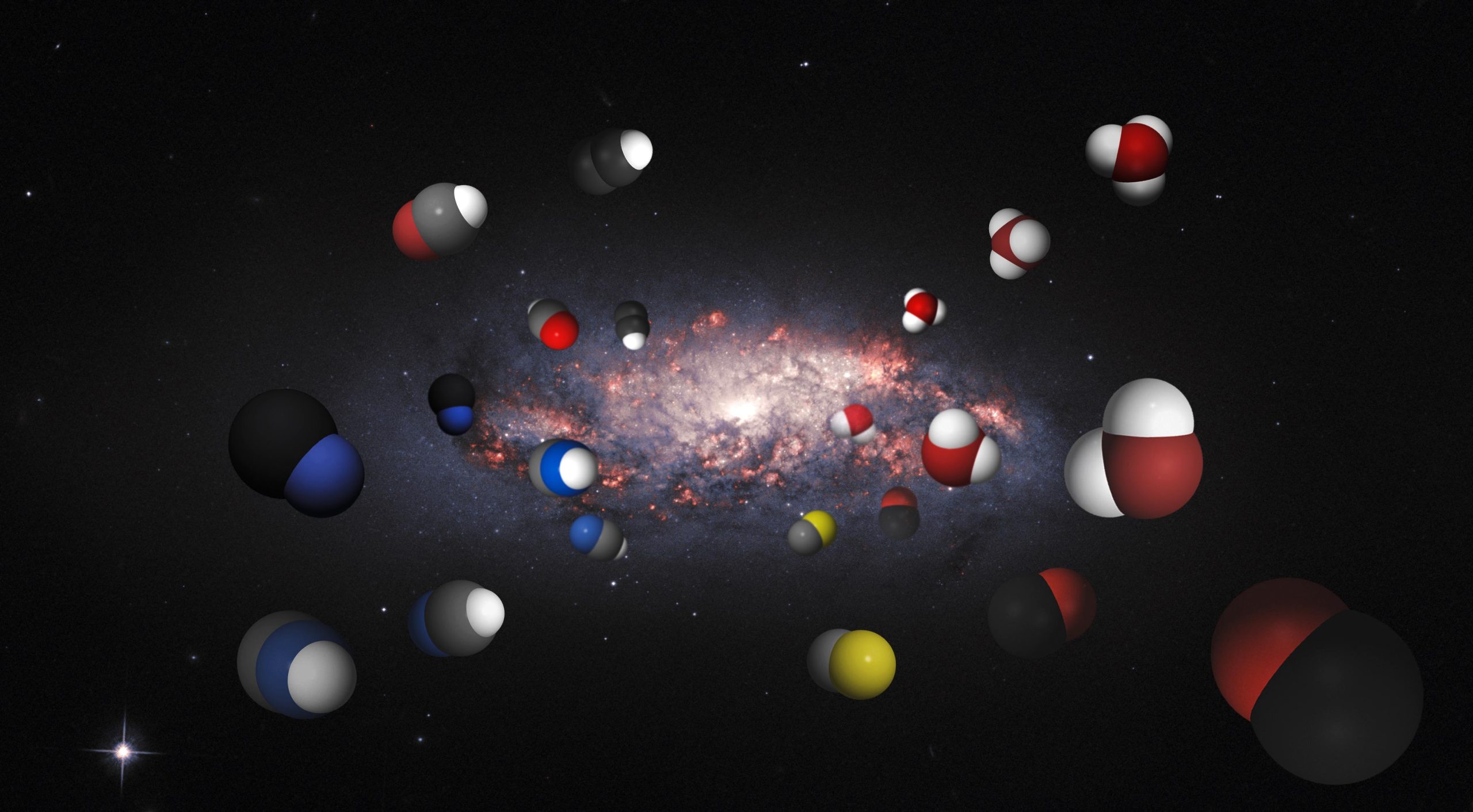
In a groundbreaking study published in Astronomy & Astrophysics, an international team led by Chalmers University astronomer Chentao Yang took a closer look at two brilliant galaxies from the early universe. Using the NOEMA (NOrthern Extended Millimetre Array) telescope in France, the team captured light from these galaxies. One was identified as a quasar, and both revealed intense star-forming activity.
“We knew these galaxies were prodigious star factories, perhaps amongst the biggest the universe has ever seen. To be able to find out how they work, we measured their light at wavelengths around one millimeter, hoping to collect new clues,” says Chentao Yang.
Molecular Insights From Distant Galaxies
The measurements proved to be successful beyond the scientists’ expectations. In the light they recorded from both galaxies, they identified traces of many different kinds of molecules. From deep within these galaxies, light is emitted in many different wavelengths from the clouds of gas and dust where new stars are born.
“It’s an amazing explosion of color, in shades that the human eye can’t see. But by combining our observations with our knowledge of physics and chemistry, we can understand what the colors mean, and see what differences there are between different galaxies,” explains Sergio Martín, astronomer at ESO and Joint ALMA Observatory, Chile, and member of the research team.
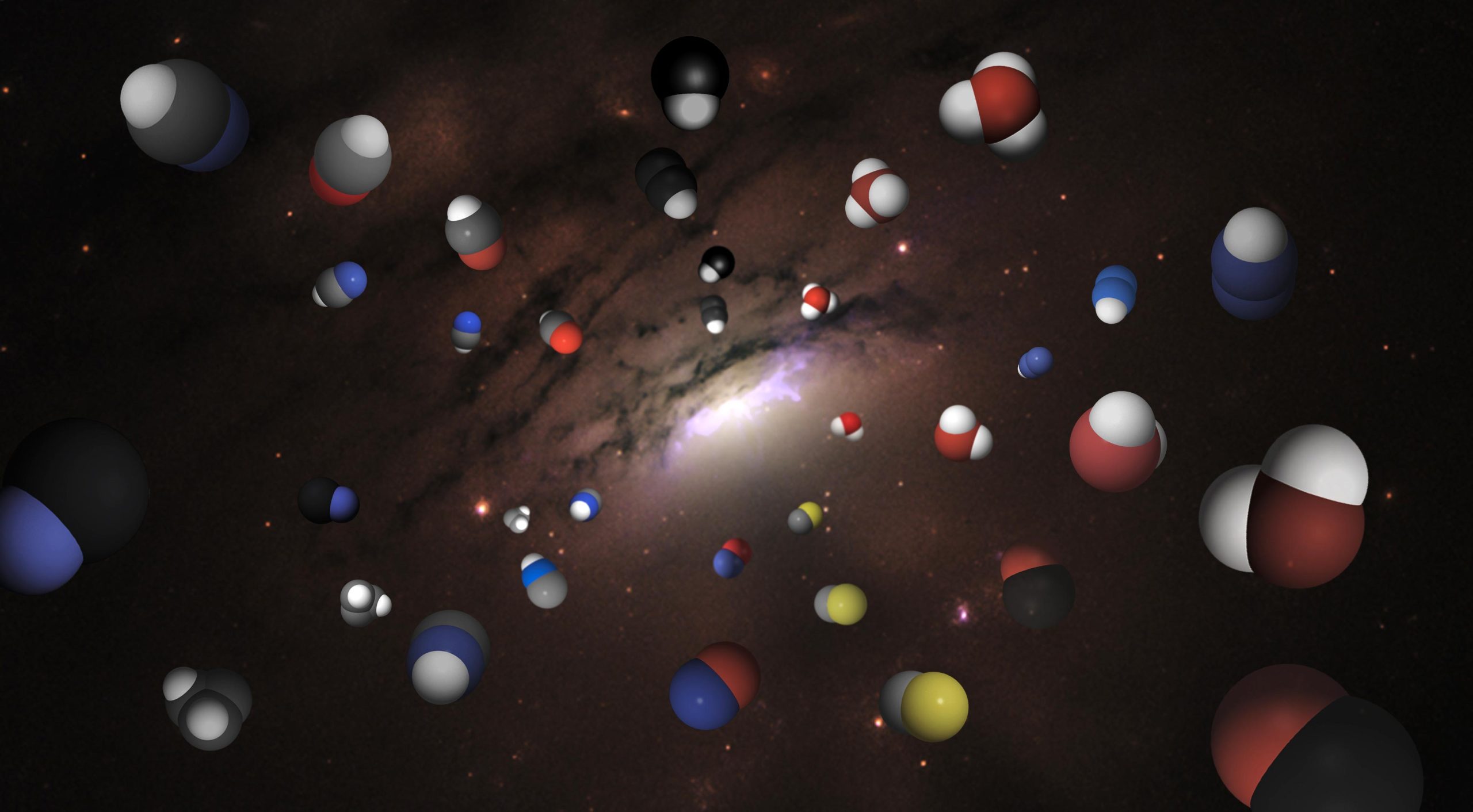
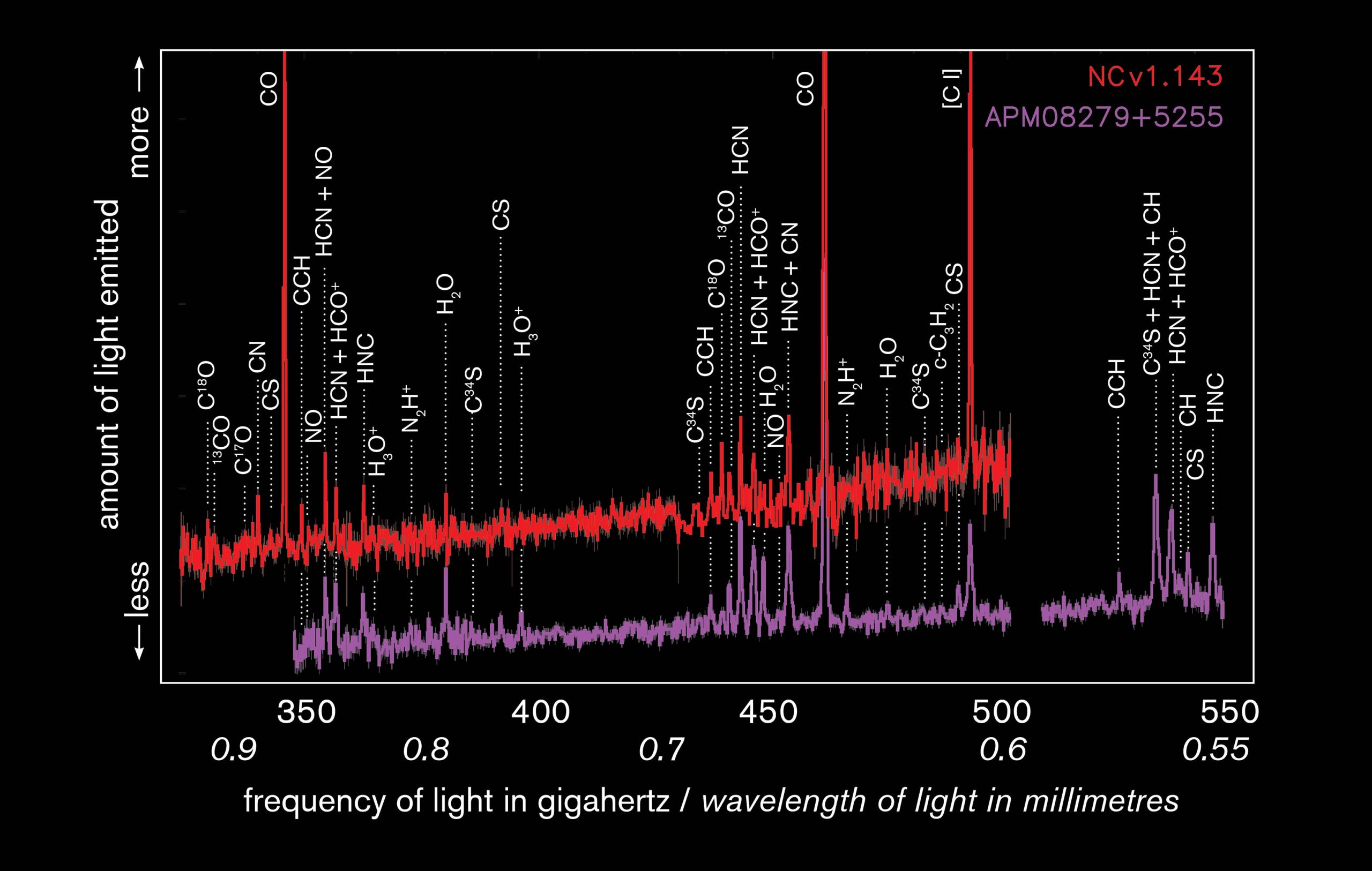
By analyzing each galaxy’s spectrum – the individual colors of their light – the scientists were able to identify 13 molecules, several of which have never been seen before in such distant galaxies. Each molecule gives different clues about the temperature, pressure, and density in the space between the stars, and about how starlight, radiation, and matter interact – providing key new information on the physical and chemical conditions in these galaxies.
“Interpreting the signals is a challenge. We are seeing part of the electromagnetic spectrum that is hard to observe in nearby galaxies. But thanks to the expansion of the universe, the light from distant galaxies like these is shifted to longer wavelengths that we can see with radio telescopes observing in the sub-millimeter,” says Chentao Yang.
More Like a Neon-Lit City Than a Night Under the Stars
The two galaxies studied by the team are so far away that their light takes almost 13 billion years to reach us.
“Looking at these galaxies is less like a night under the stars and more like seeing a city lit with neon lights,” says Susanne Aalto, Chalmers astronomer and team member.
Astronomers are used to taking pictures of our galaxy’s star factories, like the Orion Nebula and the Carina Nebula, she explains.
“In these two distant galaxies, we are instead seeing star factories that are bigger, brighter, full of dust, and different in many ways. The Orion and Carina nebulae are lit up thanks to ultraviolet light from hot, newborn stars. In these two distant galaxies, ultraviolet light can’t get past the layers of dust. Much of the illumination is instead thanks to cosmic rays – high energy particles that can be created by exploding stars, or close to a supermassive black hole,” says Susanne Aalto.
The Uniqueness of Early-Universe Galaxies
While galaxies like these two are rare, the scientists have plans to study more of them, using both NOEMA and its even bigger sister telescope, ALMA (the Atacama Large Millimetre/Submillimetre Array) in Chile. Both telescopes are sensitive to light with wavelengths of around one millimeter.
“Our results show how NOEMA, with its broadband receivers and powerful correlator computer, has opened up new opportunities for studying extreme galaxies like these in the northern sky. From the southern hemisphere, ALMA’s planned wideband sensitivity upgrades will offer even more exciting prospects. The most remarkable galaxies in the early universe are finally able to tell their stories through their molecules,” says Pierre Cox, astronomer at CNRS and Sorbonne Université, France.
More About the Research Results
Over a hundred different molecules have been detected in interstellar space. In this study, the astronomers identified molecules of carbon monoxide (CO), the cyano radical (CN), the ethynyl radical (CCH), hydrogen cyanide (HCN), the formyl cation (HCO+), hydrogen isocyanide (HNC), carbon monosulphide (CS), water (H2O), the hydronium ion (H3O+), nitric oxide (NO), diazenylium (N2H+), the methylidyne radical (CH), and cyclopropenylidene (c-C3H2). Several of these (CH, CCH, c-C3H2, N2H+, and H3O+) have never been seen before at such large distances.
The two galaxies in the study have catalog numbers APM 08279+5255 and NCv1.143. Previous studies have shown that they are so far away that their light has been traveling towards us for nearly 13 billion years, corresponding to redshifts of 3.911 and 3.565, respectively. Redshift means that the expansion of the universe stretches the light from distant galaxies to longer wavelengths, which can be observed with radio telescopes.
Despite their distance, the galaxies shine brightly at radio wavelengths. Their signals are amplified thanks to clusters of other galaxies that lie along the light’s path – an effect known as gravitational lensing. One of the galaxies, APM 08279+5255, is also a quasar, a galaxy whose center glows brightly all the way from radio waves to X-rays, due to material swirling around a supermassive black hole. NCv1.143 may also contain a central black hole.
Reference: “SUNRISE: The rich molecular inventory of high-redshift dusty galaxies revealed by broadband spectral line surveys” by Chentao Yang, Alain Omont, Sergio Martín, Thomas G. Bisbas, Pierre Cox, Alexandre Beelen, Eduardo González-Alfonso, Raphaël Gavazzi, Susanne Aalto, Paola Andreani, Cecilia Ceccarelli, Yu Gao, Mark Gorski, Michel Guélin, Hai Fu, R. J. Ivison, Kirsten K. Knudsen, Matthew Lehnert, Hugo Messias, Sebastien Muller, Roberto Neri, Dominik Riechers, Paul van der Werf and Zhi-Yu Zhang, 14 December 2023, Astronomy & Astrophysics.
DOI: 10.1051/0004-6361/202347610
More about the research group:
The team is composed of: Chentao Yang (Chalmers University of Technology, Sweden), Alain Omont (CNRS and Sorbonne Université, France), Sergio Martín (ESO and Joint ALMA Observatory, Chile), Thomas G. Bisbas (Zhejiang Laboratory, China), Pierre Cox (CNRS and Sorbonne Université, France), Alexandre Beelen (Aix Marseille University, France), Eduardo González-Alfonso (Universidad de Alcalá, Spain), Raphaël Gavazzi (Aix Marseille University), Susanne Aalto (Chalmers University of Technology), Paola Andreani (ESO), Cecilia Ceccarelli (Université Grenoble Alpes, CNRS), Yu Gao (Xiamen University, China), Mark Gorski (Chalmers University of Technology), Michel Guélin (IRAM, France), Hai Fu (University of Iowa, USA), Rob J. Ivison (ESO, Macquarie University, Dublin IAS, University of Edinburgh), Kirsten K. Knudsen (Chalmers University of Technology), Matthew Lehnert (Centre de Recherche Astrophysique de Lyon, CRAL, France), Hugo Messias (ESO and Joint ALMA Observatory), Sebastien Muller (Chalmers University of Technology), Roberto Neri (IRAM), Dominik Riechers (Universität zu Köln), Paul van der Werf (Leiden University, Netherlands) and Zhi-Yu Zhang (Nanjing University, China).
More about NOEMA
NOEMA, the Northern Extended Millimetre Array, is the most powerful millimeter observatory in the Northern Hemisphere, located on 2500 meters above sea level on the Plateau de Bure in the French Alps and run by IRAM. It consists of an array of 12 individual 15-metre antennas. During observations, the antennas function as a single telescope by using a technique called interferometry.
Never miss a breakthrough: Join the SciTechDaily newsletter.
Follow us on Google and Google News.