
Close Menu
    Facebook X (Twitter) Instagram
    SciTechDaily
    • Biology
    • Chemistry
    • Earth
    • Health
    • Physics
    • Science
    • Space
    • Technology
    Facebook X (Twitter) Pinterest YouTube RSS
    SciTechDaily
    Home»Space»Star Formation Is Triggered by Collisions of Gas Clouds in Space
    Space

    Star Formation Is Triggered by Collisions of Gas Clouds in Space

    By Nagoya UniversityMay 26, 20212 Comments3 Mins Read
    Facebook Twitter Pinterest Telegram LinkedIn WhatsApp Email Reddit
    Share
    Facebook Twitter LinkedIn Pinterest Telegram Email Reddit

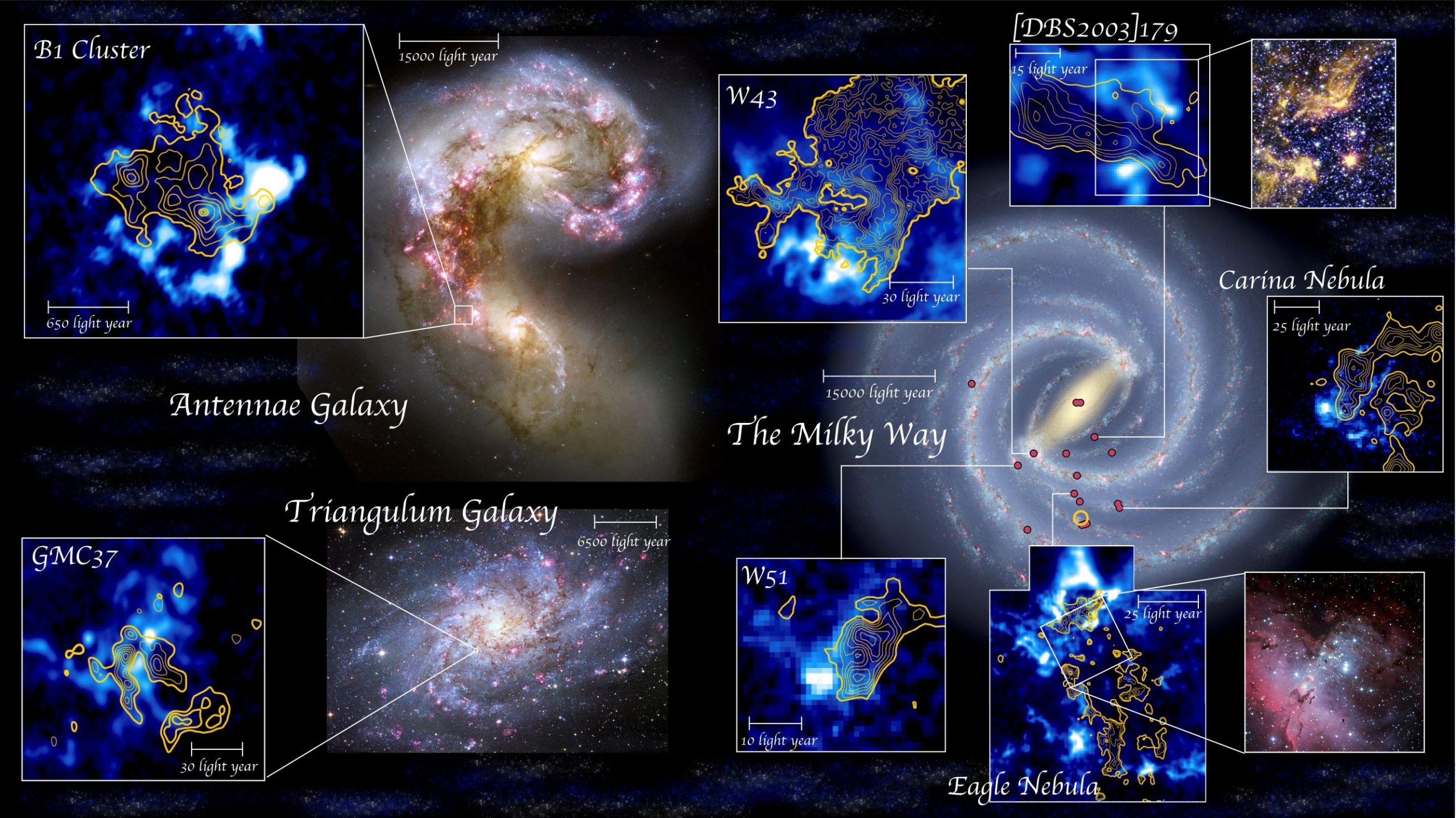
    Colliding Molecular Clouds
    Demonstration of typical colliding molecular clouds (represented by blue color and yellow contours) forming star clusters discovered by radio observations. Positions of the cluster-forming colliding clouds reported in the present special issue are denoted by red dots plotted on the picture of the Milky Way Galaxy on the right (the circle denotes the position of the Sun). Images of the Antennae Galaxies and the Triangulum Galaxy are shown on the left.
    The inset optical images show the Eagle Nebula and [DBS2003]179, where shining nebulae and newly born star clusters can be seen. Credit: Nagoya University, National Astronomical Observatory of Japan, NASA, JPL-Caltech, R. Hurt (SSC/Caltech), Robert Gendler, Subaru Telescope, ESA, The Hubble Heritage Team (STScI/AURA), Hubble Collaboration, and 2MASS
    Japanese researchers have found that collisions of gas clouds hovering in space bring about the birth of star clusters.

    Stars form by the gravitational contraction of clouds of gas in space and can have various masses. Massive stars, together with many other stars, may form a huge star cluster (a group of more than 10,000 stars). The formation of such a star cluster requires the rapid packing of enormous amounts of gas and other materials into a small space, but the mechanism by which this occurs has yet to be clarified.

    A research team led by Associate Professor Kengo Tachihara and Emeritus Professor Yasuo Fukui of Nagoya University focused on a hypothesis in which multiple gas clouds collide, which allows them to gather efficiently and thereby form a star cluster. To verify this hypothesis, the team, in collaboration with researchers from Osaka Prefecture University and the National Astronomical Observatory of Japan, conducted observational studies of a vast amount of data obtained as a result of more than a decade of research, as well as theoretical studies of numerical simulations with the data. As a result, they found that collisions of gas clouds hovering in space do, in fact, induce the birth of a star cluster.

    They observed many collisions of gas clouds in our Milky Way Galaxy and also in other galaxies, suggesting that these collisions are a universal phenomenon. From this perspective, there is an increasingly likely possibility that the Milky Way Galaxy collided with other galaxies soon after its birth, which caused gas clouds in the galaxies to collide frequently, resulting in the formation of many globular clusters (groups of more than one million stars). Their findings have contributed to a deeper understanding of the formation of massive stars and the birth of globular clusters.

    The studies were published in the peer-reviewed journal Publications of the Astronomical Society of Japan in January 2021 as a special issue titled “Star Formation Triggered by Cloud-Cloud Collision Ⅱ,” which contains a collection of 20 original papers based on elaborate verifications of individual astronomical bodies, as well as a review paper summarizing the latest understandings of star formation by collisions of gas clouds.

    Never miss a breakthrough: Join the SciTechDaily newsletter.
    Follow us on Google and Google News.

    Astronomy Astrophysics Nagoya University Osaka Metropolitan University Stars
    Share. Facebook Twitter Pinterest LinkedIn Email Reddit

    Related Articles

    Stellar Egg Hunt: Tracing Evolution From Embryo to Baby Star

    New Findings on the Birth of Distant Suns

    Astronomers Discover Star Orbiting the Black Hole at Center of the Milky Way

    Ultramassive Stars of Cluster R136 Were Created from the Merger of Lighter Stars

    Examining the Accuracy of the Spectral Energy Distribution Models

    NASA Data Reveals Significant Changes in Exoplanet’s Atmosphere

    Astronomers Discover Radio Emissions From a Brown Dwarf

    Astronomers Combine Hundreds of Images of Carina Nebula to Reveal Thousands of Stars in Stellar Nursery

    Hubble Observes Rare Blue Stars in Andromeda’s Core

    2 Comments

    1. JY on May 27, 2021 4:55 am

      There is nothing to trigger cause space is fake. It’s only in the minds of science fiction space monkeys. Who cant think or use common sense.

      Reply
      • Fake Space on May 27, 2021 7:02 am

        “Space is fake… ”
        And the Oscar goes to… someone else!

        Reply
    Leave A Reply Cancel Reply

    • Facebook
    • Twitter
    • Pinterest
    • YouTube

    Don't Miss a Discovery

    Subscribe for the Latest in Science & Tech!

    Trending News

    Your Blood Pressure Reading Could Be Wrong Because of One Simple Mistake

    Astronomers Stunned by Ancient Galaxy With No Spin

    Physicists May Be on the Verge of Discovering “New Physics” at CERN

    Scientists Solve 320-Million-Year Mystery of Reptile Skin Armor

    Scientists Say This Daily Walking Habit May Be the Secret to Keeping Weight Off After Dieting

    New Therapy Rewires the Brain To Restore Joy in Depression Patients

    Giant Squid Detected off Western Australia in Stunning Deep-Sea Discovery

    Popular Sugar-Free Sweetener Linked to Liver Disease, Study Warns

    Follow SciTechDaily
    • Facebook
    • Twitter
    • YouTube
    • Pinterest
    • Newsletter
    • RSS
    SciTech News
    • Biology News
    • Chemistry News
    • Earth News
    • Health News
    • Physics News
    • Science News
    • Space News
    • Technology News
    Recent Posts
    • Hidden Warm Water Beneath Antarctica Could Rapidly Raise Global Sea Levels
    • Scientists Revive Ancient Chemistry Trick To Engineer Next-Generation Glass
    • Scientists Use AI To Supercharge Ultrafast Laser Simulations by More Than 250x
    • Scientists Just Found a Surprising Way To Destroy “Forever Chemicals”
    • Popular Supplement Ingredient Linked to Shorter Lifespan in Men
    Copyright © 1998 - 2026 SciTechDaily. All Rights Reserved.
    • Science News
    • About
    • Contact
    • Editorial Board
    • Privacy Policy
    • Terms of Use

    Type above and press Enter to search. Press Esc to cancel.