
Close Menu
    Facebook X (Twitter) Instagram
    SciTechDaily
    • Biology
    • Chemistry
    • Earth
    • Health
    • Physics
    • Science
    • Space
    • Technology
    Facebook X (Twitter) Pinterest YouTube RSS
    SciTechDaily
    Home»Space»New Planck Mission Images Show Strange Haze and Cold Gas
    Space

    New Planck Mission Images Show Strange Haze and Cold Gas

    By Whitney Clavin, Jet Propulsion Laboratory; Markus Bauer, European Space AgencyFebruary 14, 2012No Comments5 Mins Read
    Facebook Twitter Pinterest Telegram LinkedIn WhatsApp Email Reddit
    Share
    Facebook Twitter LinkedIn Pinterest Telegram Email Reddit
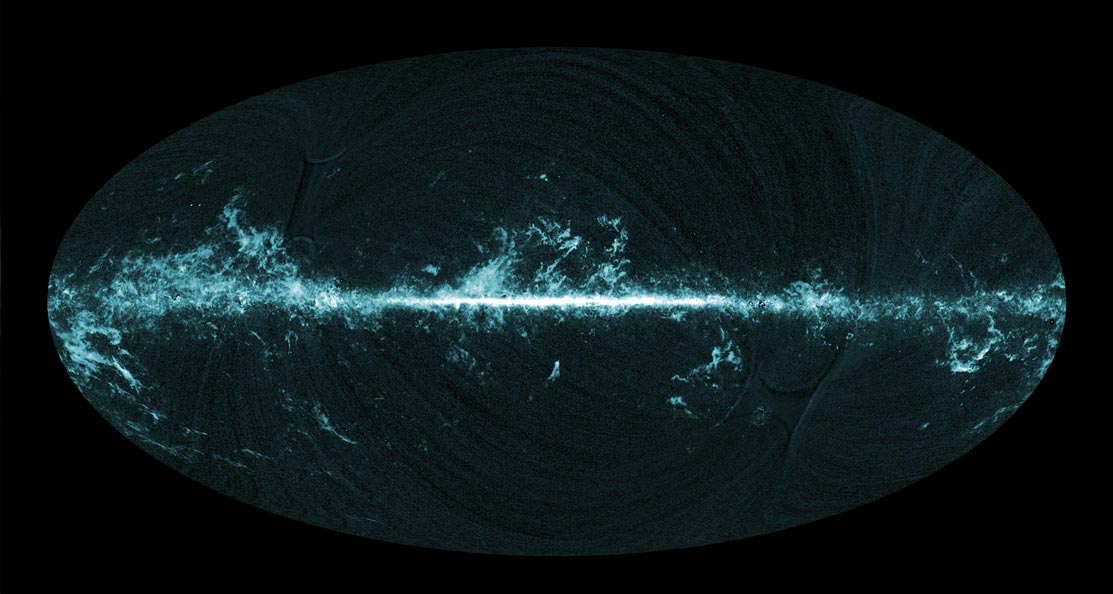
    All-Sky Image of Molecular Gas Seen by Planck
    This all-sky image shows the distribution of carbon monoxide (CO), a molecule used by astronomers to trace molecular clouds across the sky, as seen by Planck. Credit: ESA/Planck Collaboration

    Scientists are studying the new images from the Planck mission to hopefully gain a better understanding of our galaxy. The images show previously undiscovered islands of star formation and a mysterious haze of microwave emissions around the center of the Milky Way.

    New images from the Planck mission show previously undiscovered islands of star formation and a mysterious haze of microwave emissions in our Milky Way galaxy. The views give scientists new treasures to mine and take them closer to understanding the secrets of our galaxy.

    Planck is a European Space Agency mission with significant NASA participation.

    “The images reveal two exciting aspects of the galaxy in which we live,” said Planck scientist Krzysztof M. Gorski from NASA’s Jet Propulsion Laboratory in Pasadena, California, and Warsaw University Observatory in Poland. “They show a haze around the center of the galaxy, and cold gas where we never saw it before.”
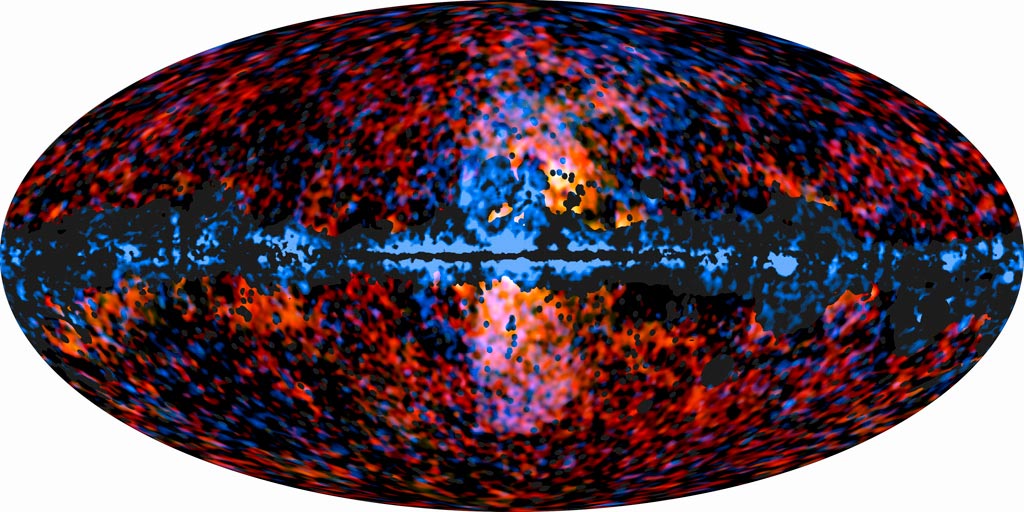
    Galactic Haze Seen by Planck and Galactic ‘Bubbles’ Seen by Fermi
    This all-sky image shows the distribution of the galactic haze seen by ESA’s Planck mission at microwave frequencies superimposed over the high-energy sky, as seen by NASA’s Fermi Gamma-ray Space Telescope. The Planck data (shown here in red and yellow) correspond to the haze emission at frequencies of 30 and 44 GHz, extending from and around the galactic center. The Fermi data (shown here in blue) correspond to observations performed at energies between 10 and 100 gigaelectronvolt and reveal two bubble-shaped, gamma-ray emitting structures extending from the galactic center. Credit: ESA/Planck Collaboration (microwave); NASA/DOE/Fermi LAT/D. Finkbeiner et al. (gamma rays)

    The new images show the entire sky, dominated by the murky band of our Milky Way galaxy. One of them shows the unexplained haze of microwave light previously hinted at in measurements by NASA’s Wilkinson Microwave Anisotropy Probe (WMAP).

    “The haze comes from the region surrounding the center of our galaxy and looks like a form of light energy produced when electrons accelerate through magnetic fields,” said Davide Pietrobon, another JPL Planck scientist.

    “We’re puzzled though, because this haze is brighter at shorter wavelengths than similar light emitted elsewhere in the galaxy,” added Gorski.

    Several explanations have been proposed for this unusual behavior.
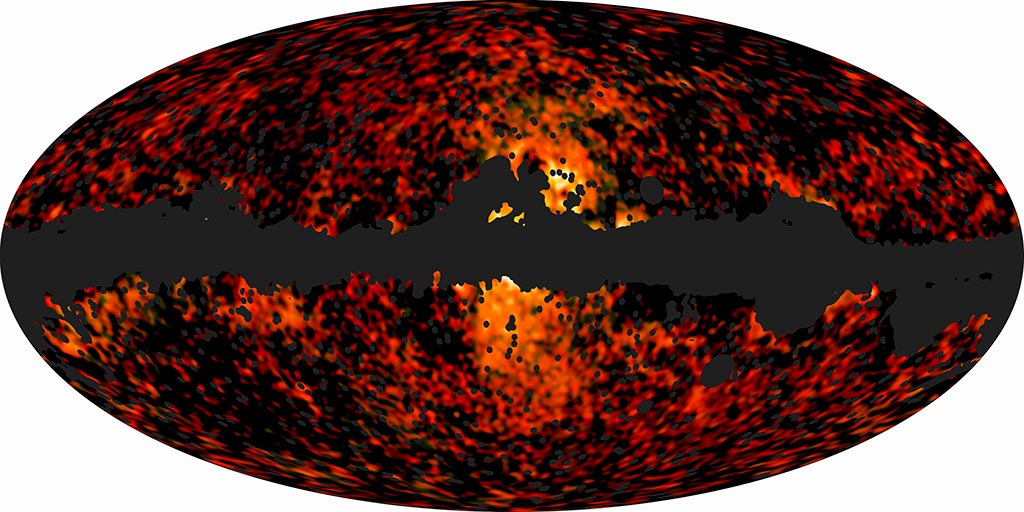
    Mysterious Galactic Haze Seen by Planck
    This all-sky image shows the spatial distribution over the whole sky of the galactic haze at 30 and 44 GHz, extracted from the Planck observations. In addition to this component, other foreground components such as charged particles accelerated radially, known as synchrotron radiation, thermal dust, spinning dust, and extragalactic point sources contribute to the total emission detected by Planck at these frequencies. The prominent empty band across the plane of the galaxy corresponds to the mask that has been used in the analysis of the data to exclude regions with strong foreground contamination due to the galaxy’s diffuse emission. The mask also includes strong point-like sources located over the whole sky. Credit: ESA/Planck Collaboration

    “Theories include higher numbers of supernovae, galactic winds and even the annihilation of dark-matter particles,” said Greg Dobler, a Planck collaborator from the University of California in Santa Barbara, California. Dark matter makes up about a quarter of our universe, but scientists don’t know exactly what it is.

    The second all-sky image is the first map to show carbon monoxide over the whole sky. Cold clouds with forming stars are predominantly made of hydrogen molecules, difficult to detect because they do not readily emit radiation. Carbon monoxide forms under similar conditions, and though it is rarer, the gas emits more light. Astronomers can use carbon monoxide to identify the clouds of hydrogen where stars are born.

    Surveys of carbon monoxide undertaken with radio telescopes on the ground are time-consuming, so they are limited to portions of the sky where clouds of molecules are already known or expected to exist. Planck scans the whole sky, allowing astronomers to detect the gas where they weren’t expecting to find it.

    Planck’s primary goal is to observe the Cosmic Microwave Background, the relic radiation from the Big Bang, and to extract its encoded information about what our universe is made of, and the origin of its structure.

    This relic radiation can only be reached once all sources of foreground emission, such as the galactic haze and the carbon monoxide signals, have been identified and removed.

    “The lengthy and delicate task of foreground removal provides us with prime datasets that are shedding new light on hot topics in galactic and extragalactic astronomy alike,” said Jan Tauber, Planck project scientist at the European Space Agency.

    Planck’s first findings on the Big Bang’s relic radiation are expected to be released in 2013. The new results are being presented this week at an international astronomy conference in Bologna, Italy.

    Never miss a breakthrough: Join the SciTechDaily newsletter.
    Follow us on Google and Google News.

    European Space Agency Fermi Gamma-ray Space Telescope JPL Milky Way Planck Mission Star Formation
    Share. Facebook Twitter Pinterest LinkedIn Email Reddit

    Related Articles

    The Interaction Between Interstellar Dust and Our Galaxy’s Magnetic Field

    Planck Space Telescope Reveals the Magnetic Field Lines of the Milky Way

    Detailed Map Reveals New Information about the Age, Contents and Origins of the Universe

    Searching for Link Between Star Formation and Black Hole Activity

    Searching for “Bubbles” in the Milky Way

    New Images of Orion Nebula Show Young Stars Hidden in Gas and Dust Clouds

    Astronomers Hypothesize that Milky Way Might Be Teeming with Planets

    Milky Way Galaxy Has Over 100 Billion Planets

    Milky Way Galaxy Mosaic of Images from WISE

    Leave A Reply Cancel Reply

    • Facebook
    • Twitter
    • Pinterest
    • YouTube

    Don't Miss a Discovery

    Subscribe for the Latest in Science & Tech!

    Trending News

    The Universe Is Expanding Too Fast and Scientists Can’t Explain Why

    “Like Liquid Metal”: Scientists Create Strange Shape-Shifting Material

    Early Warning Signals of Esophageal Cancer May Be Hiding in Plain Sight

    Common Blood Pressure Drug Shows Surprising Power Against Deadly Antibiotic-Resistant Superbug

    Scientists Uncover Dangerous Connection Between Serotonin and Heart Valve Disease

    Scientists Discover a “Protector” Protein That Could Help Reverse Hair Loss

    Bone-Strengthening Discovery Could Reverse Osteoporosis

    Scientists Uncover Hidden Trigger Behind Stem Cell Aging

    Follow SciTechDaily
    • Facebook
    • Twitter
    • YouTube
    • Pinterest
    • Newsletter
    • RSS
    SciTech News
    • Biology News
    • Chemistry News
    • Earth News
    • Health News
    • Physics News
    • Science News
    • Space News
    • Technology News
    Recent Posts
    • A Common Diabetes Drug May Hold the Key to Stopping HIV From Coming Back
    • Ancient “Syphilis-Like” Disease in Vietnam Challenges Key Scientific Assumptions
    • Drinking Alcohol To Cope in Your 20s Could Damage Your Brain for Life
    • Scientists Crack Alfalfa’s Chromosome Mystery After Decades of Debate
    • Ancient Ant-Plant Alliance Collapses As Predatory Wasps Move In
    Copyright © 1998 - 2026 SciTechDaily. All Rights Reserved.
    • Science News
    • About
    • Contact
    • Editorial Board
    • Privacy Policy
    • Terms of Use

    Type above and press Enter to search. Press Esc to cancel.