
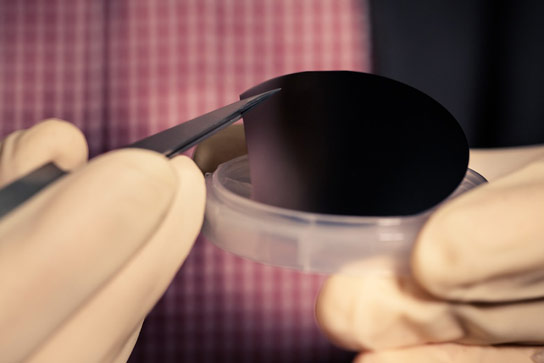
Based on the photon-enhanced thermionic emission (PETE) process, a new solar-energy device is about 100 times more efficient than its previous design.
Scientists working at the Stanford Institute for Materials and Energy Sciences (SIMES) have improved an innovative solar-energy device to be about 100 times more efficient than its previous design in converting the sun’s light and heat into electricity.
“This is a major step toward making practical devices based on our technique for harnessing both the light and heat energy provided by the sun,” said Nicholas Melosh, associate professor of materials science and engineering at Stanford and a researcher with SIMES, a joint SLAC/Stanford institute.
The new device is based on the photon-enhanced thermionic emission (PETE) process first demonstrated in 2010 by a group led by Melosh and SIMES colleague Zhi-Xun Shen, who is SLAC’s advisor for science and technology. In a report last week in Nature Communications, the group described how they improved the device’s efficiency from a few hundredths of a percent to nearly 2 percent, and said they expect to achieve at least another 10-fold gain in the future.
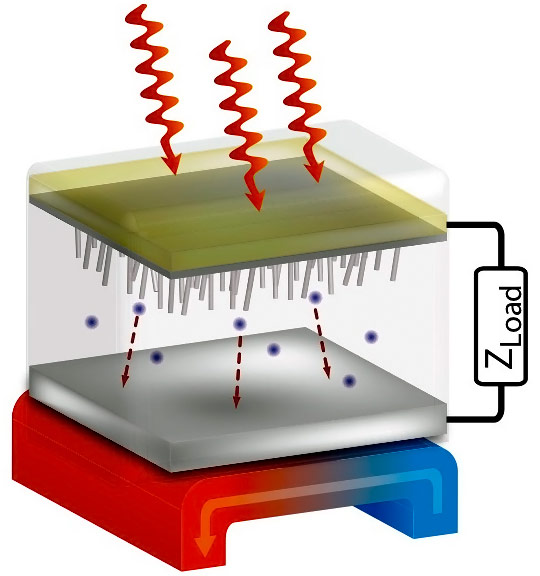
Conventional photovoltaic cells use a portion of the sun’s spectrum of wavelengths to generate electricity. But PETE uses a special semiconductor chip to make electricity by using the entire spectrum of sunlight, including wavelengths that generate heat. In fact, the efficiency of thermionic emission improves dramatically at high temperatures, so adding PETE to utility-scale concentrating solar power plants, such as multi-megawatt power tower and parabolic trough projects in California’s Mojave Desert, may increase their electrical output by 50 percent. Those systems use mirrors to focus sunlight into superbright, blazingly hot regions that boil water into steam, which then spins an electrical generator.
“When placed where the sunlight is focused, our PETE chips produce electricity directly; and the hotter it is, the more electricity it will make,” Melosh said.
The heart of the improved PETE chip is a sandwich of two semiconductor layers: One is optimized to absorb sunlight and create long-lived free electrons, while the other is designed to emit those electrons from the device so they can be collected as an electrical current. A cesium oxide coating on the second layer eases the electrons’ passage from the chip. Future research is aimed at making the device up to an additional 10 times more efficient by developing new coatings or surface treatments that will preserve the atomic arrangement of the second layer’s outer surface at the high temperatures it will encounter in the concentrating solar power plant.
“We expect that other materials, such as those incorporating barium or strontium, will make the surface much more stable up to at least 500 degrees Celsius,” said Jared Schwede, a Stanford graduate student who performed many of the PETE experiments. (play video to see Schwede explain the PETE technology)
An additional challenge will be to engineer the device to withstand the dramatic 500-degree daily temperature swings at solar power plants, as their systems heat up during the day and then cool down at night.
Reference: “Photon-enhanced thermionic emission from heterostructures with low interface recombination” by J.W. Schwede, T. Sarmiento, V.K. Narasimhan, S.J. Rosenthal, D.C. Riley, F. Schmitt, I. Bargatin, K. Sahasrabuddhe, R.T. Howe, J.S. Harris, N.A. Melosh and Z.-X. Shen, 12 March 2013, Nature Communications.
DOI: 10.1038/ncomms2577
PETE research has received support from Stanford’s Global Climate and Energy Project, the Gordon and Betty Moore Foundation, the Department of Energy’s SunShot Initiative and the Defense Advanced Research Projects Agency.
Never miss a breakthrough: Join the SciTechDaily newsletter.
Follow us on Google and Google News.
21 Comments
here finally we go. phase out the coal/oil/gas energy for solar energy which is free and non polluting. planet saved from the greed created by
the enormous profits made from coal/oil/gas.
Good! Depends on thermal differences: Dark cold side to bright hot side for electron drive? Heat sinks on cold side for improvements? Good luck and Thank You for your good work! May you never have to hide your successes in China to avoid the Big Oil Ogres from disappearing your work in U.S. Patent Hell, to save their vested interests, old investments older patents and proprietary secrets. Thorium reactors to you and may the nano carbon super capacitors ride shotgun over your works!
I hope this doesn’t disappear into an oil/gas industry vault.
do you believe solar energy is going to be free and without profit?
Does someone go out of their way to charge you for simply seeing the sun? No… Solar energy will always be free.
Hans-dieter otto, I strongly hope you will be right!
Oil&Gas killed too many people animals and plants!
This sounds very promising, however I have been seeing promising solar tech research announcements for the past 10 years. And we have seen advancements in panel efficiency, but improvements have been steadily incremental. This tech claims two orders of magnitude improvement.
Can anyone provide credible probability estimate on this tech making it to the market in the next 5 years?
Okeemokee,
It claims an order of magnitude of improvement on the previous PETE chip, NOT on standard panels. The title is a bit misleading.
More and more researches are going on for increasing the efficiency of solar panels. These kind of synthetic materials are far more effective than older solar panels.
sir I am doing a project on solar based energy consumption. I am in need of a information regarding calculation of thermal energy from solar thermal collector.
Just go on google imaages for Solar Energy Stats and explore!
Another great new inventions of solar energy design. I agree that this is more efficient than the previous design.
Interesting and exciting but it means nothing. Our problem is that we are to worried about the global giants resources, why not try and invest in the independent less fortunate people they can only gain and they way out number the Giants
Can I save photon energy? How do I save it? Please replay me in my mail
So I am vary untreated to here more on this if you have time me and my father are starting a solar business in Branson Missouri and I need to keep up with the new tech
A dust cloud from a meteor, a nuclear explosion or a big volcano can reduce the power at the worst time. A hurricane can make things dark. We still need emergency generators to make electricity in emergencies like these.
It’s good to know how solar power production and enhancement progressing. Now we can have more than energy to store and provide for our house even if you’re using this on your business. Solar powered technology is applicable to anything that is consuming energy. Using solar energy on your business can give you lots of benefits unto it.
I sm also a solar owner who loves my pvc panels. However I cant wait to change over when the science is complete. This new advance in thinking is a remarkable event. I can’t imagine how good this will be for our sick planet. I just hope that whoever is out there believes in voting. If we fail to turn this mess around soon, I don’t think we will be able to in the future. We don’t have much time left to turn this burning home of ours into a green safe place for all of us. Fight the oil industry,Vote in all elections, and don’t trust the government to save us. Revolution is our religion. Science is our real savior.
Im selling my 800 gs bmw motorcycle and buying a new electric model. Please vote.
Its our last chance.
This article mentions the use of BARIUM and STRONTIUM, two of the three major metals used for worldwide WEATHER GEOENGINEERING. Sprayed on the whole planet every day…see any connection here?? How do we DEactivate Barium and Strontium, and Aluminum? (The third they are spraying on us. ??)
Hi, will this endeavor be replacing solar panels. If so, I would like to take advantage of this opportunity to save on energy using my electricity.
Thank you,
ricardo
Just a wild crazy thought, if the cell generates electricity from what would have been wasted heat and the hotter the better, could the cell be used to replace using steam in a power generating plant? Just how hot is better and could all wasted heat be eliminated from a power generating plant?