
Close Menu
    Facebook X (Twitter) Instagram
    SciTechDaily
    • Biology
    • Chemistry
    • Earth
    • Health
    • Physics
    • Science
    • Space
    • Technology
    Facebook X (Twitter) Pinterest YouTube RSS
    SciTechDaily
    Home»Space»LOFAR Discovers a New Giant Radio Galaxy
    Space

    LOFAR Discovers a New Giant Radio Galaxy

    By ASTRONMarch 20, 2013No Comments3 Mins Read
    Facebook Twitter Pinterest Telegram LinkedIn WhatsApp Email Reddit
    Share
    Facebook Twitter LinkedIn Pinterest Telegram Email Reddit
    LOFAR Discovers a New Giant Radio Galaxy
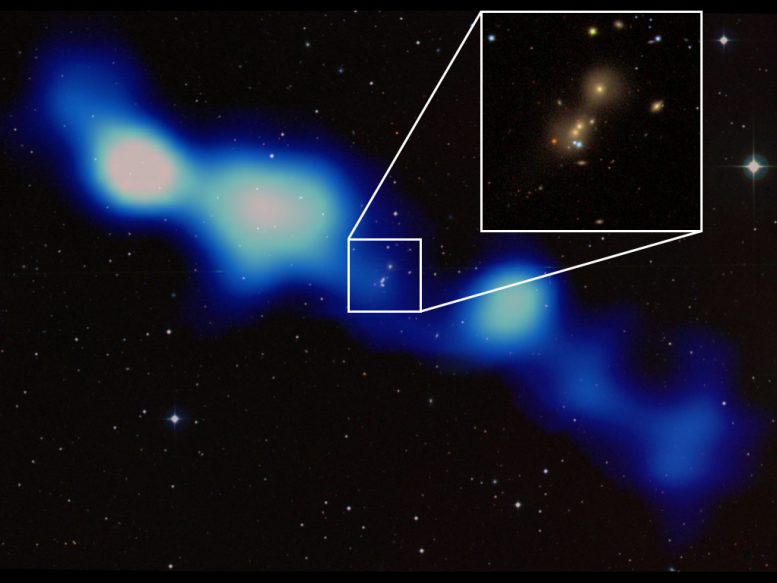
    Overlay of the new GRG (blue-white colors) on an optical image from the Digitized Sky survey. The inset shows the central galaxy triplet (image from Sloan Digital Sky Survey). The image is about 2 Mpc across. Credit: Sloan Digital Sky Survey

    Using the International LOFAR Telescope, astronomers identified a new galaxy that is a member of a class of objects called Giant Radio Galaxies (GRGs).

    A team of astronomers led by ASTRON astronomer Dr. George Heald has discovered a previously unknown gigantic radio galaxy, using initial images from a new, ongoing all-sky radio survey. The galaxy was found using the powerful International LOFAR Telescope (ILT), built and designed by ASTRON. The team is currently performing LOFAR’s first all-sky imaging survey, the Multi-frequency Snapshot Sky Survey (MSSS). While browsing the first set of MSSS images, Dr. Heald identified a new source the size of the full moon projected on the sky. The radio emission is associated with material ejected from one member of an interacting galaxy triplet system tens to hundreds of millions of years ago. The physical extent of the material is much larger than the galaxy system itself, extending millions of light-years across intergalactic space. The MSSS survey is still ongoing, and is poised to discover many new sources like this one.

    The new galaxy is a member of a class of objects called Giant Radio Galaxies (GRGs). GRGs are a type of radio galaxy with extremely large physical size, suggesting that they are either very powerful or very old. LOFAR is an effective tool to find new GRGs like this one because of its extreme sensitivity to such large objects, combined with its operation at low frequencies that are well suited to observing old sources.

    The center of the new GRG is associated with one member of a galaxy triplet known as UGC 09555. The central galaxy is located at a redshift of z=0.054536, or 750 million light-years from Earth. The central radio source was previously known and has a flat radio spectrum, typical of giant radio galaxies.

    LOFAR’s MSSS survey is a concerted effort to image the entire northern sky at very low radio frequencies, between 30 and 160 MHz (wavelengths from 2m to 10m). The primary aim of the survey is to perform an initial shallow scan of the sky, in order to create an all-sky model that will support the calibration of much deeper observations. It is comparable in sensitivity and angular resolution to previous surveys with ‘classical’ radio telescopes like the Very Large Array (VLA) in the USA, ASTRON’s Westerbork Synthesis Radio Telescope (WSRT), and the Giant Metrewave Radio Telescope (GMRT) in India. MSSS is unique in that it operates at substantially lower frequencies, and is therefore poised to uncover new sources that were missed by previous surveys. Its broad bandwidth coverage is also novel in all-sky radio surveys, and will be used to provide additional information about the detected objects.

    The international team of astronomers that is performing the MSSS survey is made up of about fifty members from various institutes, mostly in the Netherlands, Germany, the UK, Poland, France, and Italy.

    Never miss a breakthrough: Join the SciTechDaily newsletter.
    Follow us on Google and Google News.

    ASTRON Astronomy Astrophysics
    Share. Facebook Twitter Pinterest LinkedIn Email Reddit

    Related Articles

    Cosmic Probes: Astronomers Discover Massively Powerful Fast Radio Bursts That Skewer Nearby Galaxy

    Ultra-Sensitive Deep Radio Images Reveal Thousands of Star-Forming Galaxies in Early Universe

    Puzzling Periodicity of a Fast Radio Burst Probed by Two of the Biggest Radio Telescopes in the World

    Astronomers Obtain the Most Accurate Distance for a Radio Pulsar

    Galaxy Cluster Abell 2256 Undergoing Collisions

    Baryon Oscillation Spectroscopic Survey Measures the Universe’s Expansion and Dark Energy

    SN Primo Is Farthest Type Ia Supernova Discovered

    Scientists Convene to Take a Picture of the Supermassive Black Hole at the Center of the Milky Way

    Hubble Observes Rare Blue Stars in Andromeda’s Core

    Leave A Reply Cancel Reply

    • Facebook
    • Twitter
    • Pinterest
    • YouTube

    Don't Miss a Discovery

    Subscribe for the Latest in Science & Tech!

    Trending News

    Popular Sugar-Free Sweetener Linked to Liver Disease, Study Warns

    What Is Hantavirus? The Deadly Disease Raising Alarm Worldwide

    Scientists Just Discovered How the Universe Builds Monster Black Holes

    Scientists Unveil New Treatment Strategy That Could Outsmart Cancer

    A Simple Vitamin May Hold the Key to Treating Rare Genetic Diseases

    Scientists Think the Real Fountain of Youth May Be Hiding in Your Gut

    Ravens Don’t Follow Wolves, They Predict Them

    This Common Knee Surgery May Be Doing More Harm Than Good

    Follow SciTechDaily
    • Facebook
    • Twitter
    • YouTube
    • Pinterest
    • Newsletter
    • RSS
    SciTech News
    • Biology News
    • Chemistry News
    • Earth News
    • Health News
    • Physics News
    • Science News
    • Space News
    • Technology News
    Recent Posts
    • Scientists Just Found a Surprising Way To Destroy “Forever Chemicals”
    • Popular Supplement Ingredient Linked to Shorter Lifespan in Men
    • Scientists May Have Found a Way To Repair Nerve Damage in Multiple Sclerosis
    • GLP-1 Weight Loss Linked To Dramatically Lower Risk of Sleep Apnea, Kidney Disease and More
    • Scientists Uncover the Surprising Source of Strange Clouds Near the Milky Way’s Supermassive Black Hole
    Copyright © 1998 - 2026 SciTechDaily. All Rights Reserved.
    • Science News
    • About
    • Contact
    • Editorial Board
    • Privacy Policy
    • Terms of Use

    Type above and press Enter to search. Press Esc to cancel.