
Close Menu
    Facebook X (Twitter) Instagram
    SciTechDaily
    • Biology
    • Chemistry
    • Earth
    • Health
    • Physics
    • Science
    • Space
    • Technology
    Facebook X (Twitter) Pinterest YouTube RSS
    SciTechDaily
    Home»Space»SN Primo Is Farthest Type Ia Supernova Discovered
    Space

    SN Primo Is Farthest Type Ia Supernova Discovered

    By SciTechDailyJanuary 16, 2012No Comments2 Mins Read
    Facebook Twitter Pinterest Telegram LinkedIn WhatsApp Email Reddit
    Share
    Facebook Twitter LinkedIn Pinterest Telegram Email Reddit
    Tycho Supernova Remnant
    Tycho supernova remnant. Credit: NASA/CXC/SAO

    Supernova Primo originated 9 billion years ago, when its progenitor star exploded. The light was captured by the Hubble Space Telescope by a three-year project specifically trying to find Type Ia supernovae. These types of supernovae are paramount in order to discover more about the inflationary nature of our universe.

    Researchers have been able to verify its distance by redshift and it will help astronomers better understand our inflationary universe, but also the constraints of dark energy. It brings astronomers a step closer to understanding the nature of dark energy which drives the cosmic acceleration states John Grunsfeld, associate administrator for NASA’s Science Mission Directorate in Washington.
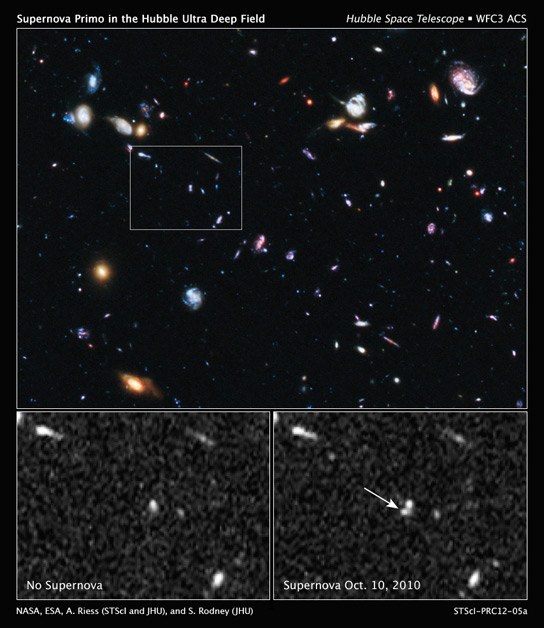
    supernova-primo-hubble

    Scientists believe that Type Ia supernovae originate from white dwarf stars that have collected an excess of materials from their companions and subsequently exploded. Due to their remote nature, they have been used to measure great distances with acceptable accuracy. The CANDELS, Cosmic Assembly Near-infrared Deep Extragalactic Legacy Survey, and CLASH,  Cluster Lensing and Supernova Survey with Hubble, Supernova Projects aims to create a census, thanks to the versatility of Hubble’s Wide Field Camera 3 so that astronomers can verify their distance with spectroscopy.

    Researchers say that while they’ve exhausted optical light, they’ve only begun in infrared light. It took the research team several months to locate SN Primo’s faint signature. It was first captured in October 2010. Then, the WFC3’s spectrometer needed to validate SN Primo’s distance and analyze the spectra to confirm that it’s a Type Ia supernova. As more of these types of supernovae are studied, if there are variations, it may lead to a way of categorizing these changes and aid in measuring dark energy. Riess and two other astronomers shared the 2011 Nobel Prize in Physics for discovering dark energy 13 years ago and using Type Ia supernova to plot the universe’s expansion rate.

    If supernovae take a long time to evolve to a point of explosion, it could take a long time to find Type Ia supernovae. However, if they form quickly, then they’ll be immediately visible, relatively speaking, and there should be many of them in our universe.

    Never miss a breakthrough: Join the SciTechDaily newsletter.
    Follow us on Google and Google News.

    Astronomy Astrophysics Dark Matter Hubble Space Telescope Supernova Telescope
    Share. Facebook Twitter Pinterest LinkedIn Email Reddit

    Related Articles

    Astronomers Watch as Collapsing Star Turns Into a Black Hole

    Fermi Data Reveal New Clues to Dark Matter

    New Spitzer Image of the Supernova in M82

    Hubble Views Polar Ring Galaxy NGC 660

    Hubble Reveals Largest Known Group of Star Clusters, Clues to Dark Matter

    Hubble Views Supernova Remnant SNR 0519

    Hubble Views Supernova That Exploded Over 10 Billion Years Ago

    New Observation of Dark Matter in Galaxy Cluster Abell 520

    Lonestar Supercomputer Helps Explore Dark Matter

    Leave A Reply Cancel Reply

    • Facebook
    • Twitter
    • Pinterest
    • YouTube

    Don't Miss a Discovery

    Subscribe for the Latest in Science & Tech!

    Trending News

    Popular Sugar-Free Sweetener Linked to Liver Disease, Study Warns

    What Is Hantavirus? The Deadly Disease Raising Alarm Worldwide

    Scientists Just Discovered How the Universe Builds Monster Black Holes

    Scientists Unveil New Treatment Strategy That Could Outsmart Cancer

    A Simple Vitamin May Hold the Key to Treating Rare Genetic Diseases

    Scientists Think the Real Fountain of Youth May Be Hiding in Your Gut

    Ravens Don’t Follow Wolves, They Predict Them

    This Common Knee Surgery May Be Doing More Harm Than Good

    Follow SciTechDaily
    • Facebook
    • Twitter
    • YouTube
    • Pinterest
    • Newsletter
    • RSS
    SciTech News
    • Biology News
    • Chemistry News
    • Earth News
    • Health News
    • Physics News
    • Science News
    • Space News
    • Technology News
    Recent Posts
    • Scientists Uncover the Surprising Source of Strange Clouds Near the Milky Way’s Supermassive Black Hole
    • This Dazzling Green Snake Was Hiding in Plain Sight for Decades
    • Scientists Discover That a Single Dose of Psilocybin Changes the Human Brain
    • “Totally Unexpected” – Scientists Discover Pancreatic Cancer’s Fatal Addiction
    • A Strange Quantum Effect May Explain One of Biology’s Greatest Mysteries
    Copyright © 1998 - 2026 SciTechDaily. All Rights Reserved.
    • Science News
    • About
    • Contact
    • Editorial Board
    • Privacy Policy
    • Terms of Use

    Type above and press Enter to search. Press Esc to cancel.