
Close Menu
    Facebook X (Twitter) Instagram
    SciTechDaily
    • Biology
    • Chemistry
    • Earth
    • Health
    • Physics
    • Science
    • Space
    • Technology
    Facebook X (Twitter) Pinterest YouTube RSS
    SciTechDaily
    Home»Biology»Mesodinium Chamaeleon Is A Unique Life Form That is Half Plant Half Animal
    Biology

    Mesodinium Chamaeleon Is A Unique Life Form That is Half Plant Half Animal

    By SciTechDailyJanuary 15, 20123 Comments3 Mins Read
    Facebook Twitter Pinterest Telegram LinkedIn WhatsApp Email Reddit
    Share
    Facebook Twitter LinkedIn Pinterest Telegram Email Reddit
    ciliate-mesodinium-protozoan
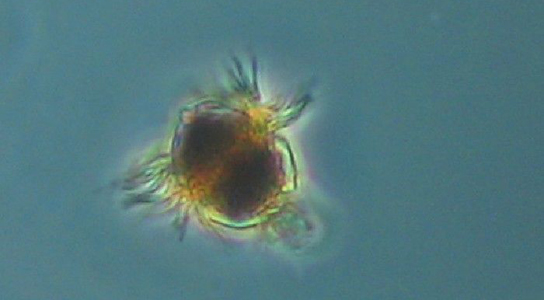
    M. chamaeleon temporarily takes in algal cells, keeping them for several weeks before breaking them down. The chameleon changes colors based on the hosted algae, displaying red, green, or a combination of both. This method of taking other cells in is called endosymbiosis, M. chamaeleon offers a portrait of how endosymbiosis was initially developed.

    In nature, you’ll find animals that undergo vast transformations, becoming almost unreco_gnizable in their new forms. Examples like caterpillars becoming butterflies and tadpoles becoming frogs that almost look like distinct animals in the different stages of their evolution.

    While this might sound amazing, all stages of these animals still belong to the same biological taxonomic rank, Animalia. This means that caterpillars don’t become plants, in their new shapes, they remain animals. That’s not what Mesodinium chamaeleon does. This single-celled organism is a unique mix of animal and plant life.

    Mesodinium chamaeleon, a ciliate – a group of protozoans – found in the oceans around Scandinavia and North America, was discovered in Nivå Bay (Baltic Sea) in Denmark by Øjvind Moestrup of the University of Copenhagen and his team. Other specimens have been found off the coasts of Finland and Rhode Island.
    planktonic-protist-hard-parts

    Ciliates use their hair-like appendages to move around rapidly in the oceans. They get their food by ingesting other organisms, rather than synthesizing the nutrients themselves, which makes them Animalia.

    However, some Mesodinium species are different. They engulf their prey, generally other microorganisms like a type of algae called cryptomonads, and then form a partnership. The algae produce sugars through photosynthesis, while the Mesodinium protects them and carries them around. A hybrid organism like this is both Animalia and Vegetabilia. This makes them hard to classify, and basically collapses the division between animals and plants. M. chamaeleon is halfway between a pure animal and a hybrid.

    While M. chamaeleon takes in algal cells, just like M. rubrum which is responsible for the red tides, it doesn’t keep them on a permanent basis. It also doesn’t digest them immediately. Instead, the cells will remain intact for several weeks before they are broken down. During this time, they continue to produce sugar by photosynthesis. M. chamaeleon changes colors depending on whether it’s hosting red or green algae, or even both.

    This method of taking other cells in is called endosymbiosis, and it’s one of life’s prime inventions. Two billion years ago, a single-celled organism swallowed a bacterium and used it as an energy source. They eventually became the mitochondria that power all complex cells, including our own. Without endosymbiosis, there wouldn’t be any multicellular life.

    M. chamaeleon offers a portrait of how endosymbiosis was initially developed. The organism still needs to ingest other cells to keep them alive within itself.

    Never miss a breakthrough: Join the SciTechDaily newsletter.
    Follow us on Google and Google News.

    Animals Endosymbiosis Hybrid Marine Biology Plants Popular
    Share. Facebook Twitter Pinterest LinkedIn Email Reddit

    Related Articles

    Insight on the Evolution of Cocaine Biosynthesis

    Increased Number of Plant Species Responding to Global Warming

    Butterfly Research Reveals Genetic Sharing from Hybridization

    “Map of Life” to Illustrate All Living Things Geographically

    Adult White Killer Whale Spotted in the Wild for the First Time

    Relationships of Male Dolphins from Shark Bay Determined by Slow Swimming

    Black Band Disease Puts Great Barrier Reef at Risk

    Noise Affects More Than Just Your Ears

    Researchers Discover ‘Supergiant’ Amphipods in the Kermadec Trench

    3 Comments

    1. Kiel on February 24, 2014 4:47 pm

      Who wrote this article?
      https://scitechdaily.com/mesodinium-chamaeleon-is-a-unique-life-form-that-is-half-plant-half-animal/
      I am writing a paper and I would like the information for my bibliography.
      Thank you

      Reply
      • Staff on February 24, 2014 6:48 pm

        One of our staff writers, goes by Range…Article is a summary of the New Scientist article (link at end of article) and other scientific information.

        Reply
    2. Lion man on October 16, 2021 12:50 am

      😎cool read

      Reply
    Leave A Reply Cancel Reply

    • Facebook
    • Twitter
    • Pinterest
    • YouTube

    Don't Miss a Discovery

    Subscribe for the Latest in Science & Tech!

    Trending News

    Scientists May Have Found the Key to Jupiter and Saturn’s Moon Mystery

    Scientists Uncover Brain Changes That Link Pain to Depression

    Saunas May Do More Than Raise Body Temperature – They Activate Your Immune System

    Exercise in a Pill? Metformin Shows Surprising Effects in Cancer Patients

    Hidden Oceans of Magma Could Be Protecting Alien Life

    New Study Challenges Alzheimer’s Theories: It’s Not Just About Plaques

    Artificial Sweeteners May Harm Future Generations, Study Suggests

    Splashdown! NASA Artemis II Returns From Record-Breaking Moon Mission

    Follow SciTechDaily
    • Facebook
    • Twitter
    • YouTube
    • Pinterest
    • Newsletter
    • RSS
    SciTech News
    • Biology News
    • Chemistry News
    • Earth News
    • Health News
    • Physics News
    • Science News
    • Space News
    • Technology News
    Recent Posts
    • Researchers Capture Quantum Interference in One of Nature’s Rarest Atoms
    • Ancient DNA Reveals Irish Goats Have a 3,000-Year-Old Lineage Still Alive Today
    • Historians Reveal Secrets of the Strange Hat Wars That Shook Early Modern England
    • “A Plague Is Upon Us”: The Mass Death That Changed an Ancient City Forever
    • This Strange Material Can Turn Superconductivity on and off Like a Switch
    Copyright © 1998 - 2026 SciTechDaily. All Rights Reserved.
    • Science News
    • About
    • Contact
    • Editorial Board
    • Privacy Policy
    • Terms of Use

    Type above and press Enter to search. Press Esc to cancel.