
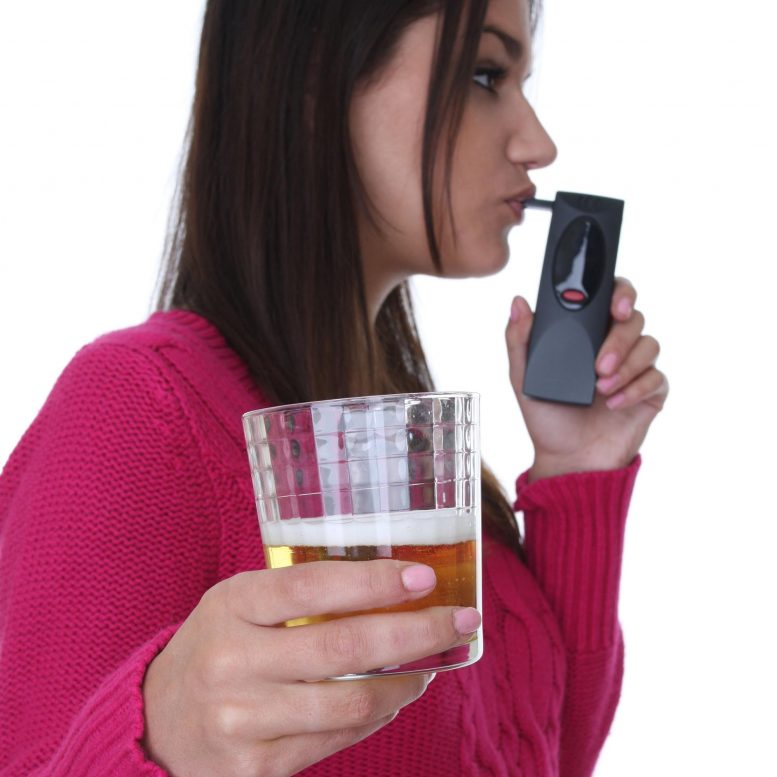
Some failed to detect users were over the legal driving limit more than half the time, Penn medicine research finds.
Alcohol-impaired driving kills 29 people a day and costs $121 billion a year in the U.S. After years of progress in reducing alcohol-impaired driving fatalities, efforts began to stall in 2009, and fatalities started increasing again in 2015. With several studies demonstrating that drinkers cannot accurately estimate their own blood alcohol concentration (BAC), handheld alcohol breath testing devices, also known as breathalyzers, allow people to measure their own breath alcohol concentration (BrAC) to determine if they are below the legal limit of .08% before attempting to drive.
The latest generation of personal alcohol breath testing devices pair with smartphones. While some of these devices were found to be relatively accurate, others may mislead users into thinking that they are fit to drive, according to a new study from the Perelman School of Medicine at the University of Pennsylvania.
The findings, published today (May 9, 2021) in Alcoholism: Clinical & Experimental Research, compares the accuracy of six such devices with that of two validated alcohol-consumption tests — BAC taken from venipuncture, and a police-grade handheld breath testing device.
“All alcohol-impaired driving crashes are preventable tragedies,” says lead investigator M. Kit Delgado, MD, MS, an assistant professor of Emergency Medicine and Epidemiology at Penn. “It is common knowledge that you should not drive if intoxicated, but people often don’t have or plan alternative travel arrangements and have difficulty judging their fitness to drive after drinking. Some may use smartphone breathalyzers to see if they are over the legal driving limit. If these devices lead people to incorrectly believe their blood alcohol content is low enough to drive safely, they endanger not only themselves, but everyone else on the road or in the car.”
To assess these devices, researchers engaged 20 moderate drinkers between the ages of 21 and 39. The participants were given three doses of vodka over 70 minutes with the goal of reaching a peak BAC over the legal driving limit of around 0.10%. After each dose, participants’ BrAC was measured using smartphone-paired devices and a police-grade handheld device. After the third dose, their blood was drawn and tested for BAC, the most accurate way of measuring alcohol consumption. Researchers also explored the devices’ ability to detect breath alcohol concentration above common legal driving limits (0.05% and 0.08%). They used statistical analysis to explore differences between the measurements.
A Mixed Bag: Some Devices Show Promise
All seven devices underestimated BAC by more than 0.01%, though the some were consistently more accurate than others. Two devices failed to detect BrAC levels of 0.08% as measured by a police-grade device more than half the time. Since the completion of the study, one of the devices was discontinued and is no longer sold, and other models have been replaced by newer technologies. However, two of the other devices had similar accuracy as a police-grade device. These devices have been used to remotely collect accurate measurements of alcohol consumption for research. They could also be used to scale up contingency management addiction treatment programs that have been shown to help promote abstinence among patients with alcohol use disorders. These programs, which have proven to be highly effective, have traditionally provided prizes for negative in person breathalyzer measurements. Smartphone breathalyzer apps allow these programs to be administered remotely as breath alcohol readings can be verified with automatically captured pictures of the person’s face providing the reading and prize redemption could be automated.
“While it’s always best to plan not to drive after drinking, if the public or addiction treatment providers are going to use these devices, some are more accurate than others. Given how beneficial these breathalyzer devices could be to public health, our findings suggest that oversight or regulation would be valuable,” Delgado concludes. “Currently, the Food and Drug Administration doesn’t require approval for these devices — which would involve clearance based on review of data accuracy — but it should reconsider this position in light of our findings.”
Reference: “Accuracy of Consumer-marketed smartphone-paired alcohol breath testing devices: A laboratory validation study” by Mucio Kit Delgado, Frances Shofer, Reagan Wetherill, Brenda Curtis, Jessica Hemmons, Evan Spencer, Charles Branas, Douglas J. Wiebe andHenry R. Kranzler, 9 May 2021, Alcoholism: Clinical & Experimental Research.
DOI: 10.1111/acer.14597
Research reported in this publication was supported by the Centers for Disease Control and Prevention (R49 CE002474) and the National Institutes of Health (K23 HD090272001 and UL1 TR001878). This research was also supported in part by the VISN 4 Mental Illness Research, Education and Clinical Center of the Department of Veterans Affairs and Abramson Family Foundation Fund for Acute Care and Injury Prevention Research.
Never miss a breakthrough: Join the SciTechDaily newsletter.
Follow us on Google and Google News.
1 Comment
so – where is the data?