
ETH Zurich researchers have succeeded in demonstrating that quantum mechanical objects that are far apart can be much more strongly correlated with each other than is possible in conventional systems. For this experiment, they used superconducting circuits for the first time.
- ETH Zurich researchers have made the first-ever loophole-free Bell test with superconducting circuits.
- They have confirmed that the conventional concepts of causality do not apply in the quantum world.
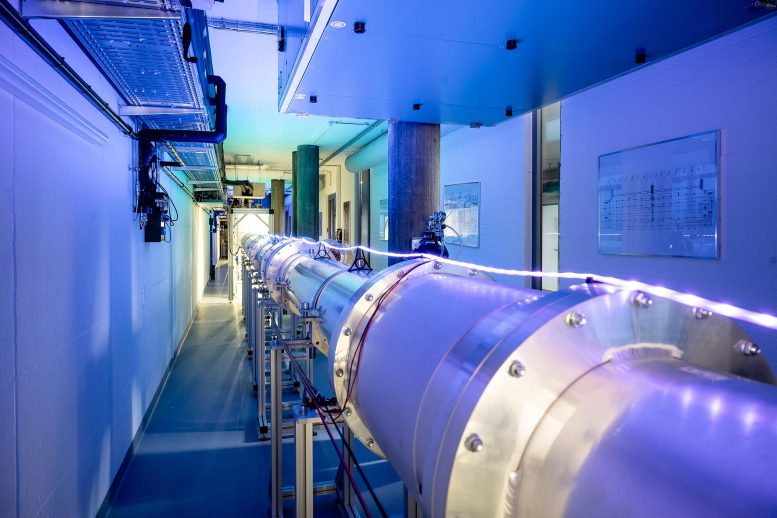
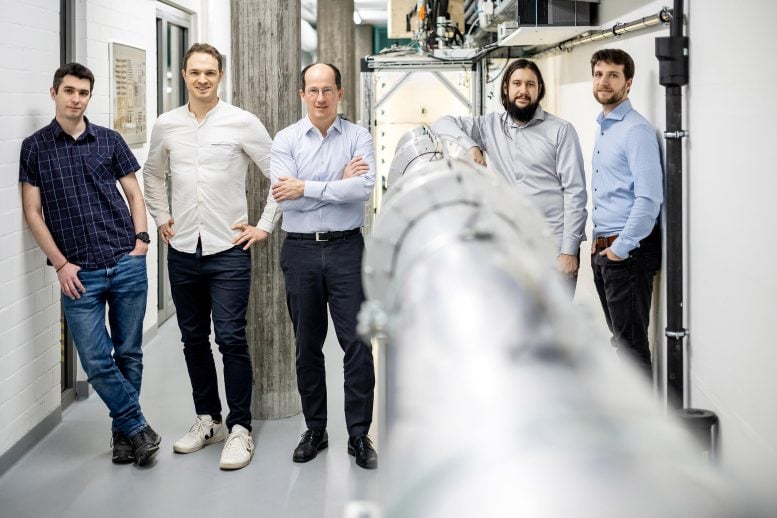
- For these experiments, they used a 30-meter-long tube whose interior is cooled to a temperature just above absolute zero (–273.15°C).
A group of researchers led by Andreas Wallraff, Professor of Solid State Physics at ETH Zurich, has performed a loophole-free Bell test to disprove the concept of “local causality” formulated by Albert Einstein in response to quantum mechanics. By showing that quantum mechanical objects that are far apart can be much more strongly correlated with each other than is possible in conventional systems, the researchers have provided further confirmation for quantum mechanics. What’s special about this experiment is that the researchers were able for the first time to perform it using superconducting circuits, which are considered to be promising candidates for building powerful quantum computers.
An Old Dispute
A Bell test is based on an experimental setup that was initially devised as a thought experiment by British physicist John Bell in the 1960s. Bell wanted to settle a question that the greats of physics had already argued about in the 1930s: Are the predictions of quantum mechanics, which run completely counter to everyday intuition, correct, or do the conventional concepts of causality also apply in the atomic microcosm, as Albert Einstein believed?
To answer this question, Bell proposed to perform a random measurement on two entangled particles at the same time and check it against Bell’s inequality. If Einstein’s concept of local causality is true, these experiments will always satisfy Bell’s inequality. By contrast, quantum mechanics predicts that they will violate it.
The Last Doubts Dispelled
In the early 1970s, John Francis Clauser, who was awarded the Nobel Prize in Physics last year, and Stuart Freedman carried out the first practical Bell test. In their experiments, the two researchers were able to prove that Bell’s inequality is indeed violated. But they had to make certain assumptions in their experiments to be able to conduct them in the first place. So, theoretically, it might still have been the case that Einstein was correct to be skeptical of quantum mechanics.
Over time, however, more and more of these loopholes could be closed. Finally, in 2015, various groups succeeded in conducting the first truly loophole-free Bell tests, thus finally settling the old dispute.
Promising Applications
Wallraff’s group can now confirm these results with a novel experiment. The work by the ETH researchers published in the renowned scientific journal Nature shows that research on this topic is not concluded, despite the initial confirmation seven years ago. There are several reasons for this. For one thing, the ETH researchers’ experiment confirms that superconducting circuits operate according to the laws of quantum mechanics too, even though they are much bigger than microscopic quantum objects such as photons or ions. The several hundred micrometer-sized electronic circuits made of superconducting materials and operated at microwave frequencies are referred to as macroscopic quantum objects.
For another thing, Bell tests also have a practical significance. “Modified Bell tests can be used in cryptography, for example, to demonstrate that information is actually transmitted in encrypted form,” explains Simon Storz, a doctoral student in Wallraff’s group. “With our approach, we can prove much more efficiently than is possible in other experimental setups that Bell’s inequality is violated. That makes it particularly interesting for practical applications.”
The Search for a Compromise
However, the researchers need a sophisticated test facility for this. Because for the Bell test to be truly loophole-free, they must ensure that no information can be exchanged between the two entangled circuits before the quantum measurements are complete. Since the fastest that information can be transmitted is at the speed of light, the measurement must take less time than it takes a light particle to travel from one circuit to another.
So, when setting up the experiment, it’s important to strike a balance: the greater the distance between the two superconducting circuits, the more time is available for the measurement – and the more complex the experimental setup becomes. This is because the entire experiment must be conducted in a vacuum near absolute zero.
The ETH researchers have determined the shortest distance over which to perform a successful loophole-free Bell test to be around 33 meters, as it takes a light particle about 110 nanoseconds to travel this distance in a vacuum. That’s a few nanoseconds more than it took the researchers to perform the experiment.
Thirty-Meter Vacuum
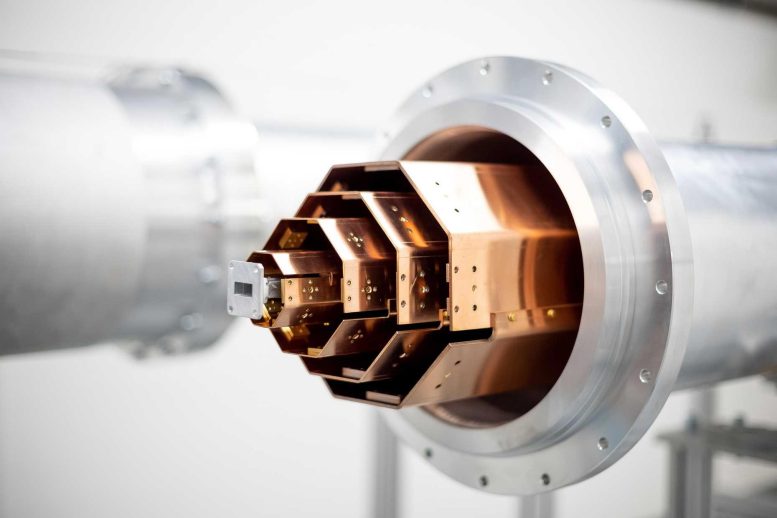
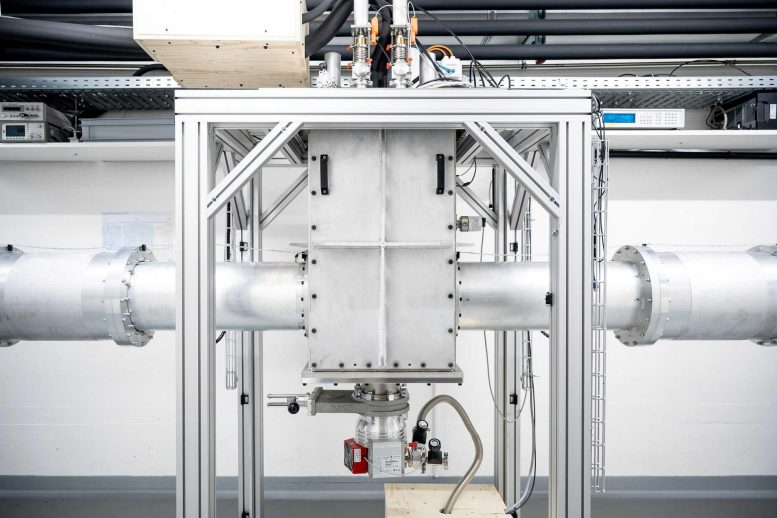
Wallraff’s team has built an impressive facility in the underground passageways of the ETH campus. At each of its two ends is a cryostat containing a superconducting circuit. These two cooling apparatuses are connected by a 30-meter-long tube whose interior is cooled to a temperature just above absolute zero (–273.15°C).
Before the start of each measurement, a microwave photon is transmitted from one of the two superconducting circuits to the other so that the two circuits become entangled. Random number generators then decide which measurements are made on the two circuits as part of the Bell test. Next, the measurement results on both sides are compared.
Large-Scale Entanglement
After evaluating more than one million measurements, the researchers have shown with very high statistical certainty that Bell’s inequality is violated in this experimental setup. In other words, they have confirmed that quantum mechanics also allows for non-local correlations in macroscopic electrical circuits and consequently that superconducting circuits can be entangled over a large distance. This opens up interesting possible applications in the field of distributed quantum computing and quantum cryptography.
Building the facility and carrying out the test was a challenge, Wallraff says. “We were able to finance the project over a period of six years with funding from an ERC Advanced Grant.” Just cooling the entire experimental setup to a temperature close to absolute zero takes considerable effort. “There are 1.3 tonnes of copper and 14,000 screws in our machine, as well as a great deal of physics knowledge and engineering know-how,” Wallraff says. He believes that it would in principle be possible to build facilities that overcome even greater distances in the same way. This technology could, for instance, be used to connect superconducting quantum computers over great distances.
Reference: “Loophole-free Bell inequality violation with superconducting circuits” by Simon Storz, Josua Schär, Anatoly Kulikov, Paul Magnard, Philipp Kurpiers, Janis Lütolf, Theo Walter, Adrian Copetudo, Kevin Reuer, Abdulkadir Akin, Jean-Claude Besse, Mihai Gabureac, Graham J. Norris, Andrés Rosario, Ferran Martin, José Martinez, Waldimar Amaya, Morgan W. Mitchell, Carlos Abellan, Jean-Daniel Bancal, Nicolas Sangouard, Baptiste Royer, Alexandre Blais and Andreas Wallraff, 10 May 2023, Nature.
DOI: 10.1038/s41586-023-05885-0
Never miss a breakthrough: Join the SciTechDaily newsletter.
Follow us on Google and Google News.
19 Comments
“for instance, be used to connect superconducting quantum computers over ***great*** distances.”
What, like 1/1000 0f a mm.? ‘great’ ‘large’ are imprecise errors in terminology repeated over and over by scientists, like “observe,” means nothing like it is normally understood to mean.A great distance could be 10 billion light years, or a millimeter, or when you have to sweep the entire gymnasium. Excellent article otherwise.
So… A list of technical biases and “codicils” and, a couple of hundred words later, Schrödinger’s Cat is… DEAD?
Hmmm… that leaves eight additional lives “swinging” in the balance of a MACRO Universe…
On a more practical note, there Ne0: Cryptography and Super Computing will take a leap at the Moon. No more secrets!
Mr. Smith (his cyber-soul) will be pleased as Punch… and Judy.
🎪
I could have sworn I just read an article very recently that said quantum entanglement MUST obey the speed of light, hence crushing any hopeful ideas about building a Star Trek style communication device that could communicate over vast light years instantly or with a much smaller delay, at least (it seemed to change throughout the show how long so-called subspace communications took (Does the quantum realm equate to subspace? Who knows.), being instant when convenient for a video call and delayed when convenient for a plot of “No help is coming”.
This article appears to suggest that light speed is NOT a factor in quantum entanglement and that the two qubits act as a single system regardless of distance (after all, how can they act as one if they’re delayed over vast tracts of time/distance?). Or did I misread it? Frankly, I find it very disconcerting (spooky if you will) that two such “proof” articles exist so close together, yet there’s no mention of the other one. Or perhaps I simply don’t understand quantum mechanics at all, which seems a probable reality factor.
Albert, I remember that pop article, too. Seeing that, I followed the link to the paper.
The problem with that article (not the paper and experiment it described) is it encouraged just that sort of misunderstanding, that what was being measured was the time it took for the collapse of one particle’s state of superposition to affect the other. In fact it seems likely the author of the pop article was confused on this point.
But the paper itself was about measuring the duration of the process in which two particles become entangled. This is not the “speed” with which the collapse of one particle’s state from a state of superposition affects the state of the other particle. One is a question regarding the beginning of entanglement, which takes time.
The other is a question regarding the end of the state of entanglement, where the joint state of superposition ends with the collapse of superposition at the time one measures the state of one of the particles. It provides information regarding what result a measurement of the other particle will result in. In fact, in a state of maximum entanglement (one of the four Bell states), the measurement of one tells you exactly what the measurement of the state of the will be.
That is what is “instantaneous” in the popular explanation of the phenomenon. But according to quantum mechanics, if two particles are entangled this is because neither has a state independently of the other.
Expressed mathematically, their entangled state of superposition cannot be factored into two independent states of superposition. This is what is meant when we say that they exist in an entangled state. Thus when a measurement of one is performed we obtain information about what a measurement of the other will result in.
Interestingly, according to special relativity this means that depending upon one’s frame of reference, the order of measurements may be reversed. Regardless, this cannot be used to transfer information as cannot force a state to collapse one way or the other. The collapse is random.
There other related misconceptions that affect our understanding of superposition worth debunking.
Like most, I speak of measurement as collapsing the wave function, but it is really the process of interaction whereby a once-insulated subsystem interacts and and therefore becomes entangled with the larger system, the particle pair plus it’s environment. After the interaction, a description of the subsystem as if it were in isolation from the it’s environment will be as a mixed state where it cannot be described by a single wave function (a vector where each element in the vector is a complex number coefficient of an eigen state) but must instead be described by a probability density operator, a matrix of coefficients of joint eigen states. But this is only because we are trying to analyse the system as if it were isolated.
The mathematics of quantum mechanics tells us that systems always evolve in a unitary fashion, that is, in accordance with a deterministic process where a state vector rotates in Hilbert space.
The trouble is, once a macroscopic object interacts with a subsystem that is in a state of superposition, since the macroscopic object is typically in a constant state of interaction with it’s environment one cannot describe the subsystem plus measurement instrument as if it were in isolation from the instrument’s environment except as a statistical mixture.
However, everything that exists is ultimately composed of quantum subsystems and itself quantum in nature. Ultimately this even applies to the universe itself – which would by definition be a closed system that has no larger system in which it is embedded and thus no environment with which to interact.
The way I see it photography has an outstanding understanding to so many areas. Whom ever started this world wide controversy has many talents to space clouds and photos, photosynthesis,and more. Sucks being annonimous
When scaling down from the standard to the quantum for measurement is the speed of light scaled faster or slower because of the size difference in the quantum, how about electrical charge abilities at the quantum level is the standard to large for quantum manipulation, scaling in the correct direction from standard to the quantum particle level is adaptiful tool. Is the speed of light multiplied negative or is the speed of light multiplied plus. Scale is relevant and fundamental in searching to answer Quantum.
Forgive me in advance for my ignorance of this subject and quantum mechanics in general. But, from a practical “spooky at a distance communication of information” standpoint, how exactly do we continuously store and sequester and measure/read entangled quantum particles to create a communications protocol? Could one, say, leave Earth with a “set” of entangled particles with the complimentary entangled “set” left behind, and then communicate information instantaneously – faster than light speed – from many light years away? Thanks for any explanations.
Yes.
If I understand it correctly (and I may not), Bell’s inequality is violated by classical electromagnetic waves, and there’s no violation of locality or relativity or causality there. Similarly, violating Bell’s inequality demonstrates that fields, not particles, are what is fundamental. That’s not a new idea: it’s the basis of Quantum Field Theory. Fields can violate Bell’s inequality without any need to communicate anything between the measurements, without nonlocality.
The Matrix is all around you. It needs to violate FTL and causality to keep control mechanisms in place for the entire Universe (something has to know where everything is located with a master clock, not relative time perception). Entanglement is simply a barely noticed function of The Matrix keeping tabs on the location of all “things”. Quantum probability comes down to saving CPU time and only rendering things in the Universe where actual people (think player characters in D&D) are looking as opposed to people that are just programs and part of the system. That is why there is so much empty space. It appears much larger than it really is and it only has to render something where a telescope is looking and keeps the objects in a matrixed data pool the rest of the time.
Sorry Neo. You’re living in a dream world.
Actually anonymously known is really well until you get to the point of where it’s no return but s*** anyways the simplicity of the whole thing is understanding energy it’s simple. But people make simple things so complex because the simplest things are just I don’t know maybe it’s too simple to perceive s*** it is what it is but it’s simple understand energy oh yeah and don’t forget to pray God bless you f*** man wisdom knowledge and understanding comes from reading the Bible bro not a science book
You need the clock and faith and science to see 👀
Schodingers cat lives, every single time. But also dies, in the alternate universe.
Schrodinger was a MONSTER.
Fascinating how we can be dead and alive at the same time! Frosted Flake, 🍦
I got a little deeper into the Bell thrym and causality trying to separate any real particle from another in reality without quantum state between the two can not be done you can only hope to insulate but never a complete separation of entanglement, touching intangles any quantum state attaching in a mixed field exchange of electrons the best to be achieved is slowing or changing transmission thru insulation, at the standard level an example would be nuclear power and shielding methods with even the best some quantum exchange is passing. Find the paths of entanglement and how to use them set paths.
Who cares about quantum physics crazy crap. It’s so small how can we ever understand it. Not even God can handle it. What does that prove? Leave it the hell alone. If it ain’t broke don’t fix it! Wake up you dumb bastards.
Just because you don’t understand it doesn’t mean that it shouldn’t be explored, learned, then utilized. It’s really annoying when people don’t understand something scientifically, they revert to “god” ( I didn’t capitalize on purpose). Anyway, knowledge of science is what will advance and maybe save humanity from possible extinction sometime in the future. Science isn’t perfect all the time, but it sure as hell isn’t broken. Science may even stall for a bit until tech advances enough to be able to answer those questions that humanity has. Right now, technology is advancing at an explosive rate, and it is mind blowing. There is some pretty impressive things happening in science, and some of it sounds like scientists are just making things up, but I feel that if you keep reading these articles, especially articles that pertain to this field of science you may start getting a better understanding as to how, and why, and then where this takes humanity. The more you inquire and read, the easier it becomes to grasp and understand the material. You obviously have a curiosity about this, so roll with that and keep learning. Just because it is a bit confusing at first, doesn’t mean you should get mad about it, shut it down, and criticize the scientists, writer, and reader/commenters. Embrace that curiosity, and ask those questions, and learn the material.
I will admit, not everyone that has commented, has stayed on subject. Maybe even confused or crossed disciplines, but that hardly makes them “dumb b*stards”. And if you believe that “god” created this complex universe and doesn’t understand it, well, I’d say that is the dumbest thing I’ve read since reading your comment. Quit bringing “god” into topics of science. You downplay womankind and mankind’s accomplishments in those fields.
Thank you
God told me not to bury my wealth of knowledge but to give it freely to everyone. Look up all the definitions for EVEN not just as a word but across so so so many languages especially when in math and spirituality. When the number 1 is a EVEN number. I will not have the name of God the father blotted out. I am the anonymous one. I will not sit in the shade but bright you to the true light.