
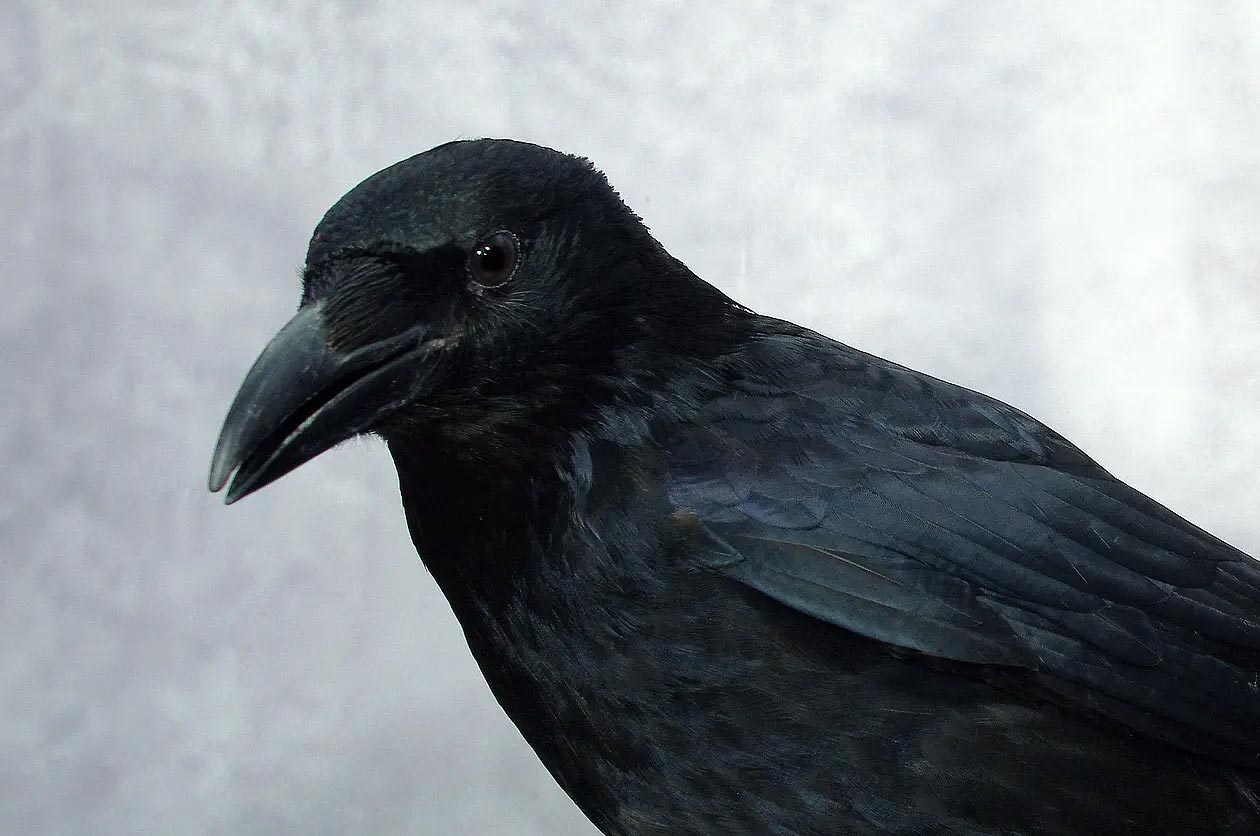
Quick decisions are essential for birds navigating the world at high speed, and new research suggests crows may have a remarkable advantage over humans in processing what they see.
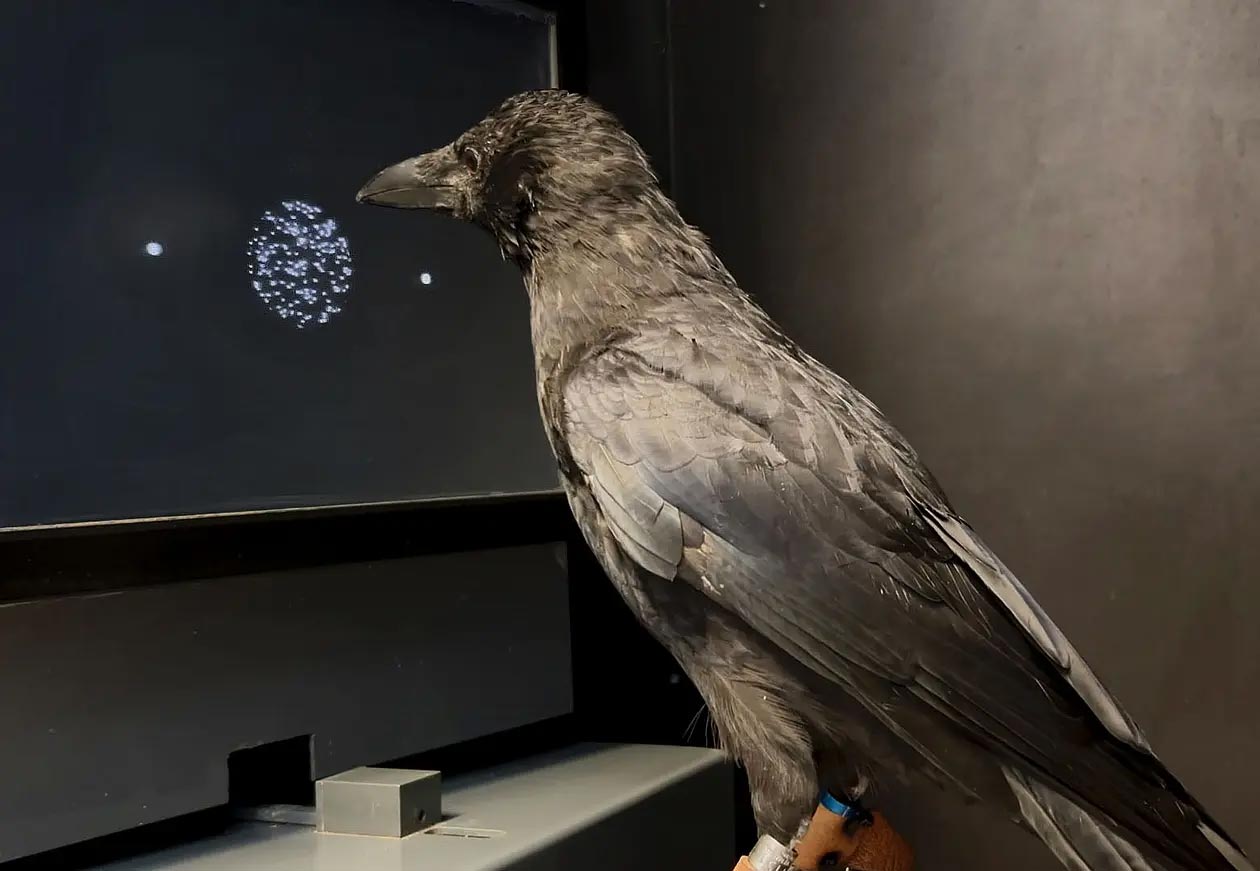
A crow can make a visual decision in less than a quarter of a second, about twice as fast as a human or monkey. Researchers at the University of Tübingen discovered this remarkable speed by asking two carrion crows to identify the direction of moving dots on a screen. The birds made their choices in an average of just 235 milliseconds while maintaining a high degree of accuracy.
During the experiment, the crows watched patterns of moving dots on a touchscreen and had to determine whether most were traveling to the left or right. They indicated their answer by pecking a target on the corresponding side of the screen. Some patterns made the direction easy to identify, while others were much harder to interpret.
“Even when the patterns of motion were hard to recognize, the crows’ decisions were still better than random choices,” Philipp Schmidbauer reports, “and with clear signals, they achieved an accuracy of nearly 100 percent.”
Crows’ brains distinguish motion in 70 milliseconds
Schmidbauer and Professor Andreas Nieder, both from the University of Tübingen’s Institute of Neurobiology, investigated how the birds’ brains could process visual information so quickly. Their study, published in the journal Science, examined the activity of individual nerve cells, or neurons, in a brain region called the nidopallium caudolaterale. This area helps birds process information and make decisions, performing a role comparable to that of the prefrontal cortex in humans.
The recordings revealed that the crows’ brains began distinguishing between the two possible directions just 70 milliseconds after the moving dots appeared. As the birds processed what they were seeing, neural activity gradually increased until it reached a threshold associated with making a decision. These signals reflected both how clearly the dots indicated a particular direction and which direction the crow ultimately chose.
“These findings show that neuronal dynamics in the avian brain are consistent with established models of decision-making in humans and non-human primates,” says Andreas Nieder.
Unlike humans and other primates, birds do not have a layered cerebral cortex. Despite this structural difference, the findings suggest that their brains use similar fundamental principles to make decisions. The remarkable difference is how quickly the crows appear to carry out this process.
Flight and foraging may favor speed
Nieder suggests that this speed may be connected to the demands of birds’ everyday lives, which often require rapid visual processing and precise movements. “Birds rely on their vision to carry out precise, rapid maneuvers during flight and to guide their beaks towards objects when foraging,” he says.
Although these demands could help explain the crows’ speed, researchers still need to determine exactly which mechanisms allow birds to make visual decisions so much faster than primates.
Reference: “Ultrarapid decision-making in an avian brain” by Philipp Schmidbauer and Andreas Nieder, 22 October 2026, Science.
DOI: 10.1126/science.aed6459
Never miss a breakthrough: Join the SciTechDaily newsletter.
Follow us on Google and Google News.
1 Comment
They have to, eat or be eaten