
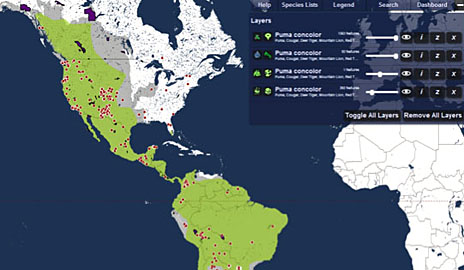
Now open to the public, a demonstration version of the “Map of Life” is set to illustrate how all living things on the planet are distributed geographically. The researchers from Yale and their colleagues believe that this Google Maps-based platform will help to identify and fill knowledge gaps in living species.
A Yale-led research team has opened to the public a demonstration version of its “Map of Life,” an ambitious Web-based endeavor to depict how all living things on the planet, animals and plants alike, are distributed geographically.
Built on a Google Maps platform, the debut version allows anyone with an Internet connection to map the known global distribution of almost all 30,000 species of terrestrial vertebrate animals, including mammals, birds, amphibians, reptiles, and North American freshwater fish.
“It is the where and the when of a species,” said Walter Jetz, associate professor of ecology and evolutionary biology at Yale University and the project lead. “It puts at your fingertips the geographic diversity of life. Ultimately, the hope is for this literally to include hundreds of thousands of animals and plants, and show how much or indeed how little we know of their whereabouts.”
Jetz and colleagues from the University of Colorado and the Calgary Zoological Society described their vision for the curated, Wiki-style mapping tool in a recent paper in the journal Trends in Ecology and Evolution.
By highlighting the known distribution of species, the researchers hope to identify and fill knowledge gaps and also offer a tool for detecting change over time. They expect the map tool will prove useful for professional scientists, wildlife and land managers, conservation organizations, and interested laypersons alike. Sources for species location in the debut version include museum, local, and regional checklists, and the recorded observations of professional and amateur scientists alike.
The extent to which the project results in a truly exhaustive depiction of life on earth will depend on participation over time by other professional scientists and informed amateurs, the researchers said. Subsequent iterations of the mapping tool will offer mechanisms for users to supply new or missing information. Fundamentally, Jetz said, the map is “an infrastructure, something to help us all collaborate, improve, share, and understand the still extremely limited geographic knowledge about biodiversity.”
The initial version of the map tool released today is intended to introduce it to the broader public. It allows users to see several levels of detail for a given species — at broadest, the type of environment it lives in; at finest, specific locations where its presence has been documented. One function allows users to click a point on the map and generate a list of vertebrate species in the surroundings. More functions will be added over time.
“Ever wanted to know which birds or frogs you may encounter in your backyard or vacation destination?“ said project collaborator Rob Guralnick of the University of Colorado. “Map of Life gives you the list and also informs you which ones may be of particular conservation concern.”
The National Science Foundation and NASA provided initial support for the project. Other partners and contributors include the Encyclopedia of Life, Senckenberg Museum, and BiK-F Germany, The International Union for Conservation of Nature, and the Global Biodiversity Information Facility.
Never miss a breakthrough: Join the SciTechDaily newsletter.
Follow us on Google and Google News.