
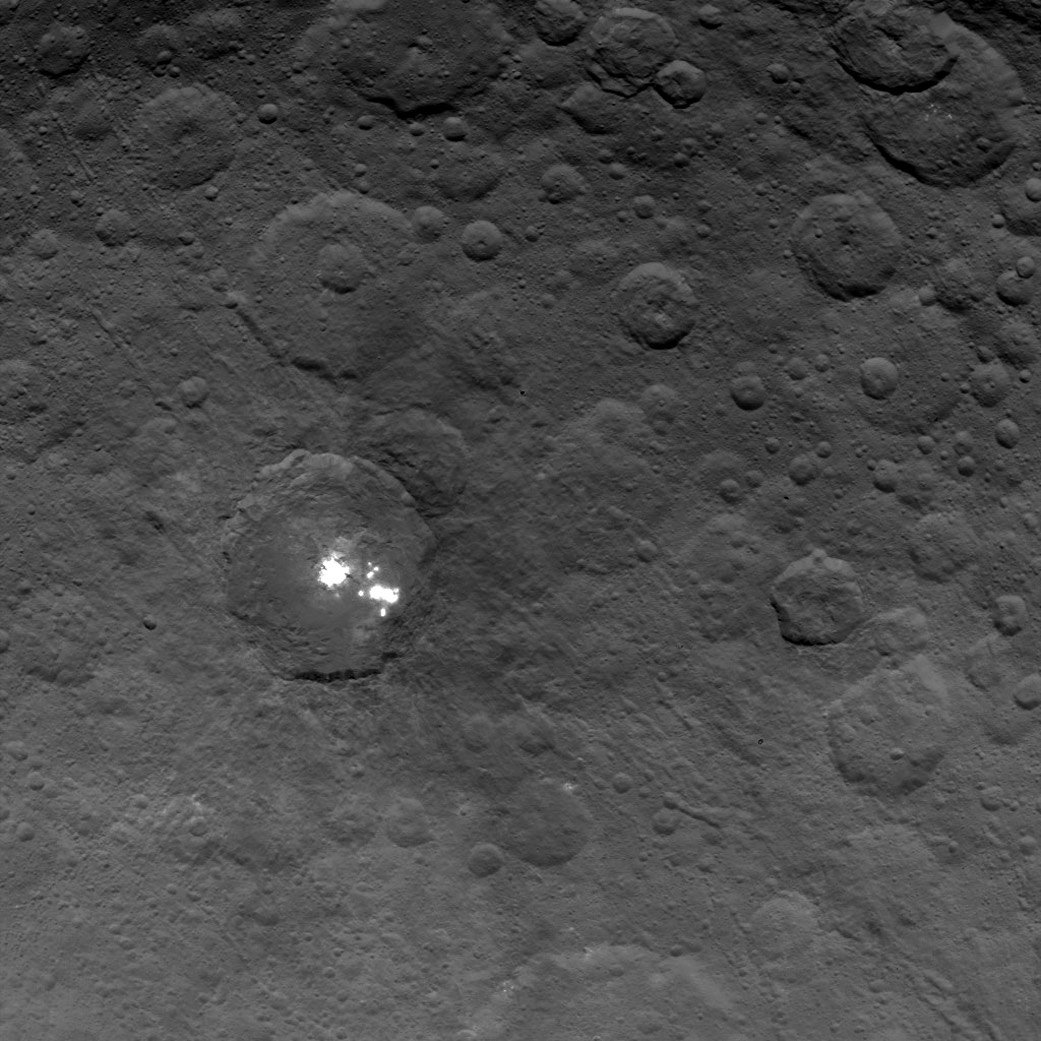
New images taken on June 6, 2015, get a closer look at the mysterious bright spots on dwarf planet Ceres.
New images of dwarf planet Ceres, taken by NASA’s Dawn spacecraft, show the cratered surface of this mysterious world in sharper detail than ever before. These are among the first snapshots from Dawn’s second mapping orbit, which is 2,700 miles (4,400 kilometers) above Ceres.
The region with the brightest spots is in a crater about 55 miles (90 kilometers) across. The spots consist of many individual bright points of differing sizes, with a central cluster. So far, scientists have found no obvious explanation for their observed locations or brightness levels.
“The bright spots in this configuration make Ceres unique from anything we’ve seen before in the solar system. The science team is working to understand their source. Reflection from ice is the leading candidate in my mind, but the team continues to consider alternate possibilities, such as salt. With closer views from the new orbit and multiple view angles, we soon will be better able to determine the nature of this enigmatic phenomenon,” said Chris Russell, principal investigator for the Dawn mission based at the University of California, Los Angeles.
Numerous other features on Ceres intrigue scientists as they contrast this world with others, including protoplanet Vesta, which Dawn visited for 14 months in 2011 and 2012. Craters abound on both bodies, but Ceres appears to have had more activity on its surface, with evidence of flows, landslides, and collapsed structures.
Additionally, new images from Dawn’s visible and infrared mapping spectrometer (VIR) show a portion of Ceres’ cratered northern hemisphere, taken on May 16, including a true-color view and a temperature image. The temperature image is derived from data in the infrared light range. This instrument is also important in determining the nature of the bright spots.
Having arrived in its current orbit on June 3, Dawn will observe the dwarf planet from 2,700 miles (4,400 kilometers) above its surface until June 28. In orbits of about three days each, the spacecraft will conduct intensive observations of Ceres. It will then move toward its next orbit of altitude 900 miles (1,450 kilometers), arriving in early August.
On March 6, 2015, Dawn made history as the first mission to visit a dwarf planet, and the first to orbit two distinct extraterrestrial targets. At its previous target, Vesta, Dawn took tens of thousands of images and made many observations about the body’s composition and other properties.
Dawn’s mission is managed by the Jet Propulsion Laboratory (JPL) for NASA’s Science Mission Directorate in Washington. Dawn is a project of the directorate’s Discovery Program, managed by NASA’s Marshall Space Flight Center in Huntsville, Alabama. UCLA is responsible for overall Dawn mission science. Orbital ATK Inc., in Dulles, Virginia, designed and built the spacecraft. The German Aerospace Center, Max Planck Institute for Solar System Research, Italian Space Agency, and Italian National Astrophysical Institute are international partners on the mission team.
Never miss a breakthrough: Join the SciTechDaily newsletter.
Follow us on Google and Google News.
9 Comments
I was thinking that the overall pattern might be consistent with an impact of a fractured bolide, but the major bright spot is not quote circular and is possibly more than coincidentally centered on the relatively large crater it is located in. I’m guessing that the central peak of the large crater that the bright spots are located in might have some relationship to the formation of the bright spots, based solely on the unlikely odds of this “bullseye” geography. This would, in itself, not explain the other nearby spots, but it might be a clue as to the formation mechanism, such as the latent heat of impact and Ceres style fumaroles.
All the explanations are fascinating but I have one question. If they are reflective phenomenon why doesn’t their brightness change as Ceres turns on it’s axis and is exposed to a different angle of sunlight to reflect? To me it seems the spots are lighted from the surface and not be reflective light.
The camera and lens system has some limit in terms of spatial resolution and contrast as well as dealing with the effects of light bleed. You can see that the difference between the dark and light areas (contrast) is so great that the bright areas are washed out and that adjacent pixels to the bright areas are washed out as well. So we’ll have to wait for more resolved images to better guess at the nature of the bright areas – the data we need to determine the spatial variations, patters, and topography to better guess at the geology.
The answer you question may be that although light seems to be emanating from the surface, that is really an affect of the flaws in the camera imaging.
I edited my previous post:
I was thinking that the overall pattern might be consistent with an impact of a fractured bolide, but the major bright spot is not quite circular and is possibly more than coincidentally centered on the relatively large crater it is located in. I’m guessing that the central part of the large crater that the bright spots are located in might have some relationship to the formation of the bright spots, based solely on the unlikely odds of this “bullseye” geography. This would not directly explain the other nearby spots, but it might be a clue as to a formation mechanism related to the crater itself, such as the latent heat of impact resulting in Ceres-style fumaroles.
I enlarged the image to 900%. http://i.imgur.com/KyZ9Kve.jpg
They remind me of what you see when you try to find Area 51 on Google Earth. Same whited out area…
If you click on the bottom picture, you get a wider field image. Look at the 7 o’clock position of the enlarged image, you can see talks lashings directly toward the bright objects at the center of the large crater. Maybe it was a piece of uranium or plutonium.
Tracks leading, not talks lashings. Darned spellcheck.
To me are lights on the surface. Not be reflective light. Why don’t take the wavelength of the supposed spot? Or really –the most probable thing– NASA have done it but no release the information. I’m not blame the NASA. The perplexity can very much. Already they are working n another spacecraft to clarify doubts and clear up if the spot are in fact artificial ligts.
These Phenom are not reflected light. Sometimes when i break wind, i could swear i see a reflected image of myself or some Ghostly Spectre, looking back @ me, but as for this discussion….radioactive element, which like some on earth (Radium), will emit Visible wavelengths of light, after energized, loosing a photon, in the Process of Shifting atomic Electron shells. A theory, like Luminescent Signage !