
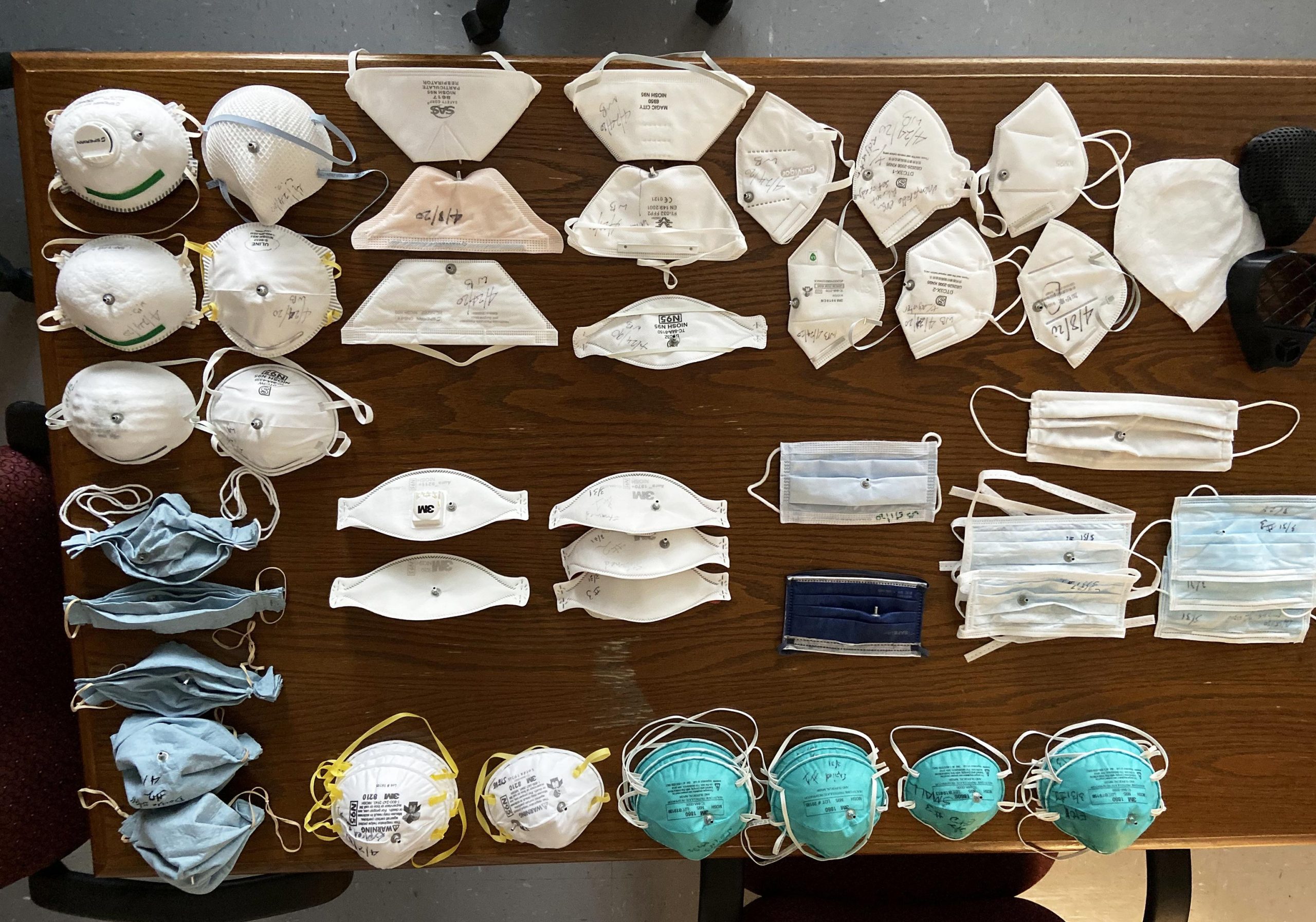
Published in JAMA Internal Medicine, research conducted at an EPA facility on the UNC-Chapel Hill campus shows that expired and sterilized used N95 masks are still very good at protecting wearers.
This spring, due to limited national supplies of N95 face masks, hospitals across the country asked the public and private companies to donate personal protective equipment (PPE), including many different types of masks, to be sure healthcare workers were protected while caring for patients.
With so many options, infection prevention experts at the UNC Medical Center set out to gather evidence on the fitted filtration efficiency of dozens of different types of masks and mask modifications, including masks sterilized for reuse, expired masks, novel masks sourced from domestic and overseas sources, and homemade masks.
Their data, published today (August 11, 2020) in JAMA Internal Medicine, show that reused, sterilized N95 masks and very out-of-date N95 masks retain their effectiveness at protecting healthcare workers from COVID-19 infection.

To assess mask-fitted filtration effectiveness, Emily Sickbert-Bennett, Ph.D., director of Infection Prevention at UNC Medical Center, and colleagues turned to someone she knew she could trust: her dad, William Bennett, Ph.D., professor of medicine, who leads the Mucociliary Clearance and Aerosol Research Laboratory at the UNC Center for Environmental Medicine, Asthma, and Lung Biology (CEMALB).
“I told him we had two types of masks – used, sterilized, and expired N95 masks – and we needed to know whether they would offer safe and effective protection, in case we needed our healthcare co-workers to use them,” Sickbert-Bennett said. “And he said it would be possible for his lab to test them and give us data upon which to base our decision-making.”
Thanks to a cooperative agreement with the EPA Human Studies Facility on the UNC-Chapel Hill campus, in which Bennett’s labs reside, Bennett, assistant professor Phillip Clapp, Ph.D., and research associate Kirby Zeman, Ph.D., teamed with EPA research scientist, James Samet, Ph.D., to measure the fraction of submicron particles that penetrate into the breathing space of subjects wearing a mask while performing a series of tasks that simulate conditions such as speech and movement during a work shift. Such tests provided infection prevention leaders with quantitative data they used to rank the best respiratory protection options for healthcare personnel during the COVID-19 outbreak.
The researchers found that certain N95 masks – as rated by the National Institute of Occupational Safety and Health (NIOSH) Administration – provide greater than 95 percent effectiveness at keeping the wearer from inhaling very small airborne particles that may carry SARS-CoV-2 – the virus that can cause COVID-19. Furthermore, these masks retain such effectiveness many years beyond the masks’ expiration dates. In addition, these NIOSH-rated masks can be subjected to sterilization with hydrogen peroxide or ethylene oxide without compromising their efficiency. Finally, their fitted filtration procedures showed that surgical masks with ties were approximately 70 percent effective at filtering their inhaled particles, while surgical masks with ear loops were about 40 percent effective. Clapp, co-first author, emphasized that “One of the keys to protection is how snug a mask fits. An N95 mask that forms a tight seal offers the optimal infection prevention. However, evidence from previous studies suggests that even the surgical masks with <95% efficiency are effective in preventing acquisition of epidemic coronaviruses.
“Our hierarchy of mask supplies essentially amounts to always using the safest option on the shelf, especially for those healthcare workers caring for COVID-19 patients,” said Sickbert-Bennett, co-first author of the JAMA Internal Medicine paper. “We start with products of our usual make and model, then follow with CDC-FDA-NIOSH approved products, and then – if necessary, we plan to reintroduce sterilized masks before we consider using non-CDC approved products that perform at less than 95 percent effectiveness levels.”
“To date, UNC Health has maintained adequate supplies of NIOSH-approved PPE,” Sickbert-Bennett said. “No UNC Health worker has used an expired or reused-sterilized N95 mask. But if needed, we feel confident we can maintain protection of the UNC Health workers with the variety of face masks and respirators tested as part of this JAMA-published study.”
Reference: “Filtration Efficiency of Hospital Face Mask Alternatives Available for Use During the COVID-19 Pandemic” by Emily E. Sickbert-Bennett, Ph.D., MS; James M. Samet, Ph.D., MPH; Phillip W. Clapp, Ph.D.; Hao Chen, Ph.D.; Jon Berntsen, Ph.D.; Kirby L. Zeman, Ph.D.; Haiyan Tong, MD, Ph.D.; David J. Weber, MD, MPH and William D. Bennett, Ph.D., 11 August 2020, JAMA Internal Medicine.
DOI
UNC Health infection prevention leaders are grateful for the partnership with the Center for Environmental Medicine, Asthma, and Lung Biology (CEMALB) and the EPA Human Studies Facility in Chapel Hill. Thanks to this collaboration, UNC Health can make evidence-based decisions on how to best protect our co-workers.
Dr. Clapp also led testing on other masks and homemade creations, using the same chamber and aerosol measurement equipment used for testing commercial masks. The UNC Office of Research Communications produced this Q and A with Dr. Clapp, along with a video about homemade masks based on his research.
Never miss a breakthrough: Join the SciTechDaily newsletter.
Follow us on Google and Google News.
1 Comment
I started wearing bandannas folded in a triangle when I couldn’t get N95 masks. Every year to prepare for fire season I weed eat 3 acres to the ground. All these years of wearing N95 mask I would suffer from asthma attacks. This is the first year I didn’t have any asthma attacks after weed eating. I wish I would have discovered this years ago it would have saved me a lot of suffering. I am try to share this information with researchers. But not sure how or where. Someone please pass this on to the mask testers.