
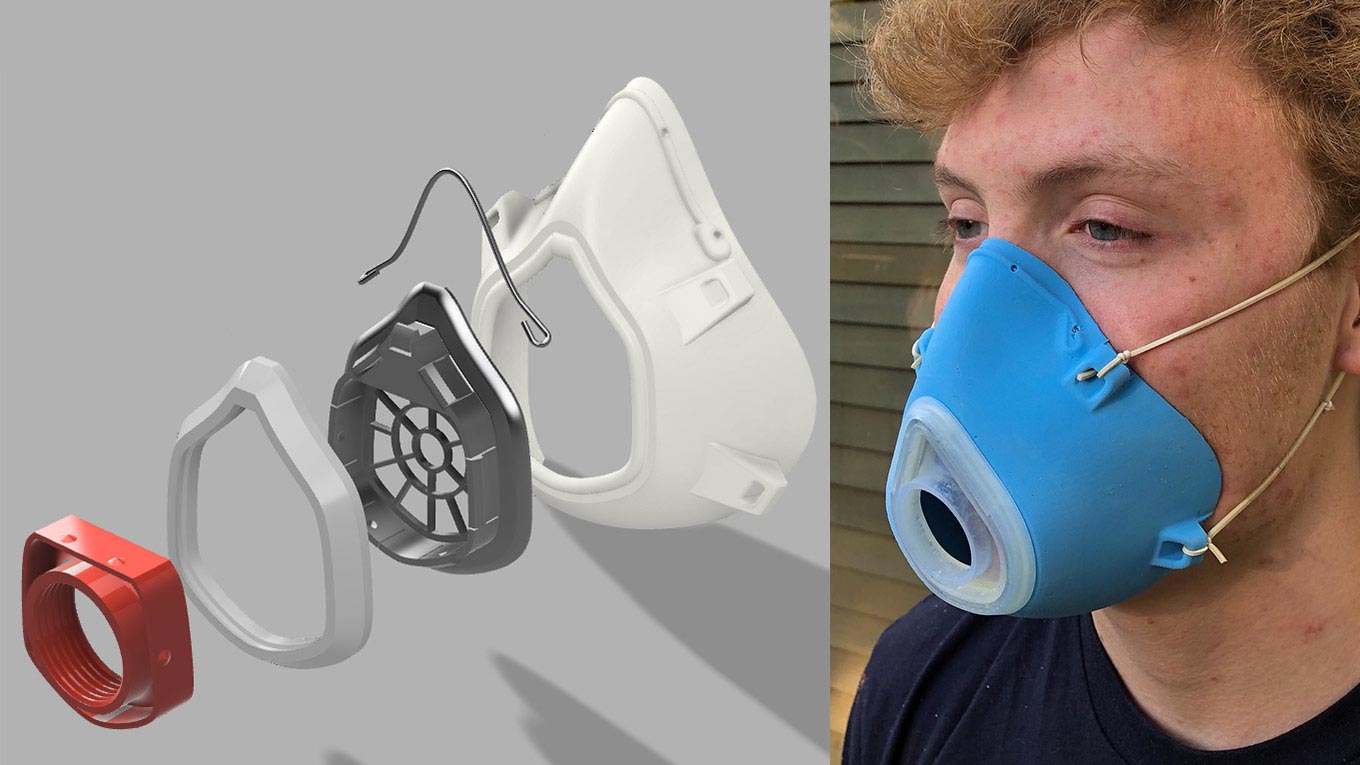
Scientists from Berkeley Lab and UC Berkeley have designed a rechargeable N95 mask with a custom fit.
In the early days of the pandemic, amidst all the uncertainty, one thing was for sure: N95 masks – the personal protective respiratory devices that filter out viruses, bacteria, and wildfire smoke – were in short supply. So when materials scientists Jeff Urban and Peter Hosemann heard that a local HMO needed advice on N95 alternatives, they immediately knew what to do: Make a better mask.
Hosemann got on the phone, and discovered that the HMO’s doctors and supply managers wanted to know what makes an effective antiviral mask, and how they could verify whether the masks they found were actually any good.
“It was helpful to learn what their needs were, and how we could fill in and help support their mission,” said Hosemann, who holds titles of faculty scientist in the Materials Sciences Division at Lawrence Berkeley National Laboratory (Berkeley Lab) and Ernest S. Kuh Chair in Engineering at UC Berkeley.
“Fortuitously, Peter and I had just joined forces because we had each started working on similar ideas at the lab level,” said Urban, who directs the Inorganic Nanostructures Facility in Berkeley Lab’s Molecular Foundry.
Urban and Hosemann were responding to a Berkeley Lab-wide call for research ideas in support of fighting COVID-19, which ultimately led to their receiving support through the National Virtual Biotechnology Laboratory (NVBL), a consortium of DOE national laboratories with core capabilities relevant to the threats posed by COVID-19, and funded under the Coronavirus Aid, Relief, and Economic Security (CARES) Act.
“We, like many others, saw the shortcomings in the PPE (personal protective equipment) supply chain and even in the functionality of what was available, so we felt this was an important area to focus on,” Urban said.
When it comes to protecting you from COVID-19 or other viral infections, N95 masks are the gold standard. They are commonly made from tightly woven layers of polypropylene that filter out at least 95% of very small particles in the submicron (millionth of a meter) range, including coronavirus particles and particulate matter from wildfire smoke. This mishmash of fibers generates an electrostatic charge that attracts and traps virus particles.
But despite their excellent filtering efficiency, N95 masks have their limits. For example, experts advise against reusing N95 masks, especially after wearing them the whole day. That’s because when we exhale, we expel moisture from our mouth and lungs – and if we’re wearing an N95 mask for long durations, that moisture eventually wears down the electrostatic charge on the virus-trapping fibers, Urban said.
Experts also say that an effective N95 mask should form a tight yet comfortable seal around your face. Otherwise, even small gaps can give virus particles easy access to your respiratory system through your nose and mouth.
Blueprint for a better N95 mask
Urban and Hosemann say that their joint research effort aims to address such problems with long-term filter efficiency by designing and fabricating a reusable silicone N95 mask with a rechargeable, wire-mesh active filter.
The wire mesh bears an electrostatic charge, which helps to trap and neutralize virus particles, Hosemann explained. “This mesh filter can be recharged, and thus the mask itself can be reusable, a key advantage,” he said. “The ultimate vision is to make a mask with a filter battery cartridge that you could plug in and recharge overnight, like a cell phone.”
To manage problems related to fit and PPE shortages, the scientists are developing a 3D-printable, silicone-cast mold for the body of the mask.
A metal wire incorporated into the silicone cast allows the mask to conform to most faces.
And in the event of a PPE shortage, a 3D-printable mold would allow anyone – from the DIY hobbyist to supply clerks at a school or hospital – to make silicone N95 masks on demand and with short lead times, Hosemann said.
“The combination of 3D printing and casting of simple parts is a powerful way to produce unavailable PPE rapidly if the raw material is available,” he added.
The scientists also designed the silicone masks to interface with commercially available N95 filters or the rechargeable mesh filter.
In designing their reusable mask prototype, the scientists also took into account that N95 masks and filters are often worn while performing manual labor. “If you’re doing physical labor, like a lot of frontline workers, having the ability to breathe more fully without compromising your health would be an important feature for an ideal protective mask,” Urban said.
To test the mask prototype’s impenetrability against small, virus-sized particles, the scientists employed fluorescent particle tests in collaboration with UC Berkeley’s Evan Variano, a professor of environmental engineering, and Simo Mäkiharju, an assistant professor in mechanical engineering. The fluorescent particles track particle distribution in and around the fabricated masks, Hosemann said.
The scientists will use the same fluorescent nanoparticle technology for future filter-efficiency tests in collaboration with Bruce Cohen of Berkeley Lab’s Molecular Foundry.
The 3D-printable silicone-casting mold and rechargeable N95 filters are still in the early stages of R&D, but Urban and Hosemann say they are making progress quickly. The scientists are in the process of developing an on-site N95 quality-assessment test for medical industry researchers and hospitals through the Molecular Foundry’s user program.
“It was very inspiring to see how national lab researchers can apply their expertise toward understanding pandemic-related problems, conceptualizing solutions, communicating with future Molecular Foundry users, and delivering prototypes, all within seven months,” said Deepti Tanjore, Berkeley Lab lead for the National Lab-Wide Manufacturing NVBL research effort.
The scientists credit the work of undergraduate student researcher Jason Duckering and research engineer Jeff Bickel in UC Berkeley’s Department of Nuclear Engineering. “Jason’s and Jeff’s engineering skills were instrumental to this effort,” Hosemann said.
The team, including postdoctorate fellows Chaochao Dun and Jaeyoo Choi, built the mask and particle test throughout the pandemic, beginning in March.
“We’re really excited to bring this new N95 user program for the development of rechargeable masks, 3D-printable mask molds, and quality-assessment particle tests to Berkeley Lab’s Molecular Foundry,” Urban said. “It’s nice to know that what we develop is going to have an immediate impact with real applications that could help so many people.”
The Molecular Foundry is a DOE Office of Science user facility located at Berkeley Lab.
This project is supported by the U.S. Department of Energy National Virtual Biotechnology Laboratory: a consortium of DOE National laboratories with core capabilities relevant to the threats posed by COVID-19, and funded under the Coronavirus Aid, Relief, and Economic Security (CARES) Act.
Never miss a breakthrough: Join the SciTechDaily newsletter.
Follow us on Google and Google News.
18 Comments
Very good & innovative, changeable Front End Inserts, quite interesting Mask Design with scalable production capability. Great Engineering… Thanks. WG
Pre star wars. Courtesy of THE ELECTION INFECTION
That’s very nice. So when will the Chinese put this into production?
I have worn N95 masks and they were not 100% effective in stopping coal dust where I worked, and I doubt they are effective in a medical setting.
Where do they sell these masks and how much are they?
Maria
Where are these masks sold and how much are they?
Maria
The same amount of money spent to develop vaccines should have been spent to develop effective face masks and we wouldn’t need the vaccines and would protect us from so much more
Tell us where we get these masks. Want AMERICAN MADE. NOT CCP MADE.
USA MADE.
Mail order or what.
Cough up the info bro!
So sick and tired of hearing about all these good ass mask so how special are they since you know it all Sir Nose and can you prove it?How much they cost that’s wtf we’re talking about bro 2021 # Stop The Spread 😷
Looks interesting. Remember, though what N95 actually means. It means that the mask offers a breathable solution to blocking 95% of particles in the air around the wearer! So, they will never block 100% of anything. They also are supposed to be “fit-tested’ meaning you have to have special training (takes about 5-10 mins) to ensure proper fit and protection. You can’t just open up a box and put a mask on and expect instant protection unless you know how to properly fit it to your face.
COVID is a hoax. Wake up.
And umm, So the Coronavirus just bounces off your eyes. Shutdowns. Masks. Hand washing. Social distancing. Yet the cases and deaths continue to surge. How stupid is the average idiot who falls for this BS?
What next eat some p*ssy and you won’t need a mask
Another option alternative to this is a design by the university of Wisconsin. That you can make yourself or buy from one of the linked manufactures. They are assembled on the US. https://making.engr.wisc.edu/mask-fitter/
Ok sheep, let’s all line up.we are going to take a short walk off this cliff… Who’s first in line?
Yeah, like I couldn’t see this coming. Covid just began a whole new industry, the n95 mask industry. The Chinese and democrats gotta get their money somehow!!!
Have two other models from 3 D printer one from small business in Trenton NJ. The other from a dentist in Mid West. Both similar. Fit with vinyl gasket that heat molds to face. Where is this style available?
Uncomfortable Facts: umm, not as stupid as the idiots who refuse to wear masks, wash hands, and practice social distancing and continue to state that the cases and deaths continue to surge. Gee, could it be because of you??