
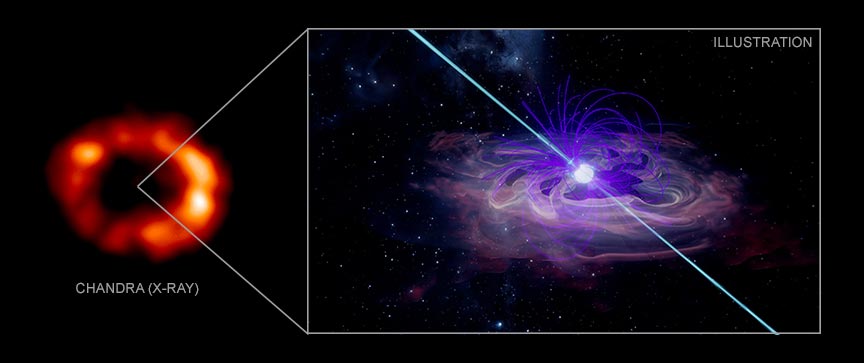
- Astronomers now have evidence from two X-ray telescopes (Chandra and NuSTAR) for a key component of a famous supernova remnant.
- Supernova 1987A was discovered on Earth on February 24, 1987, making it the first such event witnessed during the telescopic age.
- For decades, scientists have searched for a neutron star in SN 1987A, i.e. a dense collapsed core that should have been left behind by the explosion.
- This latest study shows that a “pulsar wind nebula” created by such a neutron star may be present.
Astronomers have found evidence for the existence of a neutron star at the center of Supernova 1987A (SN 1987A), which scientists have been seeking for over three decades. SN 1987A was discovered on February 24, 1987. The panel on the left contains a 3D computer simulation, based on Chandra data, of the supernova debris from SN 1987A crashing into a surrounding ring of material. The artist’s illustration (right panel) depicts a so-called pulsar wind nebula, a web of particles and energy blown away from a pulsar, which is a rotating, highly magnetized neutron star. Data collected from NASA’s Chandra X-ray Observatory and NuSTAR in a new study support the presence of a pulsar wind nebula at the center of the ring.
If this result is upheld by future observations, it would confirm the existence of a neutron star in SN 1987A, the collapsed core that astronomers expect would be present after the star exploded. The pulsar would also be the youngest one ever found.
When a star explodes, it collapses onto itself before the outer layers are blasted into space. The compression of the core turns it into an extraordinarily dense object, with the mass of the Sun squeezed into an object only about 10 miles across. Neutron stars, as they were dubbed because they are made nearly exclusively of densely packed neutrons, are laboratories of extreme physics that cannot be duplicated here on Earth. Some neutron stars have strong magnetic fields and rotate rapidly, producing a beam of light akin to a lighthouse. Astronomers call these objects “pulsars,” and they sometimes blow winds of charged particles that can create pulsar wind nebulas.
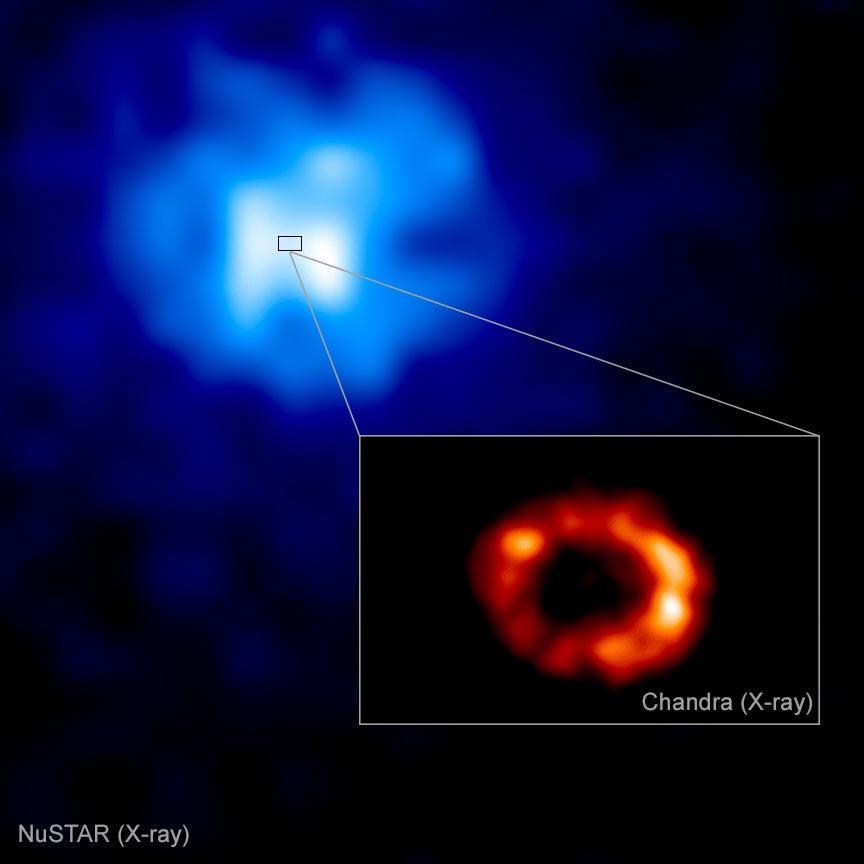
With Chandra and NuSTAR, the team found relatively low-energy X-rays from the supernova debris crashing into surrounding material. The team also found evidence of high-energy particles, using NuSTAR’s ability to detect higher-energy X-rays.
There are two likely explanations for this energetic X-ray emission: either a pulsar wind nebula, or particles being accelerated to high energies by blast wave of the explosion. The latter effect doesn’t require the presence of a pulsar and occurs over much larger distances from the center of the explosion.
The latest X-ray study supports the case for the pulsar wind nebula on a couple of fronts. First, the brightness of the higher energy X-rays remained about the same between 2012 and 2014, while the radio emission increased. This goes against expectations in the scenario of energetic particles in the explosion debris. Next, authors estimate it would take almost 400 years to accelerate the electrons up to the highest energies seen in the NuSTAR data, which is over ten times older than the age of the remnant.
The Chandra and NuSTAR data also support a 2020 result from the Atacama Large Millimeter Array (ALMA) that provided possible evidence for the structure of a pulsar wind nebula in the radio band. While this “blob” had other potential explanations, its identification as a pulsar wind nebula could be substantiated with the new X-ray data.
The center of SN 1987A is surrounded by gas and dust. The authors used state-of-the-art simulations to understand how this material would absorb X-rays at different energies, enabling more accurate interpretation of the X-ray spectrum, that is, the spread of X-rays over wavelength. This enables them to estimate what the spectrum of the central regions of SN 1987A is without the obscuring material.
A paper describing these results was published on February 24, 2021, in The Astrophysical Journal. The authors of the paper are Emanuele Greco and Marco Miceli (University of Palermo in Italy), Salvatore Orlando, Barbara Olmi and Fabrizio Bocchino (Palermo Astronomical Observatory, a National Institute for Astrophysics, or INAF, research facility); Shigehiro Nagataki and Masaomi Ono (Astrophysical Big Bang Laboratory, RIKEN in Japan); Akira Dohi (Kyushu University in Japan), and Giovanni Peres (University of Palermo).
Reference: “Indication of a Pulsar Wind Nebula in the Hard X-Ray Emission from SN 1987A” by Emanuele Greco, Marco Miceli, Salvatore Orlando, Barbara Olmi, Fabrizio Bocchino, Shigehiro Nagataki, Masaomi Ono, Akira Dohi and Giovanni Peres, 24 February 2021, The Astrophysical Journal.
DOI: 10.3847/2041-8213/abdf5a
arXiv: 2101.09029
NASA’s Marshall Space Flight Center manages the Chandra program. The Smithsonian Astrophysical Observatory’s Chandra X-ray Center controls science from Cambridge Massachusetts and flight operations from Burlington, Massachusetts.
NuSTAR is a Small Explorer mission led by Caltech and managed by NASA’s Jet Propulsion Laboratory for the agency’s Science Mission Directorate in Washington. NuSTAR was developed in partnership with the Danish Technical University and the Italian Space Agency (ASI). The spacecraft was built by Orbital Sciences Corporation in Dulles, Virginia (now part of Northrop Grumman). NuSTAR’s mission operations center is at UC Berkeley, and the official data archive is at NASA’s High Energy Astrophysics Science Archive Research Center. ASI provides the mission’s ground station and a mirror archive. JPL is a division of Caltech.
Never miss a breakthrough: Join the SciTechDaily newsletter.
Follow us on Google and Google News.
1 Comment
Formation of Pulsar or Neutŕon Star from star’s exploded part’s neo-evoiution is gùided by the Space-Time parameters, is a common consequence.Presence of acclerated particles with high amount òf magetism describe such phenomena.