
Close Menu
    Facebook X (Twitter) Instagram
    SciTechDaily
    • Biology
    • Chemistry
    • Earth
    • Health
    • Physics
    • Science
    • Space
    • Technology
    Facebook X (Twitter) Pinterest YouTube RSS
    SciTechDaily
    Home»Space»Massive Black Holes Found Wandering in Dwarf Galaxies
    Space

    Massive Black Holes Found Wandering in Dwarf Galaxies

    By National Radio Astronomy ObservatoryJanuary 5, 20202 Comments4 Mins Read
    Facebook Twitter Pinterest Telegram LinkedIn WhatsApp Email Reddit
    Share
    Facebook Twitter LinkedIn Pinterest Telegram Email Reddit
    Dwarf Galaxy Massive Black Hole Outskirts
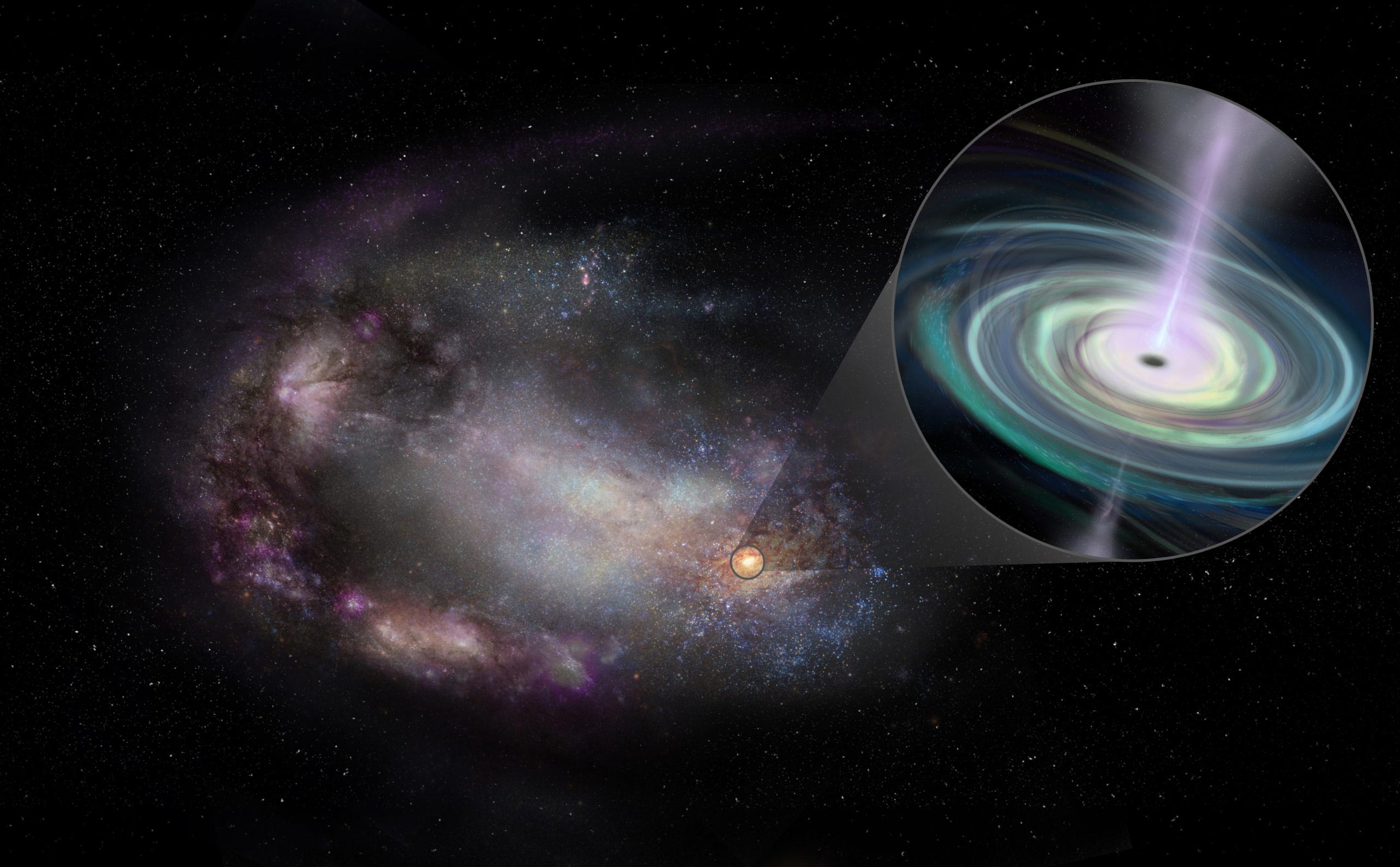
    Artist’s conception of a dwarf galaxy, its shape distorted, most likely by a past interaction with another galaxy, and a massive black hole in its outskirts (pullout). The black hole is drawing in material that forms a rotating disk and generates jets of material propelled outward. Credit: Sophia Dagnello, NRAO/AUI/NSF

    Roughly half of the newly-discovered black holes are not at the centers of their galaxies.

    Astronomers seeking to learn about the mechanisms that formed massive black holes in the early history of the Universe have gained important new clues with the discovery of 13 such black holes in dwarf galaxies less than a billion light-years from Earth.

    These dwarf galaxies, more than 100 times less massive than our own Milky Way, are among the smallest galaxies known to host massive black holes. The scientists expect that the black holes in these smaller galaxies average about 400,000 times the mass of our Sun.

    “We hope that studying them and their galaxies will give us insights into how similar black holes in the early Universe formed and then grew, through galactic mergers over billions of years, producing the supermassive black holes we see in larger galaxies today, with masses of many millions or billions of times that of the Sun,” said Amy Reines of Montana State University.

    Reines and her colleagues used the National Science Foundation’s Karl G. Jansky Very Large Array (VLA) to make the discovery, which they are reporting at the American Astronomical Society’s meeting in Honolulu, Hawaii.
    Galaxies That VLA Showed to Have Massive Black Holes
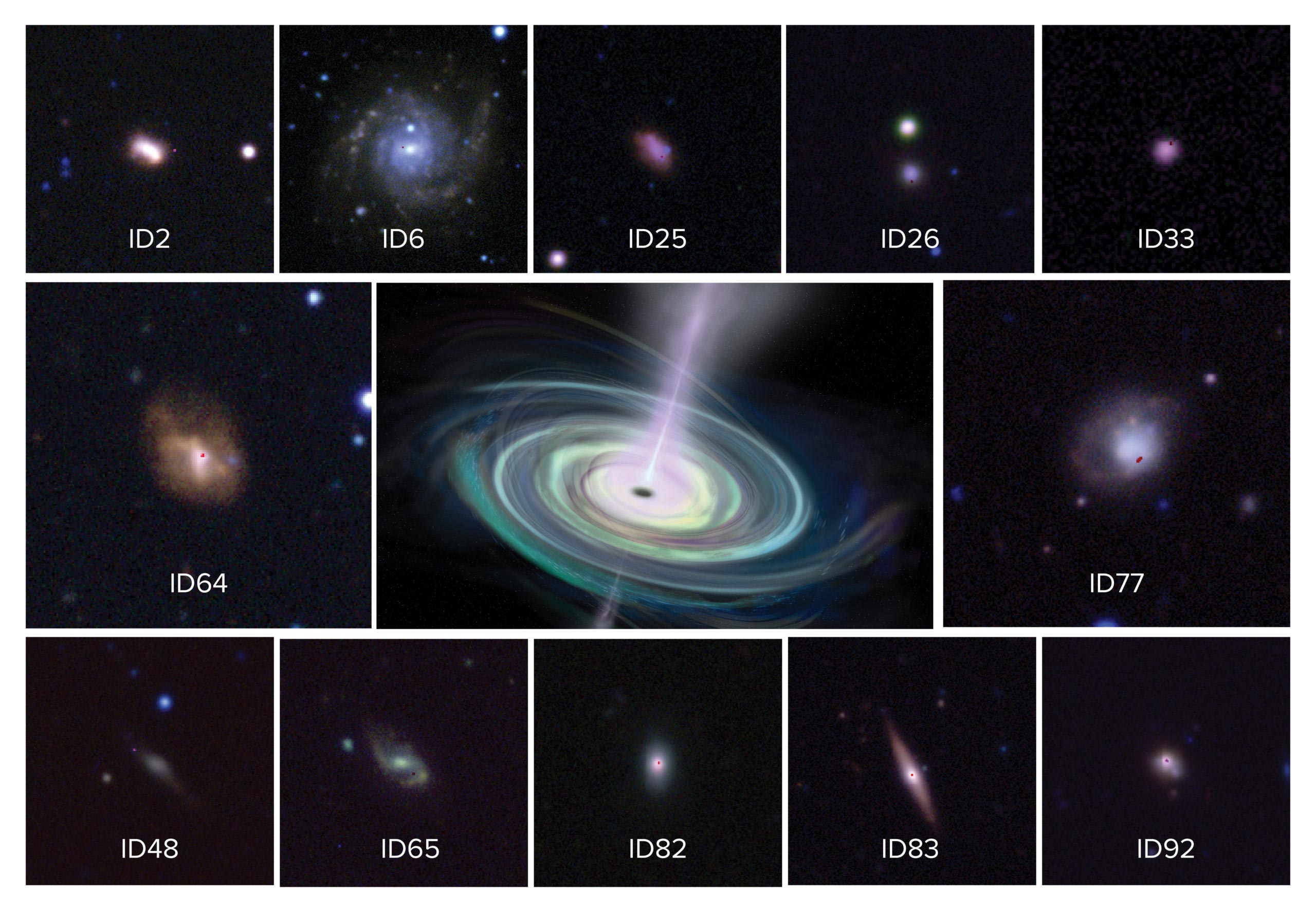
    Visible-light images of galaxies that VLA observations showed to have massive black holes. Center illustration is artist’s conception of the rotating disk of material falling into such a black hole, and the jets of material propelled outward. Credit: Sophia Dagnello, NRAO/AUI/NSF; DECaLS survey; CTIO

    Reines and her collaborators used the VLA to discover the first massive black hole in a dwarf starburst galaxy in 2011. That discovery was a surprise to astronomers and spurred a radio search for more.

    The scientists started by selecting a sample of galaxies from the NASA-Sloan Atlas, a catalog of galaxies made with visible-light telescopes. They chose galaxies with stars totaling less than 3 billion times the mass of the Sun, about equal to the Large Magellanic Cloud, a small companion of the Milky Way. From this sample, they picked candidates that also appeared in the National Radio Astronomy Observatory’s Faint Images of the Radio Sky at Twenty centimeters (FIRST) survey, made between 1993 and 2011.

    They then used the VLA to make new and more sensitive, high-resolution images of 111 of the selected galaxies.

    “The new VLA observations revealed that 13 of these galaxies have strong evidence for a massive black hole that is actively consuming surrounding material. We were very surprised to find that, in roughly half of those 13 galaxies, the black hole is not at the center of the galaxy, unlike the case in larger galaxies,” Reines said.
    Dwarf Galaxy Black Hole Outskirts
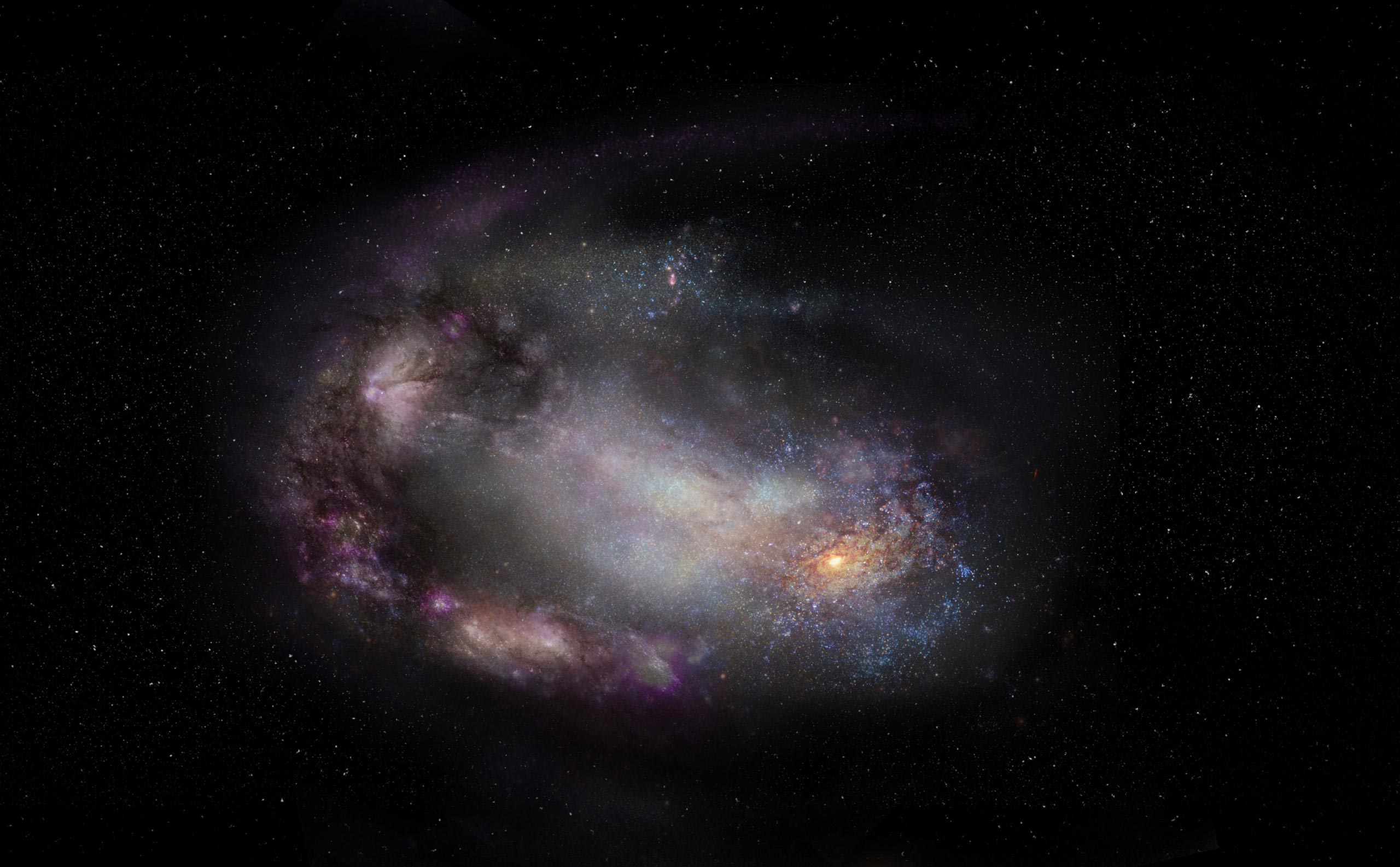
    Artist’s conception of a dwarf galaxy, its shape distorted, most likely by a past interaction with another galaxy, and a massive black hole in its outskirts (bright spot, far right; no pullout). Credit: Sophia Dagnello, NRAO/AUI/NSF

    The scientists said this indicates that the galaxies likely have merged with others earlier in their history. This is consistent with computer simulations predicting that roughly half of the massive black holes in dwarf galaxies will be found wandering in the outskirts of their galaxies.

    “This work has taught us that we must broaden our searches for massive black holes in dwarf galaxies beyond their centers to get a more complete understanding of the population and learn what mechanisms helped form the first massive black holes in the early Universe,” Reines said.

    For more on this discovery, see Astrophysicist Finds Massive Black Holes Wandering Around Dwarf Galaxies.

    Reference: “A New Sample of (Wandering) Massive Black Holes in Dwarf Galaxies from High-resolution Radio Observations” by Amy E. Reines, James J. Condon, Jeremy Darling and Jenny E. Greene, 3 January 2020, The Astrophysical Journal.
    DOI: 10.3847/1538-4357/ab4999
    arXiv: 1909.04670

    Reines worked with James Condon, of the National Radio Astronomy Observatory; Jeremy Darling, of the University of Colorado, Boulder; and Jenny Greene, of Princeton University. The astronomers are publishing their results in the Astrophysical Journal.

    The National Radio Astronomy Observatory is a facility of the National Science Foundation, operated under cooperative agreement by Associated Universities, Inc.

    Never miss a breakthrough: Join the SciTechDaily newsletter.
    Follow us on Google and Google News.

    Astronomy Astrophysics National Radio Astronomy Observatory National Science Foundation Popular VLA
    Share. Facebook Twitter Pinterest LinkedIn Email Reddit

    Related Articles

    Cracking the Magnetic Code: Distant Radio Signals Reveal Earth-Like Exoplanets’ Hidden Force

    Astronomers Discover Powerful, Newborn, Radio-Emitting Jets in Distant Galaxies

    Volcanic Impact on Jupiter’s Moon Io Shown Directly for the First Time

    Closing In on Source of Fast Radio Bursts: VLBA Makes First Direct Distance Measurement to Magnetar

    How Fast Is the Universe Expanding? Measuring Cosmic Expansion With Radio Astronomy and Gravitational Waves

    Astronomers Acting on a Hunch Solve a Galactic Mystery

    Strange New Class of Cosmic Explosions Discovered by Astronomers

    Massive Rotating Disk in Early Universe Discovered by Largest Radio Telescope in the World

    Star Formation History of the Universe Revealed by Distant Milky Way-Like Galaxies

    2 Comments

    1. Doc4U on January 6, 2020 10:27 am

      Dwarf Galaxies got that way due to Black Holes (?)

      Reply
    2. Sam on January 24, 2020 5:59 am

      I knew a scientist who told me the only blackhole that exists is everyones anus!

      Reply
    Leave A Reply Cancel Reply

    • Facebook
    • Twitter
    • Pinterest
    • YouTube

    Don't Miss a Discovery

    Subscribe for the Latest in Science & Tech!

    Trending News

    Monster Storms on Jupiter Unleash Lightning Beyond Anything on Earth

    Scientists Create “Liquid Gears” That Spin Without Touching

    The Simple Habit That Could Help Prevent Cancer

    Millions Take These IBS Drugs, But a New Study Finds Serious Risks

    Scientists Unlock Hidden Secrets of 2,300-Year-Old Mummies Using Cutting-Edge CT Scanner

    Bread Might Be Making You Gain Weight Even Without Eating More Calories

    Scientists Discover Massive Magma Reservoir Beneath Tuscany

    Europe’s Most Active Volcano Just Got Stranger – Here’s Why Scientists Are Rethinking It

    Follow SciTechDaily
    • Facebook
    • Twitter
    • YouTube
    • Pinterest
    • Newsletter
    • RSS
    SciTech News
    • Biology News
    • Chemistry News
    • Earth News
    • Health News
    • Physics News
    • Science News
    • Space News
    • Technology News
    Recent Posts
    • 25-Year Study Uncovers Hidden Paths and Early Warning Signs of Blood Cancer
    • Not Just Snoring – New Research Reveals Sleep Apnea May Be Damaging Your Muscles
    • Scientists Discover a Surprising Reason Intermittent Fasting Extends Life
    • Scientists Discover a New Meteor Shower From a Mysterious Crumbling Asteroid
    • This Simple Fruit Wash Could Make Produce Safer and Last Days Longer
    Copyright © 1998 - 2026 SciTechDaily. All Rights Reserved.
    • Science News
    • About
    • Contact
    • Editorial Board
    • Privacy Policy
    • Terms of Use

    Type above and press Enter to search. Press Esc to cancel.