
Close Menu
    Facebook X (Twitter) Instagram
    SciTechDaily
    • Biology
    • Chemistry
    • Earth
    • Health
    • Physics
    • Science
    • Space
    • Technology
    Facebook X (Twitter) Pinterest YouTube RSS
    SciTechDaily
    Home»Space»Discovery Provides Clues to How Galaxies and Black Holes Develop Together
    Space

    Discovery Provides Clues to How Galaxies and Black Holes Develop Together

    By National Radio Astronomy ObservatoryJanuary 8, 2014No Comments4 Mins Read
    Facebook Twitter Pinterest Telegram LinkedIn WhatsApp Email Reddit
    Share
    Facebook Twitter LinkedIn Pinterest Telegram Email Reddit
    Dwarf Galaxies Reveal Clues to Origin of Supermassive Black Holes
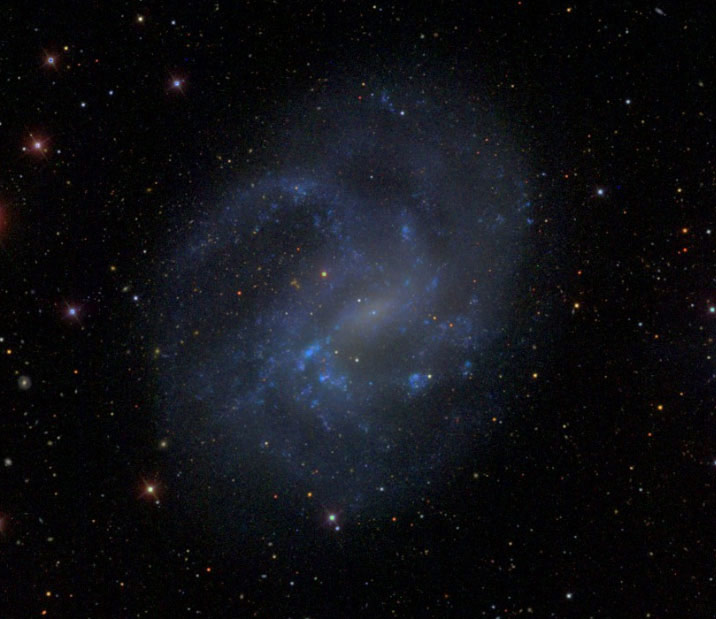
    Dwarf galaxy NGC 4395, about 13 million light-years from Earth, known to harbor a black hole some 300,000 times more massive than the Sun. It is a prototypical example of a small galaxy once thought to be too small to contain such a black hole. Credit: David W. Hogg, Michael R. Blanton, and the Sloan Digital Sky Survey Collaboration; NRAO/AUI/NSF

    Using data from the Sloan Digital Sky Survey, researchers discovered more than 100 dwarf galaxies with massive black holes, providing an important step toward understanding how galaxies and black holes developed together.

    Poring through data from a large sky survey, astronomers have found more than 100 small, dwarf galaxies with characteristics indicating that they harbor massive black holes feeding on surrounding gas. The discovery confounds a common assumption that only much larger galaxies hold such monsters, and may help resolve the question of how such black holes originated and grew in the early Universe.

    “We’ve shown that even small galaxies can have massive black holes and that they may be more common than previously thought,” said Amy Reines, of the National Radio Astronomy Observatory (NRAO). “This is really exciting because these little galaxies hold the clues to the origin of the first ‘seeds’ of supermassive black holes in the early Universe,” she said. Reines and her colleagues presented their findings to the American Astronomical Society’s meeting in Washington, DC.

    Black holes are concentrations of mass so dense that not even light can escape their gravitational pull. Nearly all “full-sized” galaxies are known to have supermassive black holes, millions or billions of times more massive than the Sun, at their cores. Until recently, however, smaller galaxies were thought not to harbor massive black holes.

    Reines, along with Jenny Greene of Princeton University and Marla Geha of Yale University, analyzed data from the Sloan Digital Sky Survey, and found more than 100 dwarf galaxies whose patterns of light emission indicated the presence of massive black holes and their feeding process.

    “The galaxies are comparable in size to the Magellanic Clouds, dwarf satellite galaxies of the Milky Way,” Geha said. “Previously, such galaxies were thought to be too small to have such massive black holes,” she added.

    In the nearby Universe, astronomers have found a direct relationship between the mass of a galaxy’s central black hole and a “bulge” in its center. This indicates that the black holes and the bulges may have affected each others’ growth.

    “Finding these small galaxies with massive black holes is an important step toward understanding how galaxies and black holes developed together,” Greene said. “These dwarf galaxies are the smallest known to host massive black holes and can provide clues to how supermassive black holes get started in the first place,” she added.

    While today’s larger galaxies hold black holes millions or billions of times more massive than the Sun, the dwarf galaxies in the new study have black holes roughly 100,000 times the Sun’s mass. The supermassive and massive black holes are distinct from stellar-mass black holes — only a few times the mass of the Sun — that result from the collapse of a massive star at the end of its “normal” life.

    Still unknown, the scientists said, is whether the massive black holes initially began as the remnants of extremely massive early stars or some other scenario of collapsing mass.

    “Getting a good census of dwarf galaxies with massive black holes is an important first step to resolving this question,” Reines said.

    The National Radio Astronomy Observatory is a facility of the National Science Foundation, operated under cooperative agreement by Associated Universities, Inc.

    Reference: “Dwarf Galaxies with Optical Signatures of Active Massive Black Holes” by Amy E. Reines, Jenny E. Greene and Marla Geha, 13 September 2013, The Astrophysical Journal.
    DOI: 10.1088/0004-637X/775/2/116
    arXiv:1308.0328

    Never miss a breakthrough: Join the SciTechDaily newsletter.
    Follow us on Google and Google News.

    Astronomy Astrophysics Black Hole National Radio Astronomy Observatory Princeton University Sloan Digital Sky Survey Yale University
    Share. Facebook Twitter Pinterest LinkedIn Email Reddit

    Related Articles

    “Never Been Seen Before” – Astronomers Discover Bizarre “Infinity” Galaxy

    Alien Structures or Shock Waves? Strange Filaments Discovered in the Milky Way Baffle Astronomers

    Einstein’s Twist: Princeton Astrophysicists Unravel the Mystery of Black Hole Jets and Galactic “Lightsabers”

    Cosmic Feast Unveiled: Two Supermassive Black Holes Discovered Dining Together

    Magnetic Structures Observed Near Supermassive Black Hole

    Stellar Collision Triggers Supernova Explosion – “This Is the First Time We’ve Actually Seen Such an Event”

    Astronomers Discover a New Type of Quasar

    Black Hole Powered Jets Push Material Out of Galaxy

    VLA Identifies Discrete Sources of Radio Waves Coming From Distant Galaxies

    Leave A Reply Cancel Reply

    • Facebook
    • Twitter
    • Pinterest
    • YouTube

    Don't Miss a Discovery

    Subscribe for the Latest in Science & Tech!

    Trending News

    New “Nanozyme Hypothesis” Could Rewrite the Story of Life’s Origins

    Anatomy Isn’t Finished: The Human Body Still Holds Secrets

    “Pretty Close to Home”: The Hidden Earthquake Threat Beneath Seattle

    The Surprising Reason You Might Want To Sleep Without a Pillow

    Scientists Say This Natural Hormone Reverses Obesity by Targeting the Brain

    35-Million-Year-Old Mystery: Strange Arachnid Discovered Preserved in Amber

    Is AI Really Just a Tool? It Could Be Altering How You See Reality

    JWST Reveals a “Forbidden” Planet With a Baffling Composition

    Follow SciTechDaily
    • Facebook
    • Twitter
    • YouTube
    • Pinterest
    • Newsletter
    • RSS
    SciTech News
    • Biology News
    • Chemistry News
    • Earth News
    • Health News
    • Physics News
    • Science News
    • Space News
    • Technology News
    Recent Posts
    • Scientists Finally Crack the 100-Million-Year Evolutionary Mystery of Squid and Cuttlefish
    • This Algae Could One Day Pull Microplastics out of Your Drinking Water
    • Scientists Can Now Read Your Body Clock From a Single Hair
    • Beyond “Safe Levels”: Study Challenges What We Know About Pesticides and Cancer
    • Researchers Have Found a Dietary Compound That Increases Longevity
    Copyright © 1998 - 2026 SciTechDaily. All Rights Reserved.
    • Science News
    • About
    • Contact
    • Editorial Board
    • Privacy Policy
    • Terms of Use

    Type above and press Enter to search. Press Esc to cancel.