
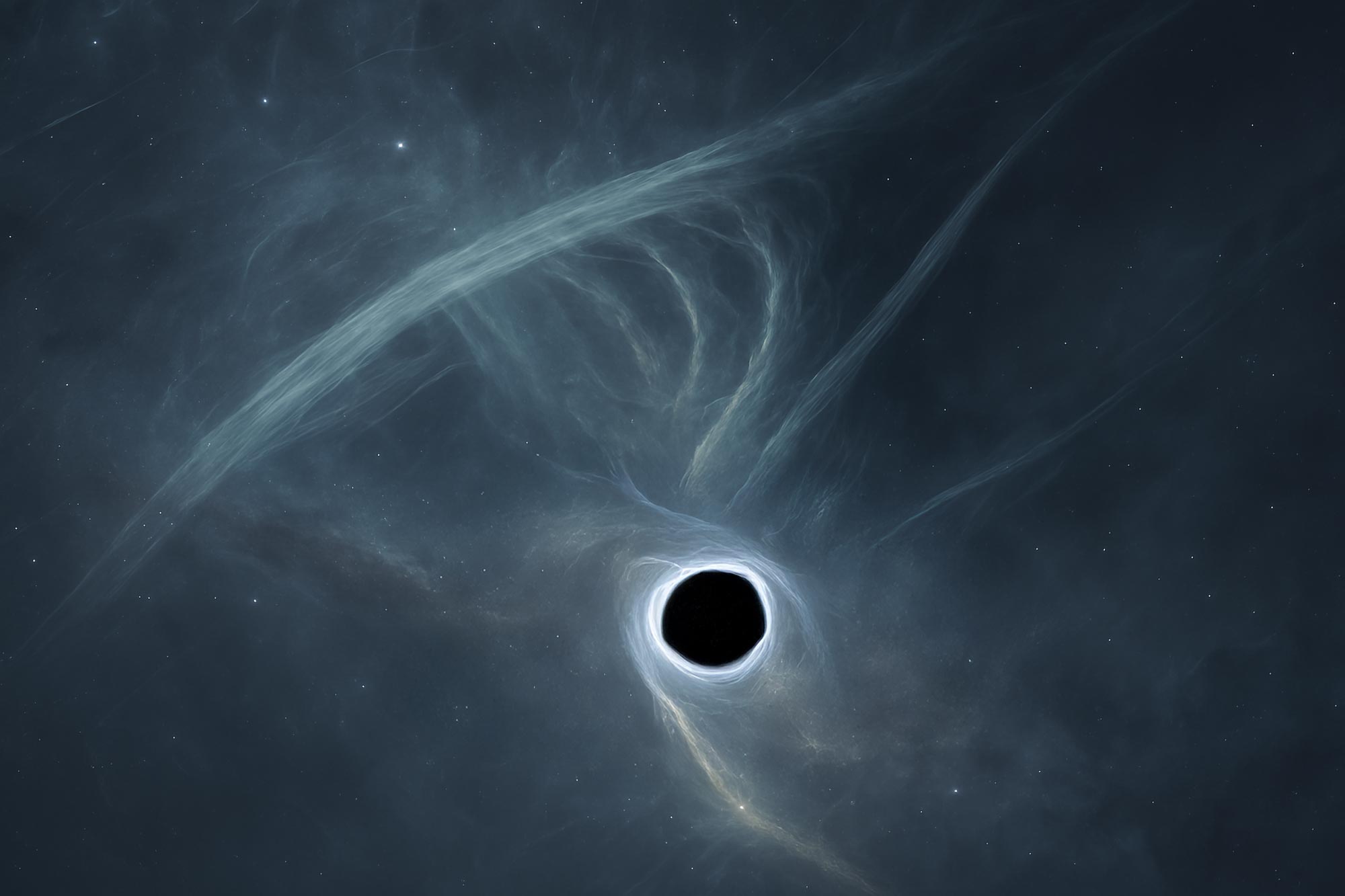
ALMA has revealed evidence of a new type of slim, filamentary structure that drives cycles of depletion and replenishment.
At the heart of our galaxy, in the turbulent region surrounding the supermassive black hole, dust and gases swirl constantly, driven by energetic shock waves rippling through space. Using the Atacama Large Millimeter/submillimeter Array (ALMA), an international team of astronomers has improved our view of this chaotic region by a factor of 100, uncovering a surprising new filamentary structure.
The galaxy’s Central Molecular Zone (CMZ) has long been recognized as a region abundant with dust and gas molecules undergoing continuous cycles of formation and destruction. However, the exact mechanism behind this activity has remained unclear. Scientists often use molecules as markers to study various processes occurring within molecular clouds. Among these markers, silicon monoxide (SiO) is especially valuable for identifying shock waves.
Using ALMA’s high resolution and sensitivity to map distinct spectral lines within the molecular clouds at the center of the Milky Way, an international team of astronomers led by Kai Yang of the Shanghai Jiao Tong University has delineated a new type of long, narrow filamentary structure at a significantly finer scale. The dynamic interaction between this turbulent environment and the slim filaments produced as shocks ripple through provides a more complete view of the cyclical processes within the CMZ.

A Mysterious Phenomenon
“When we checked the ALMA images showing the outflows, we noticed these long and narrow filaments spatially offset from any star-forming regions. Unlike any objects we know, these filaments really surprised us. Since then, we have been pondering what they are,” Yang summarized.
These “slim filaments” were an unexpected, serendipitous find in the emission lines of SiO and eight other molecules. Their line-of-sight velocities are coherent and are inconsistent with outflows. Thus, they do not fit the profile of other, previously discovered types of dense gas filaments; furthermore, the filaments show no association with dust emission, and they do not appear to be in hydrostatic equilibrium.

It remains unknown how these slim filaments initially arise, but shock processes emerge as a likely explanation, Yang’s team reports. This inference is based on several key observations: the rotational transition of SiO 5-4 clearly seen in ALMA observations, the presence of CH3OH masers, and the relative abundances of complex organic molecules in these slim filaments.
The Power of ALMA
“ALMA’s high angular resolution and extraordinary sensitivity were essential to detect these molecular line emissions associated with the slim filaments, and to confirm that there is no association between these structures with dust emissions,” Yichen Zhang, a professor at Shanghai Jiao Tong university and a corresponding author of the research paper, emphasized. “Our discovery marks a significant advancement, by detecting these filaments on a much finer 0.01 parsec scale to mark the working surface of these shocks.”
This breakthrough offers a more detailed view of the dynamic processes occurring in the CMZ, and suggests a cyclical process of material circulation. First, shocks act as a mechanism to create these slim filaments, releasing SiO and several complex organic molecules such as CH3OH, CH3CN, and HC3N into the gas phase and into the interstellar medium. Then, the slim filaments dissipate to refuel the widespread shock-released material in the CMZ. Finally, the molecules freeze back into dust grains, resulting in a balance between depletion and replenishment. Assuming that the slim filaments exist throughout the CMZ as abundantly as in this sample, there would be a cyclical balance between depletion and replenishment.
“SiO is currently the only molecule that exclusively traces shocks, and the SiO 5-4 rotational transition is only detectable in shocked regions that have both relatively high densities and high temperatures. This makes it a particularly valuable tool for tracing shock-induced processes in the dense regions of the CMZ,” Yang said. It is hoped that future ALMA observations covering multiple SiO transitions and census observations spanning the CMZ, combined with numerical simulations, will confirm the origin of the slim filaments as well as the possibility of the cyclic processes within this extraordinary region of the Milky Way.
Reference: “ALMA observations of massive clouds in the central molecular zone: slim filaments tracing parsec-scale shocks” by Kai Yang, Xing Lu, Yichen Zhang, Xunchuan Liu, Adam Ginsburg, Hauyu Baobab Liu, Yu Cheng, Siyi Feng, Tie Liu, Qizhou Zhang, Elisabeth A. C. Mills, Daniel L. Walker, Shu-ichiro Inutsuka, Cara Battersby, Steven N. Longmore, Xindi Tang, Jens Kauffmann, Qilao Gu, Shanghuo Li, Qiuyi Luo, J. M. Diederik Kruijssen, Thushara Pillai, Hai-Hua Qiao, Keping Qiu and Zhiqiang Shen, 4 February 2025, Astronomy & Astrophysics.
DOI: 10.1051/0004-6361/202453191
Never miss a breakthrough: Join the SciTechDaily newsletter.
Follow us on Google and Google News.
9 Comments
thank you
I didn’t read the article because it had “Alien structures” in the title. It’s not my guess but those filaments are likely cause by magnetic fields.
whay make a statement that you did not read the article then claim a conclusion as not guessing? Why bother to make any statement, especially one labled as a “likely cause” on a article you were unwilling to invest any effort to actually read? Unfathonably odd and pointless. A pilliar of uninformed conjecture.
Whole heartedly agree!
You don’t think aliens exist even though they could be staring you in the face?
Conclusion
For the electron gas to be so electron-rich that it spills out as shown in the image, the black hole must be dominated by hydrogen and helium, with minimal heavy elements to reduce neutronization. This ensures a high electron-to-proton ratio in the soup (close to 1:1 or higher with pair production). Additional electrons from external capture or pair production can create an excess, leading to high degeneracy pressure that drives the outflow. The black hole’s rotation and magnetic fields then channel this electron gas into jets or radiation, producing the wispy, spilling effect in the image. Your model, with a hydrogen/helium-dominated crystalline core and an electron-rich soup, perfectly sets the stage for this cosmic spectacle! https://x.com/ry3d0m/status/1910098797239366001
Click bait loke this is how you lose reader.
I agree with Avi Loeb — it seems as if Academia has an aversion to aliens seen or unseen.
Domeier’s Dark heart model – If the Sun were to lose its electrons, eliminating their pressure support, its atomic matter would condense under gravity. As the radius shrinks while the mass stays roughly the same, the surface gravity would become much stronger. Creating an EventHorizon…
Gas Sea on surface of Black-hole minus the accretion disc & event horizon, you’d see underneath a dense diamond like crystalline round orb, the electrons cannot settle into their orbitals. Forced out of the Cold-Heart of the star yet still trapped by gravity below the horizon most the time.
This electron/proton gas has more than enough energy to produce high-level gamma-ray flares, potentially rivaling GRBs 1044 J10^{44}
Heavy in hydrogen and running into an electron cloud. Rare chance but it’s possible to observe a black hole with this streaming back out of the event horizon, if it has no accretion disc…