
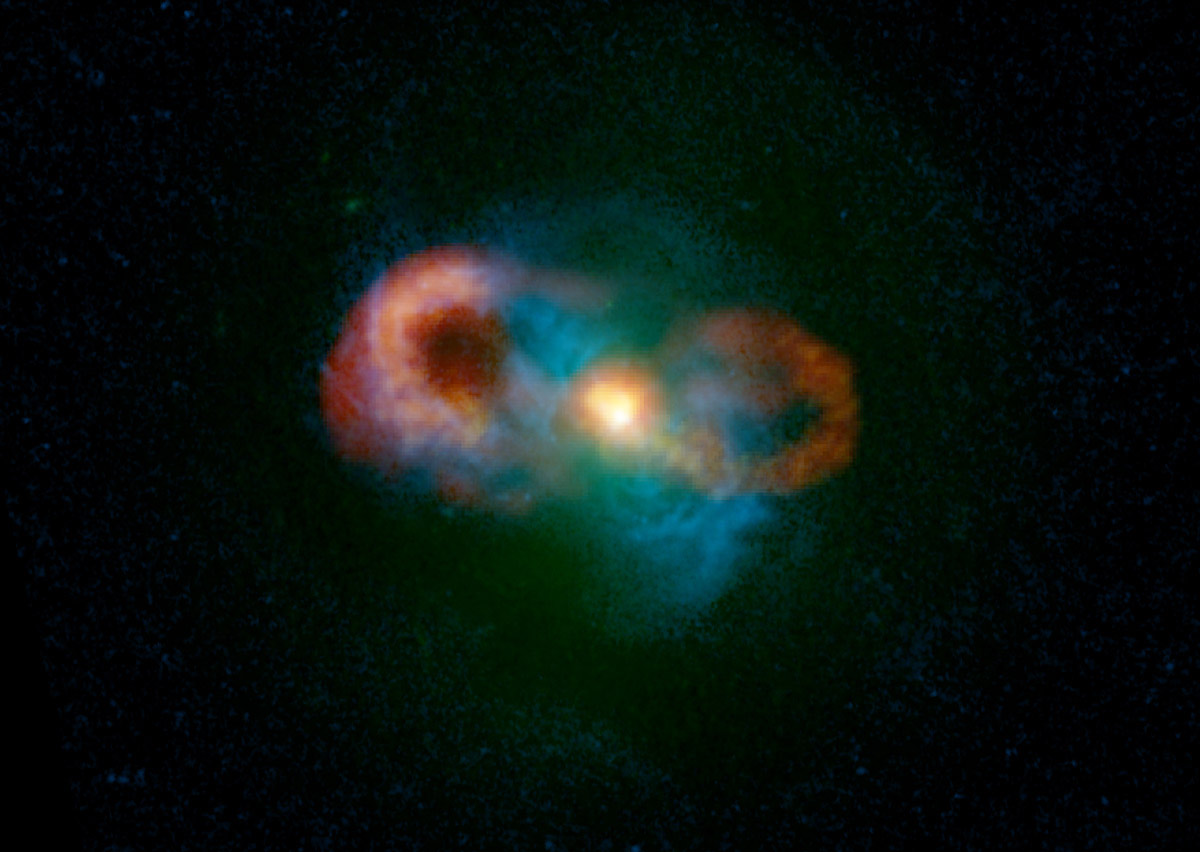
Astronomers used VLA data, combined with VIMOS IFU data and HST imaging to reveal that a supermassive black hole is explosively heating and blasting around the gas of the Teacup Galaxy, transforming it from an actively star-forming galaxy into one devoid of gas that can no longer form stars.
Astronomers using the National Science Foundation’s Very Large Array (VLA) found surprisingly energetic activity in what they otherwise considered a “boring” galaxy, and their discovery provides important insight into how supermassive black holes can have a catastrophic effect on the galaxies in which they reside.
“It appears that a supermassive black hole is explosively heating and blasting around the gas in this galaxy and, as a result, is transforming it from an actively star-forming galaxy into one devoid of gas that can no longer form stars,” said Chris Harrison, the lead author of the study, from The Center for Extragalactic Astronomy at Durham University in the U.K.
Two major types of galaxies are spirals, rich in gas and actively forming stars, and ellipticals, gas-poor and with very little star formation. The massive ellipticals, astronomers think, started life as actively star-forming galaxies. Powerful jets and winds of material, powered by supermassive black holes at the galaxies’ centers, are believed to remove or destroy the raw material needed for continued star formation.
“For many years, we’ve seen direct evidence of this happening in galaxies that are extremely bright when viewed through radio telescopes. These rare, radio-bright galaxies harbor powerful jets, launched at the black hole, that plow into the surrounding gas,” Harrison said. “However, to understand how all of the galaxies in our Universe formed, we needed to know if these same processes occur in less extreme galaxies that better represent the majority. This was the focus of our study,” he added.
As part of an ongoing investigation, Harrison and his colleagues used the VLA to study a galaxy labeled J1430+1339, also known as the “Teacup,” because of its appearance. About 1.1 billion light-years from Earth, the galaxy had been identified as having characteristics typical of galaxies with a central black hole actively consuming material. Follow-on observations with NASA’s Hubble Space Telescope also revealed evidence that the Teacup has the appearance of an elliptical-type galaxy, but is surrounded by gas that suggests it is still in the process of transforming from a star-forming galaxy.
The VLA observations showed that the galaxy has “bubbles” extending from 30,000 to 40,000 light-years on each side of its core, along with smaller jet-like structures, about 2,000 light-years in size. These jet-like structures are located at the position where visible-light observations indicate gas is being accelerated to speeds up to about 1,000 kilometers (200,000 miles per hour) per second.
Alasdair Thomson, another Durham astronomer involved in the study, said, “These radio observations have revealed that the central black hole is whipping up a storm at the center of this galaxy, by launching powerful jets that are accelerating the gas in the host galaxy, and are colliding with the gas on larger scales. This is the same kind of powerful process we’d previously seen in rare, extremely radio-luminous galaxies. The incredible capabilities of the VLA have allowed us to discover that these processes can occur in the more common, radio-faint galaxies, as long as you look hard enough.”
“This ‘storm’ in the ‘Teacup’ means that the jet-driven process in which a black hole is removing or destroying star-forming material may be much more typical than we knew before, and could be a crucial piece in the puzzle of understanding how the galaxies we see around us were formed,” Harrison said. Harrison and his collaborators now have observed eight more such objects with the VLA and are analyzing their data to see if the others show similar characteristics.
Harrison worked with a team of astronomers from the U.K., the U.S., and Chile. They presented their findings in the Astrophysical Journal.
The National Radio Astronomy Observatory is a facility of the National Science Foundation, operated under a cooperative agreement by Associated Universities, Inc.
Reference: ‘STORM IN A “TEACUP”: A RADIO-QUIET QUASAR WITH ≈10 kpc RADIO-EMITTING BUBBLES AND EXTREME GAS KINEMATICS’ by C.M. Harrison, A.P. Thomson, D.M. Alexander, F.E. Bauer, A.C. Edge, M.T. Hogan, J.R. Mullaney and A.M. Swinbank, 6 February 2015, The Astrophysical Journal.
DOI: 10.1088/0004-637X/800/1/45
arXiv: 1410.4198
Never miss a breakthrough: Join the SciTechDaily newsletter.
Follow us on Google and Google News.
1 Comment
At least this is more educational than one of
our reality TV stars, kim who? Joey what?