
Close Menu
    Facebook X (Twitter) Instagram
    SciTechDaily
    • Biology
    • Chemistry
    • Earth
    • Health
    • Physics
    • Science
    • Space
    • Technology
    Facebook X (Twitter) Pinterest YouTube RSS
    SciTechDaily
    Home»Biology»Barb Geometry of Asymmetrical Feathers Sheds Light on Evolution of Flight
    Biology

    Barb Geometry of Asymmetrical Feathers Sheds Light on Evolution of Flight

    By Bill Hathaway, Yale UniversityFebruary 11, 2015No Comments3 Mins Read
    Facebook Twitter Pinterest Telegram LinkedIn WhatsApp Email Reddit
    Share
    Facebook Twitter LinkedIn Pinterest Telegram Email Reddit
    Feathers Shed Light on Evolution of Flight
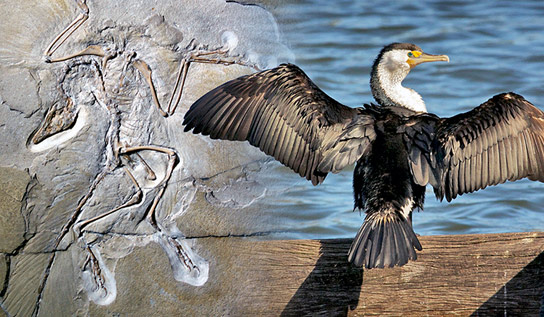
    The left image depicts Archaeopteryx, a Berlin specimen. (Photo by Ryan Marc Carney). The right image is a Pied Cormorant (Phalacrocorax various). Credit: Daniel J. Field

    By taking a closer look at feathers representing the evolutionary transition from dinosaurs to modern birds, Yale researchers demonstrate a better understanding of how feathers facilitate flight in modern birds.

    The asymmetrical flight feathers of their wings are among the most distinctive features of living birds. But how are these feathers actually constructed, and when did they first appear in evolutionary history?

    New Yale research, published February 11 in Proceedings of the Royal Society B, found subtle differences between modern bird feathers and those of ancient feathered dinosaurs like Archaeopteryx, an ancestor of birds that took to the air 150 million years ago.

    “Archaeopteryx has occupied a central place in the morphological transition from dinosaurs to modern birds, but researchers can’t agree on whether it was fully capable of modern, powered flight,” said Teresa Feo, lead author of the study and doctoral candidate in the lab of Richard Prum in the Department of Ecology and Evolutionary Biology.

    Early feathered dinosaurs, such as Archaeopteryx, exhibit asymmetrical feathers that had always been thought to be indistinguishable from those of living birds.

    “This is a well-appreciated adaptation that provides aerodynamic stability,” said Feo. “It is clear that these animals were doing something in the air.”

    Feo and fellow doctoral candidate Daniel Field decided to take a closer look at feathers representing the evolutionary transition from dinosaurs to modern birds. They found that while the shape of the wing feathers of Archaeopteryx and modern birds are generally similar, their trailing edges differed significantly in the angle where feather branches connected to the central shaft. These structural changes might be important in enabling a coherent wing surface during sustained flight, they said.

    “Our findings help us understand how these feathers facilitate flight in modern birds,” said Field, a paleontologist, ornithologist, and doctoral candidate in Yale’s Department of Geology & Geophysics. “Although the asymmetrical feathers of the Mesozoic fossils like Archaeopteryx and Microraptor indicate some capacity for aerial locomotion, there is growing evidence to suggest that this ability was considerably less sophisticated than that of living birds.”

    “In a way, it is more of a semantic debate,” Feo said. “The Wright Brothers’ plane flew, but not like a modern jet fighter. Flight is a complicated thing.”

    Prum, the William Robertson Coe Professor of Ecology and Evolutionary Biology, is the senior author of the paper.

    Support for the research came from the Yale Peabody Museum, the Smithsonian Institution, the Canadian Natural Sciences and Engineering Research Council, and the National Science Foundation.

    Reference: “Barb geometry of asymmetrical feathers reveals a transitional morphology in the evolution of avian flight” by Teresa J. Feo, Daniel J. Field and Richard O. Prum, 22 March 2015, Proceedings of the Royal Society B.
    DOI: 10.1098/rspb.2014.2864


    Never miss a breakthrough: Join the SciTechDaily newsletter.
    Follow us on Google and Google News.

    Birds Ecology Evolution Evolutionary Biology Yale University
    Share. Facebook Twitter Pinterest LinkedIn Email Reddit

    Related Articles

    Researchers Discover First-Known Hybrid Bird Species from the Amazon

    Study Projects How Climate Change Will Affect the Functions Birds in Ecosystems Worldwide

    Genetic Analysis Reveals New Family Tree for Ray-Finned Fish

    Insects Help Scientists Understand the Predictability of Evolution

    Extinctions Due to Habitat Loss are Proportional to the Area Destroyed

    Female Butterflies Prefer Flashier Mates

    Evolution Shapes Ecology of Dammed Connecticut Lakes

    Evolutionary Changes Surrounding the NOS1 Gene

    “Map of Life” to Illustrate All Living Things Geographically

    Leave A Reply Cancel Reply

    • Facebook
    • Twitter
    • Pinterest
    • YouTube

    Don't Miss a Discovery

    Subscribe for the Latest in Science & Tech!

    Trending News

    The Universe Is Expanding Too Fast and Scientists Can’t Explain Why

    “Like Liquid Metal”: Scientists Create Strange Shape-Shifting Material

    Early Warning Signals of Esophageal Cancer May Be Hiding in Plain Sight

    Common Blood Pressure Drug Shows Surprising Power Against Deadly Antibiotic-Resistant Superbug

    Scientists Uncover Dangerous Connection Between Serotonin and Heart Valve Disease

    Scientists Discover a “Protector” Protein That Could Help Reverse Hair Loss

    Bone-Strengthening Discovery Could Reverse Osteoporosis

    Scientists Uncover Hidden Trigger Behind Stem Cell Aging

    Follow SciTechDaily
    • Facebook
    • Twitter
    • YouTube
    • Pinterest
    • Newsletter
    • RSS
    SciTech News
    • Biology News
    • Chemistry News
    • Earth News
    • Health News
    • Physics News
    • Science News
    • Space News
    • Technology News
    Recent Posts
    • Scientists Overcome Major Quantum Bottleneck, Potentially Transforming Teleportation and Computing
    • Quantum Physics’ Strangest Problem May Hold the Key to Time Itself
    • Scientists Create “Liquid Gears” That Spin Without Touching
    • The Simple Habit That Could Help Prevent Cancer
    • Forgotten Medicinal Plant Shows Promise in Fighting Dangerous Superbugs
    Copyright © 1998 - 2026 SciTechDaily. All Rights Reserved.
    • Science News
    • About
    • Contact
    • Editorial Board
    • Privacy Policy
    • Terms of Use

    Type above and press Enter to search. Press Esc to cancel.