
Close Menu
    Facebook X (Twitter) Instagram
    SciTechDaily
    • Biology
    • Chemistry
    • Earth
    • Health
    • Physics
    • Science
    • Space
    • Technology
    Facebook X (Twitter) Pinterest YouTube RSS
    SciTechDaily
    Home»Biology»Genetic Analysis Reveals New Family Tree for Ray-Finned Fish
    Biology

    Genetic Analysis Reveals New Family Tree for Ray-Finned Fish

    By Bill Hathaway, Yale UniversityAugust 7, 2012No Comments3 Mins Read
    Facebook Twitter Pinterest Telegram LinkedIn WhatsApp Email Reddit
    Share
    Facebook Twitter LinkedIn Pinterest Telegram Email Reddit
    new family tree for ray-finned fish
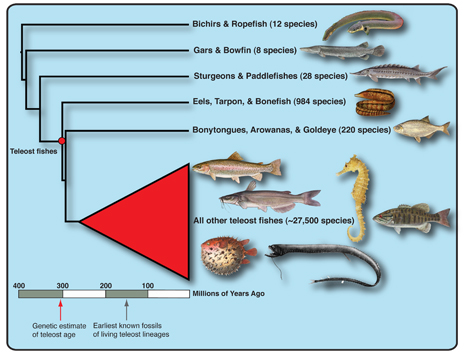
    A genetic analysis by Yale researchers show that the earliest ray-finned fishes called teleosts are more ancient than thought and appeared almost 300 million years ago. However, the much more diverse and familiar species of teleosts arose at about the same time as birds and mammals — about 120 to 60 million years ago. Credit: Illustration by Thomas Near, Alex Dornburg, and Ron Eytan

    A newly published study from Yale University scientists suggests that the earliest ray-finned fishes called teleosts appeared well before what researchers had previously thought, finding that the evolutionary age of living teleosts may be close to 300 million years old.

    The most common lineages of fish found today in oceans, lakes, and rivers evolved about the same time as mammals and birds, a new Yale University-led study shows.

    The comparative genetic analysis of more than 200 fish species, reported the week of August 6 in the Proceedings of the National Academy of Sciences, gave an earlier than expected evolutionary birthday to well-known teleost — or ray-finned — fish such as salmon, bass, or tuna.

    The analysis also shows that the very earliest lineages of living teleost fish were eels and bonefishes, not tropical freshwater bonytongue fish as some scientists had proposed.

    “Half of all animals that have backbones are ray-finned fish, but we know little about their evolutionary history in contrast to other vertebrate lineages like frogs, lizards, birds, and mammals,” said Thomas Near of the Department of Ecology and Evolutionary Biology at Yale and lead author of the paper. “Fish are usually viewed as primitive in origin, but we are learning that most of the familiar living lineages of fish arose more recently — during what we might call the Second Age of Fishes.”

    The Devonian period, 415 to 355 million years ago, is known as the Age of Fishes and saw the appearance of many types of fish such as bony fishes, sharks, skates, and rays, as well as lineages known only from the fossil record. The living lineages of teleost fish — the major group of ray-finned fish — were thought to have appeared some 150 million years ago. The Yale study suggests the evolutionary age of living teleosts may be closer to 300 million years old.

    However, the analysis shows the great majority of teleost lineages found today appeared much later — in the Cretaceous through the Paleocene, some 120 to 60 million years ago, along with the first mammals and birds. Near and his team are investigating whether the extinction event some 65 million years ago that killed off the last of the dinosaurs also may have facilitated teleost fishes to radiate throughout the world’s oceans and rivers, just as it led to rapid expansion of mammalian and bird diversity.

    “The new family tree of ray-finned fish comes close to completing the book on the evolutionary relationships of vertebrates,” Near said.

    Reference: “Resolution of ray-finned fish phylogeny and timing of diversification” by Thomas J. Near [email protected], Ron I. Eytan, Alex Dornburg, Kristen L. Kuhn, Jon A. Moore, Matthew P. Davis, Peter C. Wainwright, Matt Friedman and W. Leo Smith, 6 August 2012, Proceedings of the National Academy of Sciences.
    DOI: 10.1073/pnas.1206625109

    Other Yale authors on the study are Ron I. Eytan, Alex Dornburg, and Kristen L. Kuhn.

    The team of researchers included scientists from the University of California-Davis, John Wilkes Honors College, The Field Museum of Natural History, and the University of Oxford, United Kingdom.

    The study was funded by the Yale Peabody Museum of Natural History and the National Science Foundation.

    Never miss a breakthrough: Join the SciTechDaily newsletter.
    Follow us on Google and Google News.

    Ecology Evolutionary Biology Fish Yale University
    Share. Facebook Twitter Pinterest LinkedIn Email Reddit

    Related Articles

    Yale Study Shows Gradual Environmental Change is an Ally to Viral Pathogens

    Study Projects How Climate Change Will Affect the Functions Birds in Ecosystems Worldwide

    Barb Geometry of Asymmetrical Feathers Sheds Light on Evolution of Flight

    Yale Study Details Recent Shifts in Occurrence, Cause, and Magnitude of Mass Animal Die-Offs

    Scientists Detail the Evolutionary Success of Spiny-Rayed Fishes

    Antibiotics Might Contribute to the Health Problems of the Bee Colonies

    Extinctions Due to Habitat Loss are Proportional to the Area Destroyed

    Evolution Shapes Ecology of Dammed Connecticut Lakes

    “Map of Life” to Illustrate All Living Things Geographically

    Leave A Reply Cancel Reply

    • Facebook
    • Twitter
    • Pinterest
    • YouTube

    Don't Miss a Discovery

    Subscribe for the Latest in Science & Tech!

    Trending News

    Scientists Call for a Complete Rethink of Alzheimer’s Treatment

    Scientists Identify Molecular Switch That Lets Exercise Reverse Muscle Aging

    Why Your Most Vivid Dreams Might Be the Key to Deep, Restful Sleep

    A Bright Star Hid a Massive Secret for 50 Years: Mystery of Gamma Cassiopeiae Finally Solved

    Scientists Identify Protein That Slows Key Effects of Aging

    Revolutionary Submarine Mysteriously Disappears Without a Trace – Scientists Are Now Preparing for a Bold Return

    Why Drinking More Water Isn’t Enough To Stop Kidney Stones

    New Study Reveals Surprising Effect of Drinking Coffee at Night

    Follow SciTechDaily
    • Facebook
    • Twitter
    • YouTube
    • Pinterest
    • Newsletter
    • RSS
    SciTech News
    • Biology News
    • Chemistry News
    • Earth News
    • Health News
    • Physics News
    • Science News
    • Space News
    • Technology News
    Recent Posts
    • Your BMI Might Be Wrong: Study Finds Millions Are Misclassified
    • More Than Half of U.S. College Students Are Lonely, Major Study Reveals
    • Scientists Reveal Biological Signal Behind Mysterious Alzheimer’s Drug Side Effect
    • A Simple Blood Test Could Predict Dementia Risk 25 Years Early
    • Scientists Uncover Unexpected Behavior Deep Inside Earth’s Mantle
    Copyright © 1998 - 2026 SciTechDaily. All Rights Reserved.
    • Science News
    • About
    • Contact
    • Editorial Board
    • Privacy Policy
    • Terms of Use

    Type above and press Enter to search. Press Esc to cancel.