
Close Menu
    Facebook X (Twitter) Instagram
    SciTechDaily
    • Biology
    • Chemistry
    • Earth
    • Health
    • Physics
    • Science
    • Space
    • Technology
    Facebook X (Twitter) Pinterest YouTube RSS
    SciTechDaily
    Home»Space»Image of NASA’s Curiosity and its Parachute Heading Towards the Surface of Mars
    Space

    Image of NASA’s Curiosity and its Parachute Heading Towards the Surface of Mars

    By Guy Webster/D.C. Agle, Jet Propulsion Laboratory; NASAAugust 7, 2012No Comments4 Mins Read
    Facebook Twitter Pinterest Telegram LinkedIn WhatsApp Email Reddit
    Share
    Facebook Twitter LinkedIn Pinterest Telegram Email Reddit
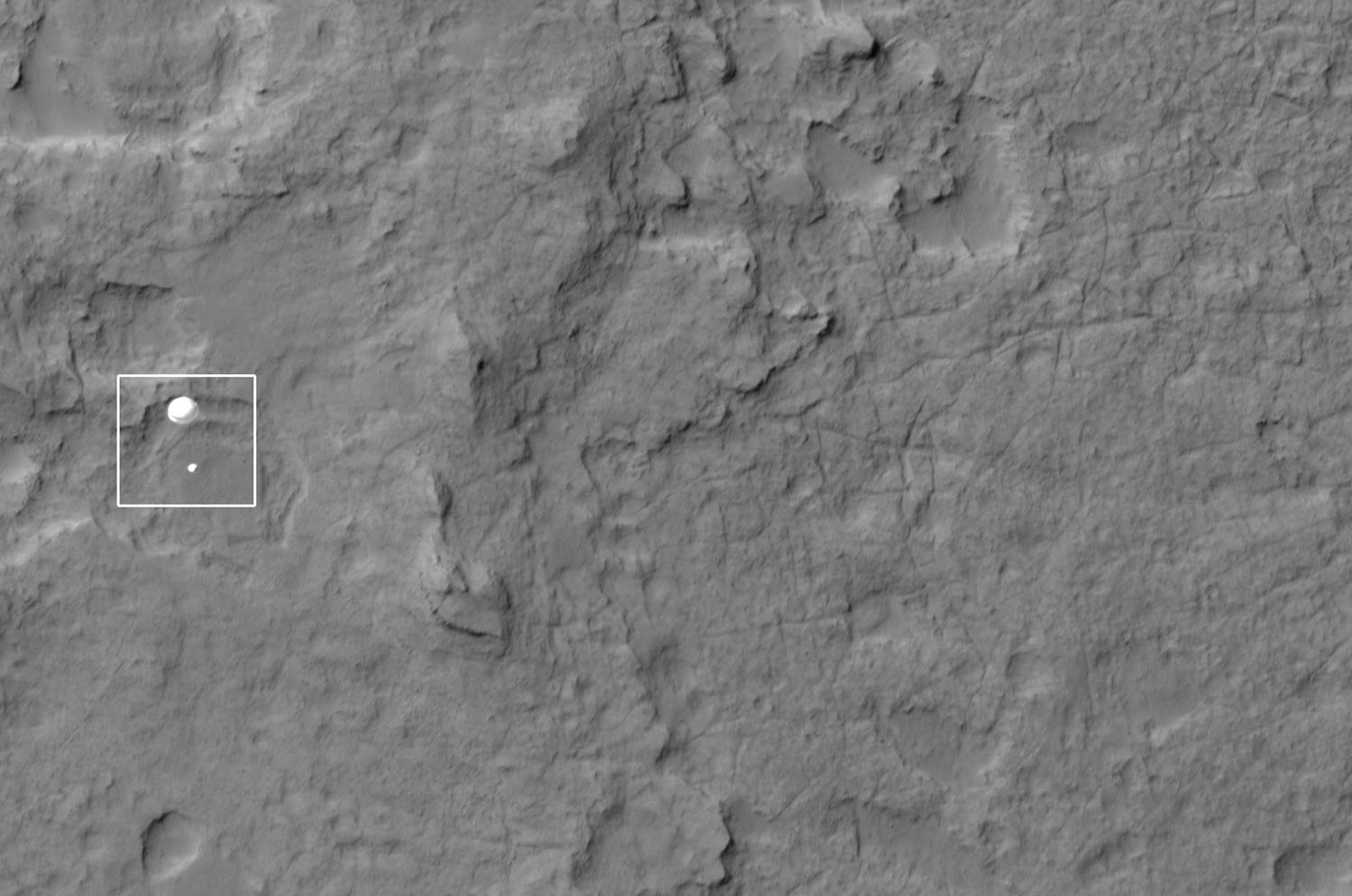
    NASA's Curiosity rover and its parachute were spotted by NASA's Mars Reconnaissance Orbiter
    NASA’s Curiosity rover and its parachute were spotted by NASA’s Mars Reconnaissance Orbiter as Curiosity descended to the surface on August 5 PDT (August 6 EDT). Credit: NASA/JPL-Caltech/University of Arizona

    As NASA’s Curiosity rover descended on Mars, NASA’s Mars Reconnaissance Orbiter captured an image of Curiosity and its parachute with the High Resolution Imaging Science Experiment (HiRISE) camera.

    An image from the High Resolution Imaging Science Experiment (HiRISE) camera aboard NASA’s Mars Reconnaissance Orbiter captured the Curiosity rover still connected to its 51-foot-wide (almost 16-meter) parachute as it descended towards its landing site at Gale Crater.

    “If HiRISE took the image one second before or one second after, we probably would be looking at an empty Martian landscape,” said Sarah Milkovich, HiRISE investigation scientist at NASA’s Jet Propulsion Laboratory in Pasadena, California. “When you consider that we have been working on this sequence since March and had to upload commands to the spacecraft about 72 hours prior to the image being taken, you begin to realize how challenging this picture was to obtain.”
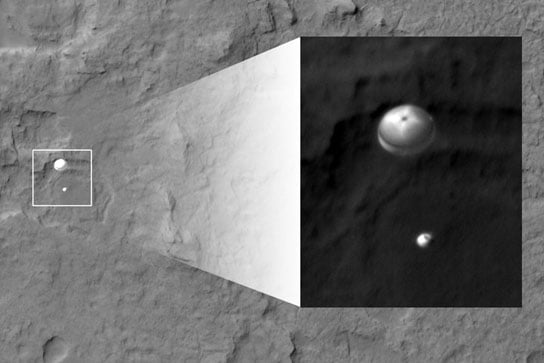
    Curiosity and its parachute
    Curiosity and its parachute are in the center of the white box; the inset image is a cutout of the rover stretched to avoid saturation. Credit: NASA/JPL-Caltech/University of Arizona

    The image was taken while MRO was 211 miles (340 kilometers) away from the parachuting rover. Curiosity and its rocket-propelled backpack, contained within the conical-shaped back shell, had yet to be deployed. At the time, Curiosity was about two miles (three kilometers) above the Martian surface.

    “Guess you could consider us the closest thing to paparazzi on Mars,” said Milkovich. “We definitely caught NASA’s newest celebrity in the act.”

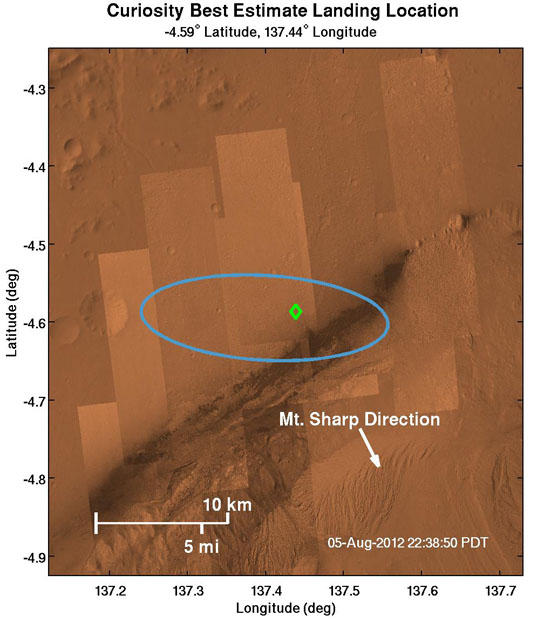
    Curiosity, NASA’s latest contribution to the Martian landscape, landed at 10:32 p.m. August 5, PDT, (1:32 on August 6, EDT) near the foot of a mountain three miles tall inside Gale Crater, 96 miles in diameter.
    where NASA's Curiosity rover landed on Mars
    The green diamond shows approximately where NASA’s Curiosity rover landed on Mars, a region about 2 kilometers northeast of its target in the center of the estimated landing region (blue ellipse). The location of the diamond is based on Earth-based navigation data taken prior to Curiosity’s entry into the Martian atmosphere, as well as data taken by the rover’s navigation instruments during descent. Credit: NASA/JPL-Caltech

    In other Curiosity news, one part of the rover team at the JPL continues to analyze the data from last night’s landing while another continues to prepare the one-ton mobile laboratory for its future explorations of Gale Crater. One key assignment given to Curiosity for its first full day on Mars is to raise its high-gain antenna. Using this antenna will increase the data rate at which the rover can communicate directly with Earth. The mission will use relays to orbiters as the primary method for sending data home, because that method is much more energy-efficient for the rover.

    Curiosity carries 10 science instruments with a total mass 15 times as large as the science payloads on the Mars rovers Spirit and Opportunity. Some of the tools are the first of their kind on Mars, such as a laser-firing instrument for checking rocks’ elemental composition from a distance. Later in the mission, the rover will use a drill and scoop at the end of its robotic arm to gather soil and powdered samples of rock interiors, then sieve and parcel out these samples into analytical laboratory instruments inside the rover.

    To handle this science toolkit, Curiosity is twice as long and five times as heavy as Spirit or Opportunity. The Gale Crater landing site places the rover within driving distance to layers of the crater’s interior mountain. Observations from orbit have identified clay and sulfate minerals in the lower layers, indicating a wet history.

    The mission is managed by JPL for NASA’s Science Mission Directorate in Washington. The rover was designed, developed, and assembled at JPL.

    Never miss a breakthrough: Join the SciTechDaily newsletter.
    Follow us on Google and Google News.

    Astronomy Curiosity Rover JPL Mars NASA
    Share. Facebook Twitter Pinterest LinkedIn Email Reddit

    Related Articles

    Curiosity Finds Ancient Streambed on Mars

    NASA’s Curiosity Prepares for Use of Its Arm and Tools

    Curiosity Sends Back Radioed Words and New Telephoto View of Mars

    NASA’s Curiosity Readies for First Drive on Mars

    Curiosity’s ChemCam Laser Analyzes Its First Martian Rock

    Color HiRISE Image of Curiosity Rover on Mars

    First 360-Degree Color Panorama From NASA’s Curiosity Mars Rover

    Curiosity’s First Color Image of Mars

    Mission Engineers Prepare for Curiosity’s Landing on Mars

    Leave A Reply Cancel Reply

    • Facebook
    • Twitter
    • Pinterest
    • YouTube

    Don't Miss a Discovery

    Subscribe for the Latest in Science & Tech!

    Trending News

    Scientists May Have Found the Key to Jupiter and Saturn’s Moon Mystery

    Scientists Uncover Brain Changes That Link Pain to Depression

    Saunas May Do More Than Raise Body Temperature – They Activate Your Immune System

    Exercise in a Pill? Metformin Shows Surprising Effects in Cancer Patients

    Hidden Oceans of Magma Could Be Protecting Alien Life

    New Study Challenges Alzheimer’s Theories: It’s Not Just About Plaques

    Artificial Sweeteners May Harm Future Generations, Study Suggests

    Splashdown! NASA Artemis II Returns From Record-Breaking Moon Mission

    Follow SciTechDaily
    • Facebook
    • Twitter
    • YouTube
    • Pinterest
    • Newsletter
    • RSS
    SciTech News
    • Biology News
    • Chemistry News
    • Earth News
    • Health News
    • Physics News
    • Science News
    • Space News
    • Technology News
    Recent Posts
    • Physicists Discover a Strange New Kind of One-Dimensional Particle
    • Scientists Discover Unexpected Climate Benefit Hidden in Forest Soils
    • The Grand Canyon’s “Swiss Cheese” Rocks Hold a Critical Secret
    • Scientists Discover 430,000-Year-Old Wooden Tools, Rewriting Human History
    • Scientists Make Breakthrough on 40-Year-Old 2D Physics Puzzle
    Copyright © 1998 - 2026 SciTechDaily. All Rights Reserved.
    • Science News
    • About
    • Contact
    • Editorial Board
    • Privacy Policy
    • Terms of Use

    Type above and press Enter to search. Press Esc to cancel.