

Scientists identified phosphatidylcholine loss as a key driver of mitochondrial aging and showed that restoring it can rejuvenate cellular energy networks.
Why do cells age, and why do people gradually lose energy and vitality over time? Scientists have long focused on mitochondria, the tiny structures inside cells responsible for producing energy. Researchers now understand that mitochondria do much more than power cells. They also help regulate communication, adaptation, and many processes essential for survival.
Mitochondria provide the energy needed for movement, growth, and tissue repair. However, their performance declines with age. While scientists have known this for years, the reasons behind the slowdown have remained unclear.
For decades, researchers believed damage to mitochondrial DNA was the main cause. But a new study published in Nature Communications by an international team led by Dr. Maria Ermolaeva of the Leibniz Institute on Aging – Fritz Lipmann Institute (FLI) in Jena points to another major factor: disruptions in the mitochondrial network caused by the loss of an important membrane lipid.
The lipid, called phosphatidylcholine, is a key building block of biological membranes. It helps membranes stay flexible so they can constantly reorganize. This flexibility is essential for “mitochondrial fusion,” a process where separate mitochondria join together into networks. These connected networks allow cells to share energy molecules, metabolic products, DNA, and signaling molecules while replacing damaged components and preventing imbalances.
Declining Phosphatidylcholine Weakens Mitochondrial Energy Networks
The researchers found that phosphatidylcholine production decreases with age, causing mitochondrial membranes to become fragmented and less functional. When genes responsible for producing phosphatidylcholine were switched off in young worms, their mitochondria quickly developed characteristics typically seen in older organisms. The team was surprised by how closely these changes matched naturally aged mitochondria.
The effects also appeared reversible. Within just two days, worms fed phosphatidylcholine or its precursor, choline, showed mitochondria with a much younger structure. “We were surprised ourselves by how strongly this molecule influences the structure, connectivity, and function of mitochondria,” said Dr. Tetiana Poliezhaieva, the study’s first author.
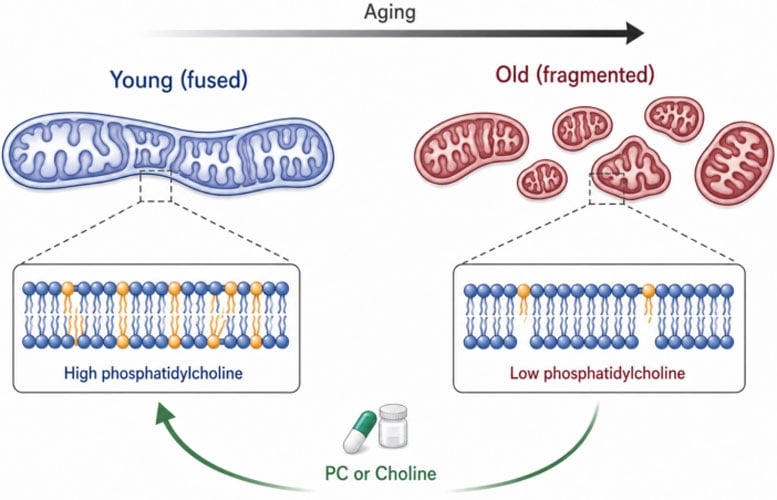
Although the change may seem minor, the consequences are significant (Butterfly effect). Under normal conditions, mitochondria form adaptable networks that respond to the cell’s changing energy demands. As aging progresses, however, these networks become unstable. “You can imagine the whole system as a finely branched power grid that becomes increasingly damaged with age: connections break down and currents stall,” explained Dr. Ermolaeva.
“Although energy production continues, it becomes less efficient and sustainable, and energy can no longer be distributed flexibly.” Over time, cells lose what scientists call “metabolic plasticity,” or the ability to quickly adapt to changing energy needs. This flexibility is critical for maintaining healthy cells, tissues, and body systems, and its decline is increasingly linked to aging and diseases such as diabetes.
Human Data and Model Organisms Reveal Aging Mechanisms
To investigate the underlying biology, the researchers combined several approaches using the worm Caenorhabditis elegans, human cell cultures, and large clinical datasets. They analyzed information on proteins, lipids, genetic variation, gene activity, and metabolism across different stages of aging in humans.
This broad strategy allowed the team to connect molecular changes seen in model organisms with patterns observed in people. By combining experimental validation with whole-body studies in worms, they uncovered a direct connection between gradual molecular shifts and systemic aging.
The findings showed that mitochondrial decline is influenced not only by genetic damage but also by age-related changes in lipid production. This expands scientists’ understanding of mitochondrial aging by highlighting the importance of membrane lipid dynamics.
The team also found evidence that aging occurs in distinct biological phases rather than as one continuous process. Cells first lose their ability to handle stress, along with disruptions in protein homeostasis, the system responsible for maintaining stable proteins. Metabolic changes follow, with epigenetic alterations appearing later.
Menopause, Metabolism, and Reversing Mitochondrial Aging
The study also identified sex-specific differences in lipid metabolism. Human metabolome data showed the sharpest drop in phosphatidylcholine levels in women around menopause. “This observation is particularly noteworthy, as it coincides with a time when many women report a significant decline in energy levels and the onset of persistent fatigue,” said Dr. Ermolaeva.
One of the study’s most important findings was that some aging-related damage may be reversible. Increasing phosphatidylcholine levels, including through diet, stabilized mitochondrial networks in older C. elegans worms and improved cellular energy production. The results suggest that targeted metabolic interventions could help extend healthy aging.
“Our work shows that both mitochondrial aging and broader systemic aging are, at least in part, modifiable. If we understand the underlying processes, we may be able to take targeted countermeasures,” Dr. Ermolaeva said. More research will be needed to determine whether these findings can lead to treatments for people. Scientists are especially interested in whether nutritional supplements could help support cell function in older age.
The researchers concluded that phosphatidylcholine supplementation may work as an anti-aging intervention even when started in middle or later life. Overall, the study shifts the focus of aging research away from irreversible decline and toward biological processes that may be altered to support healthier aging.
Reference: “Aging-associated decline of phosphatidylcholine synthesis is a malleable trigger of natural mitochondrial aging” by Tetiana Poliezhaieva, Yuting Li, Prerana Shrikant Chaudhari, Ulas Isildak, Pol Alonso-Pernas, Isabela Santos Valentim, Fengting Su, Lilia Espada, Melike Bayar, Li Fu, Andreas Koeberle, Handan Melike Dönertaş and Maria A. Ermolaeva, 18 April 2026, Nature Communications.
DOI: 10.1038/s41467-026-71508-7
Never miss a breakthrough: Join the SciTechDaily newsletter.
Follow us on Google and Google News.
1 Comment
Phosphatidylcholine is present in many foods we regularly consume, so it seems unlikely that we have deficiencies that require supplements, unless the necessary dosage is extremely high. Do our bodies process phosphatidylcholine differently as we age, or as women approach menopause? Perhaps that is the next appropriate line of inquiry.