
Researchers have uncovered a key protein, HKDC1, that helps keep cells youthful by repairing damage inside the cell’s energy and waste systems. It’s activated when the cell senses trouble, helping prevent aging and disease from taking hold.
Just like our organs keep our bodies healthy, tiny structures inside our cells, called organelles, are essential for keeping cells alive and functioning. Each organelle has a specialized role. For instance, mitochondria generate the energy that powers the cell, while lysosomes act like cellular cleanup crews, breaking down waste and keeping things tidy.
Breakthrough in Understanding Organelle Maintenance
Scientists have long known that damage to mitochondria and lysosomes is linked to aging, cellular slowdown, and a range of diseases. However, exactly how cells protect and maintain these crucial components has remained a mystery. Now, a research team at Osaka University has uncovered a major piece of the puzzle. They’ve identified a protein called HKDC1 that plays a central role in keeping both mitochondria and lysosomes in good shape, helping cells stay healthier for longer.
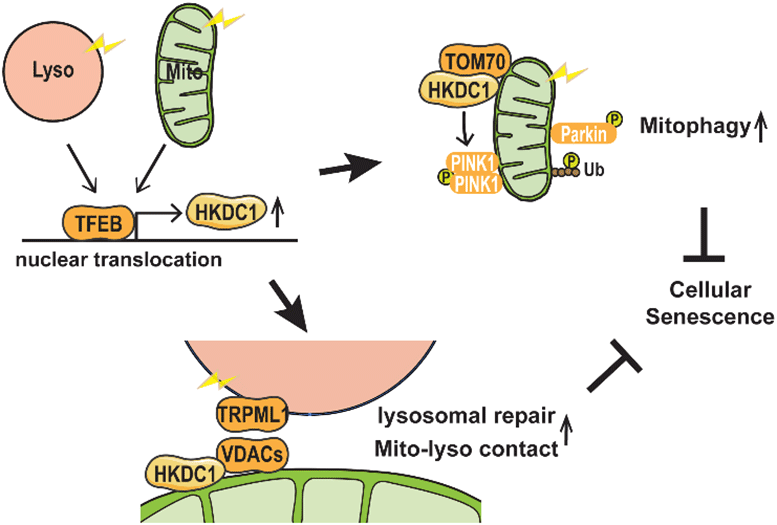
Previous studies had hinted that another protein, TFEB, might be involved in supporting these organelles, but no one knew exactly how. By analyzing gene activity under stress and using a technique called chromatin immunoprecipitation, which maps the DNA regions proteins bind to, the researchers made an exciting discovery. They found that TFEB directly activates the gene for HKDC1. Even more impressively, HKDC1 ramps up when cells experience stress in their mitochondria or lysosomes, suggesting it jumps into action to help them recover.
Mechanisms of Mitochondrial Protection
One way that mitochondria are protected from damage is through the process of “mitophagy,” the controlled removal of damaged mitochondria. There are various mitophagy pathways, and the most well-characterized of these depends on proteins called PINK1 and Parkin.
“We observed that HKDC1 co-localizes with a protein called TOM20, which is located in the outer membrane of the mitochondria,” explains lead author Mengying Cui, “and through our experiments, we found that HKDC1, and its interaction with TOM20, are critical for PINK1/Parkin-dependent mitophagy.”
Role of HKDC1 in Lysosomal Repair
So, put simply, HKDC1 is brought in by TFEB to help take out the mitochondrial trash. But what about lysosomes? Well, TFEB and KHDC1 are key players here, too. Reducing HKDC1 in the cell was shown to interfere with lysosomal repair, indicating that HKDC1 and TFEB help lysosomes to recover from damage.
“HKDC1 is localized to the mitochondria, right? Well, this turns out to also be critical for the process of lysosomal repair,” explains senior author Shuhei Nakamura. “You see, lysosomes and mitochondria contact each other via proteins called VDACs. Specifically, HKDC1 is responsible for interacting with the VDACs; this protein is essential for mitochondria–lysosome contact, and thus, lysosomal repair.”
Potential Therapeutic Implications
These two diverse functions of HKDC1, with key roles in both the lysosome and the mitochondria, help to prevent cellular senescence by simultaneously maintaining the stability of these two organelles. As dysfunction of these organelles is linked to aging and age-related diseases, this discovery opens new avenues for therapeutic approaches to these diseases.
Reference: “HKDC1, a target of TFEB, is essential to maintain both mitochondrial and lysosomal homeostasis, preventing cellular senescence” by Mengying Cui, Koji Yamano, Kenichi Yamamoto, Hitomi Yamamoto-Imoto, Satoshi Minami, Takeshi Yamamoto, Sho Matsui, Tatsuya Kaminishi, Takayuki Shima, Monami Ogura, Megumi Tsuchiya, Kohei Nishino, Brian T. Layden, Hisakazu Kato, Hidesato Ogawa, Shinya Oki, Yukinori Okada, Yoshitaka Isaka, Hidetaka Kosako, Noriyuki Matsuda, Tamotsu Yoshimori and Shuhei Nakamura, 3 January 2024, Proceedings of the National Academy of Sciences.
DOI: 10.1073/pnas.2306454120
Funding: Japan Society for the Promotion of Science, Japan Science and Technology Agency, Ministry of Education, Culture, Sports, Science and Technology, Japan Agency for Medical Research and Development
Never miss a breakthrough: Join the SciTechDaily newsletter.
Follow us on Google and Google News.
4 Comments
Want to email the article: why is this so impossible!!
Works for me: clicking the email icon opens a mail with the link. Won’t work if you are using a device where the default mail client is not configured.
You can also copy the link manually into a mail..
Again very interesting 🤔 taking Choline, is this the answer 🤔