

Researchers in Japan have shown that the mitochondrial protein COX7RP extends healthy lifespan in mice by enhancing mitochondrial energy efficiency.
As people around the world are living longer than ever before, attention is increasingly shifting from simply extending lifespan to ensuring those extra years are spent in good health. This shift has highlighted the importance of increasing “healthspan,” which refers to the years of life during which a person remains healthy, independent, and active, without serious age-related conditions.
Mitochondria play a central role in this effort. Often described as the powerhouse of the cell, these structures generate the energy that cells need to function by producing adenosine triphosphate (ATP). Because declining mitochondrial performance is closely tied to aging and a wide range of age-related diseases, researchers view mitochondria as a critical focus for strategies aimed at supporting healthy aging.
The process of energy generation inside mitochondria depends on respiratory chain complexes. These molecular systems enable the movement of protons and electrons, a process required for ATP production. Scientists have known for many years that these complexes can assemble into larger, flexible structures known as supercomplexes, which are thought to make energy production more efficient.
Despite this long-standing understanding, direct proof that supercomplex formation leads to clear health benefits has been limited. This gap is especially noticeable in animal studies, where evidence showing a direct cause-and-effect relationship between supercomplexes and improved health outcomes remains scarce.
Investigating a Key Mitochondrial Protein
To better understand this connection, a research group led by Team Leader Satoshi Inoue from the Tokyo Metropolitan Institute for Geriatrics and Gerontology in Japan focused on COX7RP, a mitochondrial protein that contributes to the assembly of respiratory supercomplexes.
The study, co-authored by Dr. Kazuhiro Ikeda from Saitama Medical University in Japan, examined how this protein influences mitochondrial organization and function. The findings were published online in the journal Aging Cell.
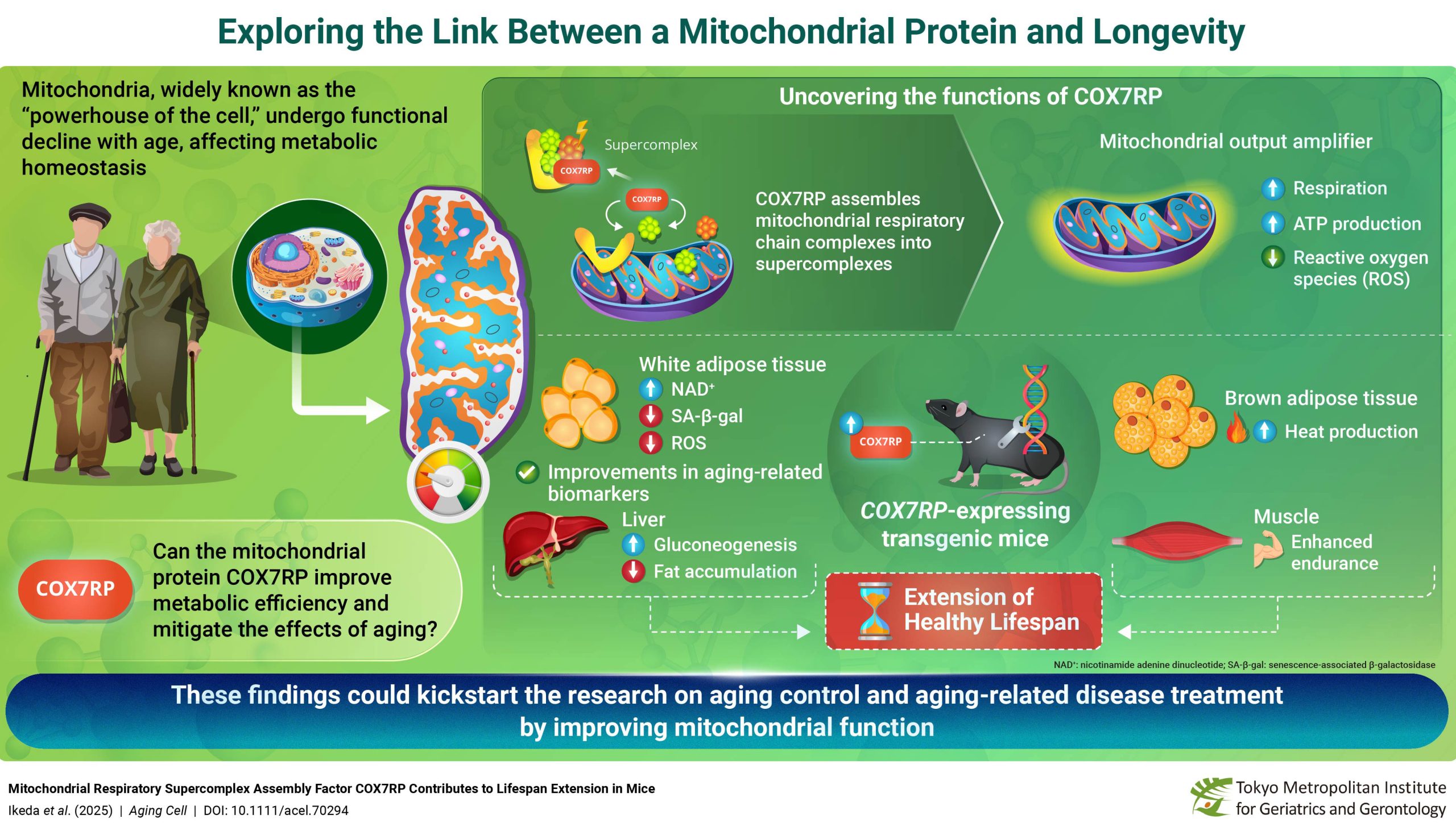
“We previously identified COX7RP, a mitochondrial protein, as a key factor that promotes the formation of mitochondrial respiratory supercomplexes, thereby enhancing energy production and reducing reactive oxygen species (ROS) that cause oxidative stress in cells,” explains Dr. Inoue. “Based on this, we investigated the role of COX7RP and mitochondrial respiratory supercomplexes in regulating aging and anti-aging processes.”
The research team developed COX7RP-transgenic (COX7RP-Tg) mice models that were genetically engineered to express higher levels of COX7RP throughout their life. This enabled the researchers to test the protein’s impact on longevity, aging, and metabolism with great detail.
Extended Lifespan and Metabolic Benefits
Surprisingly, the COX7RP-Tg mice exhibited a significantly prolonged lifespan, with the average lifespan being 6.6% higher than that of wild-type mice. Beyond longevity, these transgenic mice also demonstrated numerous health benefits, suggesting an extension of their healthspan as well. In particular, the team observed improved glucose homeostasis through enhanced insulin sensitivity, along with healthier lipid profiles with reduced blood triglycerides and total cholesterol. Additional benefits included enhanced muscle endurance and lower fat accumulation in the liver.
At the cellular level, the researchers further confirmed that COX7RP significantly improved mitochondrial performance. Tissues from the COX7RP-Tg mice showed increased formation of mitochondrial respiratory supercomplexes, leading to the production of higher levels of ATP.
Notably, a detailed analysis of white adipose tissue showed improvements in various aging-related biomarkers, such as higher levels of coenzyme NAD+ and lower levels of ROS, and the cellular aging marker β-galactosidase. Additionally, with single-nucleus RNA sequencing on white adipose tissue of older mice, the team revealed lower expression of genes linked to age-related inflammatory responses, particularly genes related to the senescence-associated secretory phenotype (SASP), a prototypic characteristic of senescent cells.
Implications for Anti-Aging Strategies
Together, these findings suggest that increasing the energy efficiency of mitochondria can delay and mitigate problems associated with aging.
“Our study elucidated novel mitochondrial mechanisms underlying anti-aging and longevity, and provided new insights into strategies for promoting healthspan and extending lifespan,” highlights Dr. Inoue. “For instance, supplements and medications that enhance the assembly and function of mitochondrial respiratory supercomplexes may contribute to longevity expansion.”
Future studies on this topic could help establish mitochondrial supercomplexes as promising therapeutic targets and pave the way for novel interventions aimed at maintaining vitality and addressing age-related metabolic diseases such as diabetes, dyslipidemia, and obesity.
Reference: “Mitochondrial Respiratory Supercomplex Assembly Factor COX7RP Contributes to Lifespan Extension in Mice” by Kazuhiro Ikeda, Sachiko Shiba, Masataka Yokoyama, Masanori Fujimoto, Kuniko Horie, Tomoaki Tanaka and Satoshi Inoue, 18 November 2025, Aging Cell.
DOI: 10.1111/acel.70294
This work was supported by grants of the Japan Society for the Promotion of Science (23K07996, 24K02505, 22K06929, 23H02962, 24K21297); the Integrated Research Initiative for Living Well with Dementia at the Tokyo Metropolitan Institute for Geriatrics and Gerontology; the Takeda Science Foundation; and the Vehicle Racing Commemorative Foundation. This research was also supported by AMED under Grant Number JP25gm2110001.
Never miss a breakthrough: Join the SciTechDaily newsletter.
Follow us on Google and Google News.
2 Comments
I’m interested in articles on longevity & healthy living. My focus being on health now & supplements that can help me achieve my health goals. Thank you for the research you guys are performing & publishing.
M.C.
Yes