
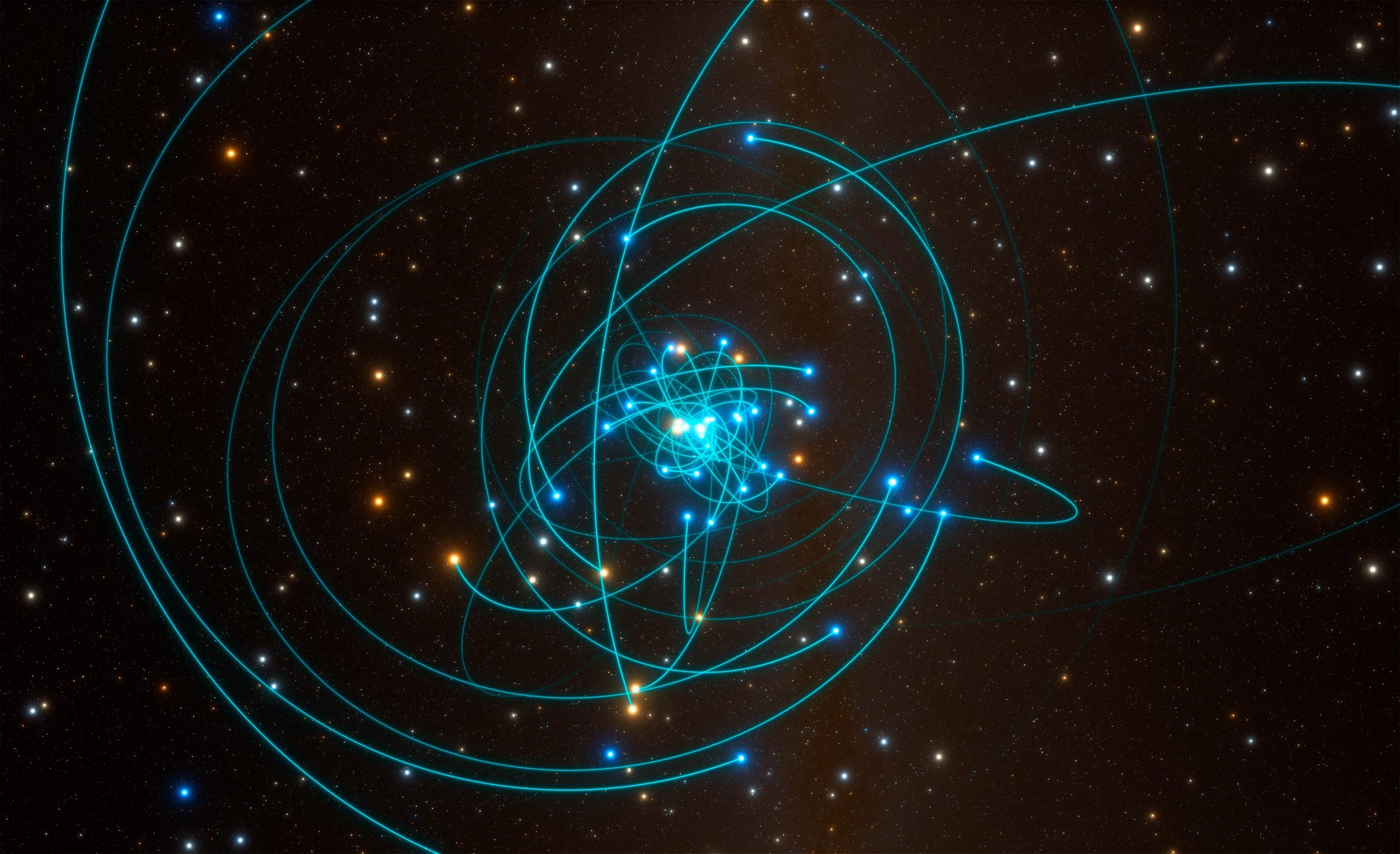
Researchers from CIERA and the Center for Astrophysics | Harvard & Smithsonian put a limit on the spin of the supermassive black hole in the center of the Milky Way. Published in the Astrophysical Journal Letters, their work shows that the black hole is spinning quite slowly.
Supermassive black holes like SgrA*, the black hole at the center of our galaxy, hold a great influence over the formation of the galaxy they inhabit. Determining that the spin of SgrA* is low will have major implications for research focused on imaging the black hole and indicates a low probability of a jet existing alongside it.
“If the black hole has a very low spin as we are concluding, then I think it also makes it very unlikely that it has a jet,” said Dr. Avi Loeb, Frank B. Baird Jr. Professor of Science at Harvard and CfA astronomer, and co-author on the research. “Maybe it’s pointed a certain way that we don’t see so clearly, but given that we don’t see it, and given the limit that we now derive, it’s very unlikely that the jet exists.”
Constraining the spin of a supermassive black hole isn’t simple. Considering that it is difficult to measure directly, the previous approach to measuring spin entailed building detailed and complex models used in comparison with observations, taking years to carefully develop.
Dr. Giacomo Fragione, co-author of the paper from CIERA, said that they used the orbits of 40 stars that were previously measured that lie closest to SgrA* to determine that the black hole at the center of our galaxy has a low spin. If the black hole was rapidly rotating, the effect of this rubbing rotation would have been reflected onto the orbits of the stars through a phenomenon known as the Lense–Thirring effect.
He said that they found their results within a matter of weeks from their original realization that they could use nearby stars to constrain the spin of the black hole.
“These are the kinds of works I like,” said Dr. Fragione. “Using a simple, physical intuition and simple equations that are very clear, that are very simple to interpret, you have the best results.”
Dr. Loeb said they found the right idea at the right time.
“Some people want you to sweat in order to demonstrate that you’re a good scientist, science is not about the sweat, how much sweat you put into [the paper], how long the paper is,” said Dr. Loeb. “That doesn’t define the quality of the science that you do. What defines the quality is the significance of the results, finding the truth, and understanding things that we haven’t understood before.”
Read The Monster in the Middle of the Milky Way Is…Spinning Slowly? for more on this research.
Reference: “An Upper Limit on the Spin of SgrA* Based on Stellar Orbits in Its Vicinity” by Giacomo Fragione and Abraham Loeb, 1 October 2020, The Astrophysical Journal Letters.
DOI: 10.3847/2041-8213/abb9b4
This work was supported in part by a CIERA Fellowship at Northwestern University, and Harvard’s Black Hole Initiative, which is funded by grants from the John Templeton Foundation and the Gordon and Betty Moore Foundation.
Never miss a breakthrough: Join the SciTechDaily newsletter.
Follow us on Google and Google News.
8 Comments
When the blackhole (sphere) is feeding the spin will increase when it’s not it will settle in a regular spin speed. Make sense? Perhaps that’s how we came to be the quiet time for our blackhole. I would imagine that when the sphere starts feeding the pull on the galaxie would be extreme. It’s all very exciting to think about and remember it’s all about time. Things in the universe take time and lots of it. Hope we are here for the show of our blacksphere feeding.ta ta for now
“He said that they found their results within a matter of weeks from their original realization that they could use nearby stars to constrain the spin of the black hole.”
Lol, do you understand the meaning of contrain…
Maybe calulate, determine or derive, but constrain here means they are reducing the spin of the black hole with the nearby stars. Ridiculous!
Could the slow spin of SgrA* explain why nothing happened when the dust cloud went right by it in 2012? Leading up to it, there was big excitement about the cloud heading right for SgrA*. The dust cloud was easily within range of being gobbled up, but when unexpectedly nothing happened to it, never heard peep about it again.
Maybe it’s spinning faster then the speed of light.
follow-up article in 2017.
https://aasnova.org/2017/07/24/the-story-of-a-boring-encounter-with-a-black-hole/
Muin re spin at speed of light that’s what I proposed in 1963 (before joining Hawking and others at Cambridge) would have caused the big bang. As blackholes coalesce eventually as contraction progresses speed of rotation at the periphery increases (like a skater pulling in their legs/centre of gravity) and reaches the speed of light turning mass into energy. Released from the incoming drag of matter the whole blackhole can accelerate into a big bang (new universe). Space is an infinite matrix of meiotically regenerating universes!
Can we take a look at a galaxie we know is feeding and compare the tightness of its inner arms it should be different than one that’s not feeding. Like ours the arms of our spiral galaxie are relaxed when feeding the inner parts will appear tight in comparison to ours. Look and see. I don’t have the tech so if you could thx.
I’m just trying to show that it is mass and spin rate of the blacksphere’s effect on galaxies and not gravity. Don’t be scared you don’t even know if gravity is real I’m just gonna show you it’s NOT. Are you ready for the challenge. Because I am 🙂